
A freshly dog-eared review
El Sends You to Wizard School to Die
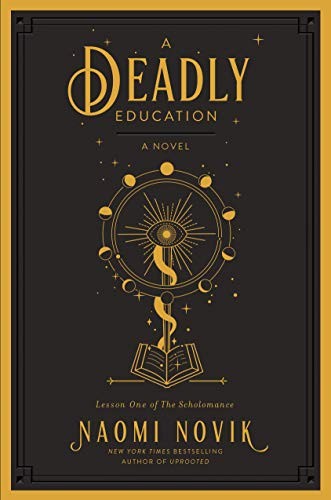
I almost put this book down on page forty because the narrator would not stop complaining, and then somewhere around page eighty I realized I was the one who couldn’t stop reading, so who’s the real problem here. El Higgins is one of the most insufferable, magnetic narrators I’ve met in years, and I mean that as the highest compliment I’ve got. This is a book about a magic school with no teachers, monsters in the plumbing, and a heroine so prickly she practically dares you to like her. I did. Eventually. Against my better judgment.
| Author | Naomi Novik |
| Published | 2020 |
| Genre | Dark academia fantasy |
| Format | Series (The Scholomance), first of three |
| Reception | Loved for its voice and setting, criticized for pacing and a slow-building romance; ratings run high but split between “brilliant” and “I couldn’t get through the first hundred pages” |
| Our rating | 4.1/5 |
| Read it if | you want a magic school that’s actually trying to murder its students, and a narrator who’d rather die than admit she likes anyone |
| Skip it if | you need a likable heroine from page one or you hate books that make you wait for the payoff |
Welcome to the School That Wants You Dead
Here’s the setup, and it’s a good one. The Scholomance is a school for wizards that exists in a kind of pocket dimension, built specifically because the alternative (kids with untrained magic getting eaten by monsters called maleficaria) is worse. There are no teachers. There’s barely any staff. The building itself is semi-sentient and mostly indifferent to whether you live or die, the cafeteria tries to poison you if you’re not careful, and graduation, the actual ceremony at the end of senior year, is a bloodbath where students have to fight their way out through a horde of monsters that have been waiting all year for exactly that moment. Something like a quarter of each class doesn’t survive graduation. That’s not a twist, that’s just Tuesday at this school.
El, our narrator, is a junior with a genuinely terrifying amount of dark, destructive magic and almost no way to use it without wiping out everyone around her, including herself. She’s spent her whole life being warned by prophecy that she’s destined to become some kind of apocalyptic sorceress, which has made her paranoid, defensive, and about as easy to befriend as a wet cat. Enter Orion Lake, golden-boy hero type who keeps saving people’s lives (including hers, repeatedly, infuriatingly) and who El resents with the kind of intensity usually reserved for people who’ve wronged you personally. He hasn’t. That’s kind of the joke. She just can’t stand owing anyone anything, especially not him.
I’m not going to spoil where any of that goes, but I’ll say the school itself, as a setting, does more narrative work than most side characters in other books. It’s a character. It’s the villain, really.
The Voice Is the Whole Show (For Better and Worse)
Look, I need to be honest about something: this book is slow to start. Not “slow” in the sense of nothing happening, plenty happens, monster attacks and magical crises every few pages, but slow in the sense that El spends a huge amount of the first act explaining the rules of her world to you in dense, digressive paragraphs. Novik built an incredibly intricate magic system, mana economics, alliance politics between school cliques, the whole sociology of who gets protected and who gets left to die, and El narrates all of it in this rambling, tangential, occasionally exhausting way that made me put the book down more than once early on.
But here’s the thing. That voice is also the entire reason to read this book. El is bitter, self-aware about her own bitterness, funny in a way that sneaks up on you, and brutally honest about how survival in this place actually works: you don’t make friends because you like people, you make alliances because dying alone is worse than dying with backup. There’s a scene where she basically talks herself out of accepting help from another student purely because accepting help means owing a debt, and the way Novik writes that paranoia, you understand immediately why El is the way she is, even while you’re a little frustrated with her for it.
I read most of this on a plane, which in hindsight was a mistake, because there’s a sequence involving the library (don’t ask, just know that libraries in this book are not safe spaces) that had me gripping the armrest hard enough that the guy next to me asked if I was okay. I was fine. El was not fine. It’s that kind of book, once it gets going.
My real criticism: the romance, such as it is, moves at a glacial pace, and if you came in expecting a lot of Orion in the first half, you’ll be disappointed. This is much more about El’s internal war with herself than it is a romance novel, and I think some readers went in expecting the latter and came out annoyed. Fair complaint. I had it too, for a while.
The scariest thing about the Scholomance isn’t the monsters. It’s that everyone inside it has already made peace with losing a quarter of their friends by graduation.
About Naomi Novik
Naomi Novik built her name on Temeraire, a nine-book series about Napoleonic-era dragons, which tells you she’s never been afraid of a long commitment or a weird premise. She won a Nebula and a Locus Award for Uprooted and did it again with Spinning Silver, both of which reimagine fairy tale logic with a kind of unsentimental sharpness. She also cofounded the Archive of Our Own, the fanfiction site, which feels relevant, because her prose has that same instinct for what readers actually crave: interiority, tension, characters who feel like they have a life outside the page. She writes big, dense worlds and then hands you a narrator smart enough to be annoyed by all of it.
If El’s Rage Wrecked You, Read These Next
Ninth House by Leigh Bardugo, for more dark academia with actual teeth and a heroine who’s just as prickly and just as good at holding a grudge.
The Name of the Wind by Patrick Rothfuss, if you want another densely built magic school narrated by someone who is, in their own way, an unreliable and defensive narrator about their own worst impulses.
A Discovery of Witches by Deborah Harkness, for readers who want the slow-burn academic magic without the body count.
The Poppy War by R.F. Kuang, if you want the “school is brutal and survival requires becoming someone you don’t recognize” theme taken somewhere much darker.
For your book club
- El spends most of the book resisting connection because she’s afraid of owing people. Did you find her paranoia justified by the world Novik built, or did it feel like she was punishing people who didn’t deserve it?
- The Scholomance has no teachers and functionally sacrifices a portion of its students every year. What does that say about the adults (or lack of them) in this world, and does the book ever really hold anyone accountable for it?
- Orion is set up as the golden boy hero, but El’s resentment of him complicates that trope. Did you end up liking him, or did you side with El’s suspicion of him longer than the book wanted you to?
- How did you feel about the pacing? Did the dense worldbuilding in the first act pay off for you by the end, or did it wear you down?
- El has been told her whole life she’s destined for something apocalyptic. How much of her personality do you think is actually who she is, versus who she’s become because everyone already assumes the worst of her?
Still thinking about the Scholomance
If El’s voice got under your skin the way it got under mine, you can grab your own copy here and see how far your patience holds out before you’re fully hooked. And if you want more books that argue with you as hard as this one did, check out more of our book reviews.