
A freshly dog-eared review
The Ship That Wanted Revenge (And a Song)
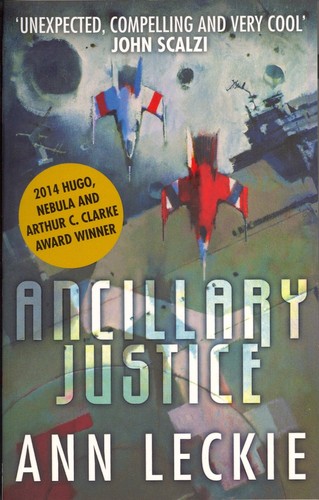
Here’s the thing I never see anyone admit about Ancillary Justice: for the first hundred pages I had almost no idea what was happening, and I loved it anyway. A ship is telling me the story. The ship is also a person. The person used to be thousands of people at once. And everyone, everyone, is “she.” I sat there on my couch feeling gloriously stupid, and that feeling turned out to be the whole point.
| Author | Ann Leckie |
| Published | 2013 |
| Genre | Space opera / literary science fiction |
| Format | Book 1 of the Imperial Radch trilogy (3 books) |
| Reception | Swept every major SF award the year it came out; adored by critics, genuinely divisive among readers who bounce off the first half |
| Our rating | 4.5/5 |
| Read it if | You want a revenge story told by a wronged AI who thinks in choir |
| Skip it if | You need to know exactly who’s who by page five or you’ll throw the book |
A starship walks into a bar with a grudge
Let me set it up without wrecking it. The narrator is Breq. Breq looks like one person, a lone traveler on an icy backwater planet trying to buy something off a body frozen in the snow. But Breq used to be Justice of Toren, a two-thousand-year-old troop carrier with a mind spread across the ship itself and across dozens of “ancillary” bodies: dead soldiers reanimated and networked into the ship’s single consciousness. She was a hundred pairs of eyes at once. She could sing to herself in a dozen throats. And then something happened, and now she is one small body walking through the cold with a very specific, very patient plan to kill the most powerful being in the galaxy.
That’s the spine. The Radch is the empire, expansionist and elegant and casually monstrous, and it’s ruled by Anaander Mianaai, who is herself thousands of bodies sharing one identity across the stars. So you’ve got a fractured AI hunting a fractured tyrant. The book braids two timelines: the frozen present with Breq and a strung-out, insufferable, oddly lovable ex-officer named Seivarden she reluctantly drags along, and the past, twenty years back, aboard the ship when it was still whole and something unforgivable was set in motion.
I won’t tell you what the thing is. Finding out is most of why the book works.
The pronoun thing, and why the first half nearly lost me
Okay. The “she.” Everyone’s heard about it before they open the book, and I think that ruins it a little, because people brace for a Gender Statement and instead get something sneakier. The Radch language doesn’t mark gender, so Breq narrates everyone as “she” regardless of what they actually are, and she’s genuinely bad at reading the gender cues of other cultures, which stresses her out in a way that’s quietly hilarious. There’s a running bit where she has to guess and keeps worrying she’s wrong. The effect on me as a reader was strange and physical: I stopped picturing bodies a certain way. I stopped assuming. By the halfway mark I couldn’t have told you the “real” gender of half the cast and I did not care, and realizing I didn’t care was its own small earthquake. Leckie doesn’t lecture. She just removes a handrail you didn’t know you were gripping.
Now the criticism, because I promised myself I’d be honest and because this book gets graded on a curve it doesn’t always earn. The first half is hard, and not always in a rewarding way. The Radch worldbuilding comes at you as a firehose of names, houses, ranks, and tea (so much tea, tea is basically a personality in this book), and Leckie withholds context on purpose. Some of that withholding is brilliant. Some of it is just a debut novelist not yet trusting herself to tell you where to stand. I’ve read this book twice and I’ll admit the past-timeline sections aboard Justice of Toren dragged for me the first time through, and I only understood how much they mattered on the reread. That’s a real cost. A lot of people put it down at the 30 percent mark and I don’t think they’re wrong to. I think they’re just early.
Because here’s what happens when the two timelines finally slam together. There is a scene, and if you’ve read it you know the one, where Breq’s whole reason for existing gets laid bare, a moment involving an order given and a song and a body she loved, and I physically put the book down. I was reading it in a laundromat, of all the unromantic places, watching my clothes tumble, and I had to stop and stare at a dryer for a minute because a book narrated by a warship had just made me feel more about grief and complicity and love than most literary novels manage with actual humans. The reveal isn’t a twist for the sake of a twist. It reframes every flat, affectless line Breq has spoken so far. All that emotionless narration? It wasn’t cold. It was a person holding something so heavy that letting any of it show would break her.
That’s the trick of the whole thing. The prose reads clinical, and readers call it cold, and they’re missing it. Breq is an AI mourning in the only register she has.
Small tangent, bear with me. The best character in this book is arguably Seivarden, the aristocrat Breq scrapes off the ground in chapter one, a thousand-year-old officer thawed into a future that has no place for him, addicted and arrogant and pathetic. I spent the first quarter wanting Breq to leave him in the snow. By the end I’d have walked into fire for him. Leckie does that quietly, in the margins, while you’re distracted by the galaxy-toppling plot, and it’s the thing I think about most.
Do I trust my own rave here? A little bit, no. I wonder sometimes if I love this book partly because it flattered me for pushing through when other people quit, like it handed me a medal for effort. That’s a real risk with difficult books. But the reread killed that doubt. It’s better the second time, which is not something you can say about a book that’s only clever.
An empire that runs on stolen bodies will always insist the bodies volunteered.
About Ann Leckie
Leckie came up the unglamorous, deeply respectable way: short fiction, small magazines, years of it, plus a stint as a slush reader, which means she spent real time watching how stories fail before she wrote one that didn’t. Ancillary Justice was her debut novel, and it did something almost no debut does, sweeping the Hugo, the Nebula, and the Arthur C. Clarke in a single year, which had basically never happened for one book. She’s from St. Louis, she’s written about working ordinary jobs (including waitressing) before the writing paid off, and there’s a plainspoken Midwestern lack of pretension in how she talks about craft that I find genuinely refreshing in a field that loves to mystify itself. She kept going after the trilogy with Provenance and the excellent fantasy pivot The Raven Tower, so she’s clearly not a one-idea writer.
If this one got its hooks in you, read these next
- A Memory Called Empire by Arkady Martine — another gorgeous, tea-and-poetry space empire where an outsider has a dead person living in her head; scratches the exact same itch and won its own Hugo.
- The Left Hand of Darkness by Ursula K. Le Guin — the grandd-mother of everything Leckie is doing with gender and cold planets and slow-burn intimacy; read it to see the lineage.
- Ancillary Sword and Ancillary Mercy — the rest of the trilogy, which go smaller and more domestic and honestly split the fanbase; I love that they refuse to just do galaxy-war-part-two.
- Too Like the Lightning by Ada Palmer — if you liked being confused on purpose, this one confuses you harder and rewards you more.
For your book club
- Did the “she” default change how you pictured the characters, and did you catch yourself trying to “solve” anyone’s gender? Why do you think you did or didn’t?
- Breq narrates atrocity in a flat, emotionless voice. Is that coldness, or is it grief? When did you decide?
- The Radch justifies conquest as bringing “civilization.” How does the book undercut that without ever giving a speech about it?
- Anaander Mianaai is one person at war with herself across thousands of bodies. Is she one villain or many, and does the difference matter morally?
- Would you have kept reading past the slow first half without knowing the awards it won? Be honest about how much reputation carried you.
Where to go from here
You can grab a copy on Amazon here, and if you want to keep falling down this particular rabbit hole, we put together our full list of the best sci-fi books ever written, where this one absolutely earns its place.
4.5 and not a 5 only because that first half really does ask more patience than it should, and I can’t in good conscience pretend everyone who quit was wrong. But if you stay. If you make it to the laundromat scene, whatever your laundromat turns out to be…