
A freshly dog-eared review
The Book That Made The Hunger Games Look Tame
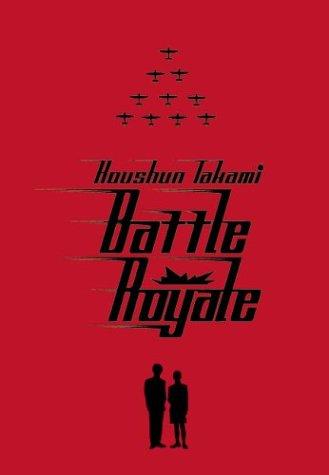
I read most of Battle Royale on a red-eye flight with my overhead light on while the guy next to me tried to sleep, and I remember thinking: this book does not care if I’m comfortable. It does not care if I like anyone. It is going to hand me forty two teenagers, kill most of them in explicit detail, and dare me to keep caring anyway. I kept caring. That’s the whole review, honestly, but let me earn it.
| Author | Koushun Takami |
| Published | 1999 (Japan), 2003 English translation |
| Genre | Dystopian thriller |
| Format | Standalone novel (plus manga and film adaptations) |
| Reception | Cult classic in translation, more respected than beloved, forever compared to the book it predates |
| Our rating | 3.8/5 |
| Read it if | You want the original ruthless version of the killing-game premise, no training wheels |
| Skip it if | You need tight prose or can’t stomach forty-plus death scenes back to back |
A class trip that ends with a shock collar
Here’s the setup, and it’s a gut punch delivered fast: forty two ninth graders from the same class, on a school trip, get gassed on a bus and wake up on an island. A teacher named Kinpatsu Sakamichi, who used to teach some of them, explains the rules like he’s reading a syllabus. This is the Program. Everyone gets a bag with random supplies, a map, and a collar that will explode if they break the rules or if the government running this thing gets bored of them. Only one student can leave the island alive. They have three days.
What got me immediately is that Takami doesn’t build up to the horror slowly. He just states it, flatly, in the tone of an announcement over a school PA system, and then cuts to a girl getting shot in the first ten minutes because she asked a question at the wrong moment. That’s the register of this book. Bureaucratic cruelty delivered in a monotone, then sudden violence, then back to bureaucratic cruelty. It’s genuinely unsettling in a way that has nothing to do with gore.
The book follows a rotating cast, but leans hardest on Shuya Nanahara, the kid trying to keep people alive instead of killing them, Noriko Nakagawa, who he’s protecting, and Shogo Kawada, a transfer student who’s been through something like this before and knows exactly how the game gets won. Then there’s Kazuo Kiriyama, who I need to talk about because he’s the character everyone remembers even if they’ve forgotten half the plot.
What actually works, and what nearly sank it for me
Kiriyama is the reason this book has a pulse. He’s a sociopath who volunteered for this, who treats the killing as a hobby he’s mildly good at, and Takami never bothers explaining him with trauma or backstory theatrics. He’s just built wrong, and the book lets that sit there unresolved, which is scarier than any tidy villain origin. There’s a stretch where he’s mowing through students with a submachine gun like he’s tidying a room, and I remember actually putting the book down for a second. Not because it was too much. Because it was staged so plainly.
Look, I have to be honest about the thing that almost lost me: the prose, at least in translation, is rough. Functional at best. There are sentences that exist purely to move a body from point A to point B, and the info-dumping about each student’s backstory, delivered right before or right after they die, becomes a rhythm you can set your watch to. Forty two kids means forty two mini-biographies crammed in wherever there’s room, and some of them land, some of them read like Takami had a spreadsheet and was checking boxes. I won’t pretend I didn’t skim a few.
And yet. The book earns its reputation in the moments it slows down and lets two kids just talk before one of them dies, or doesn’t. The rooftop scene, the radio broadcasts listing who’s dead so far in that same bored PA-announcer voice, the way friendships from homeroom curdle into paranoia within hours. That’s the real horror of Battle Royale: not the weapons, but how fast a classroom turns into a battlefield when the rules of a place get changed on you without warning.
I’ll admit I went in already knowing this book gets credited as the blueprint for The Hunger Games, fairly or not, and I wanted to find it thin by comparison, a little bit, because I love being the person who says “actually the original is better.” It isn’t cleaner or more polished. It’s messier, meaner, and much more interested in the specific ugliness of teenagers than in a polished dystopian society with a Capitol and color-coded districts. It’s less allegory, more scream. I’m still not sure which approach I prefer, and that’s an honest admission, not a dodge.
If you want to own a copy and see the cover art that’s haunted a generation of used bookstore shelves, it’s easy to find on Amazon.
This is a book that treats a classroom roll call like a body count, and never once lets you forget which one it actually is.
About Koushun Takami
Takami was a journalist before he wrote Battle Royale, which explains a lot: the flat, procedural way violence gets reported in this book reads like someone who spent years writing dispassionate copy about awful things and then decided to weaponize that same voice for fiction. The novel won a Japanese horror fiction prize but got pulled from a more prestigious literary award over the content, which is the kind of controversy that basically guarantees cult status. He hasn’t published much since, at least not that’s made it to English readers in any real way, and there’s something fitting about an author who wrote one gut-shot of a novel and mostly let it speak for itself.
If this wrecked you, read these next
The Hunger Games by Suzanne Collins, for the more streamlined, YA-friendly cousin of this same premise.
The Long Walk by Stephen King (as Richard Bachman), for a quieter, slower-burn version of teenagers being marched toward death by a government that barely explains itself.
Lord of the Flies by William Golding, for the classroom-turns-feral energy without the guns.
Squid Game, the show, if you want the same bureaucratic cruelty and rule-based horror in a different format entirely.
For your book club
- Did you find yourself rooting for a “winner,” or did the premise make that feel impossible?
- Kiriyama gets almost no interiority. Does that make him scarier or does it feel like a missed opportunity?
- How did the flat, bureaucratic tone of the announcements change how you experienced the violence?
- Is Battle Royale making a point about authoritarianism, about teenagers, or is it mostly just trying to shock you?
- Having read this, does The Hunger Games (or any other book it influenced) feel different to you now?
Not done with the killing games
If Battle Royale left you rattled and hungry for more, or if you want to argue with me about whether it’s actually better than the books it inspired, check out more of our book reviews for the rest of the dystopian shelf.