
A freshly dog-eared review
Bunny Made Me Question My Whole Book Club
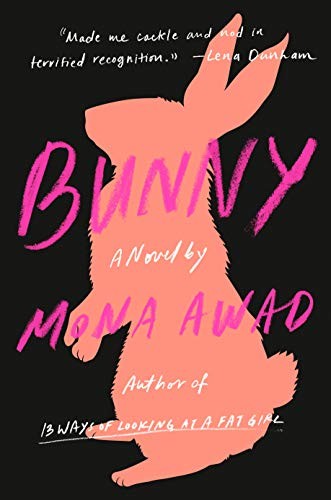
I read Bunny in three sittings on a train, in a bath that went cold twice because I refused to get out, and one very unhinged 2am session where I texted a friend “I don’t know if this book is a masterpiece or if I have brain worms now, possibly both.” That’s the whole review, honestly. But you want more, so here’s more.
| Author | Mona Awad |
| Published | 2019 |
| Genre | Dark academia / literary horror / satire |
| Format | Standalone |
| Reception | Cult favorite that splits readers hard, some call it genius, some call it a pretentious slog |
| Our rating | 3.7/5 |
| Read it if | You loved Heathers, you have MFA trauma (real or vicarious), you like your horror smeared in glitter and viscera |
| Skip it if | You need a plot you can summarize in one sentence, or you hate unreliable narrators who won’t get to the point |
Welcome to the Warren, population: four girls who call each other Bunny
Samantha Heather Mackey is a scholarship student in an elite MFA program at a New England school called Warren, and she hates the four rich girls in her cohort with the specific, curdled hatred you only develop for people who remind you what money buys. They call each other Bunny. Not ironically. They mean it. Samantha mocks them from a safe distance with her one friend Ava, an outsider who deals drugs and doesn’t own a single item of clothing that isn’t black.
Then, inexplicably, Samantha gets invited to one of the Bunnies’ “Smut Salons.” And she goes. And something in her cracks open just enough to let the story in.
I’m not going to tell you what happens at the Workshop (their word for a ritual that is very much not a ritual, wink wink) because the slow reveal is the whole engine of the book. What I will say is that Awad takes the MFA workshop, that particular hell of well-meaning people circling your worst instincts and calling it “generative feedback,” and turns it into literal alchemy. The Bunnies aren’t just writing stories. They’re making something. Someone. And it involves bunnies, real ones, and it gets grotesque fast.
Okay but does it actually work
Here’s the thing. The first third of this book is intoxicating. Awad’s prose does this thing where it’s simultaneously mocking academic pretension and drowning in it, gorgeous overripe sentences about smoke and sugar and rot, and you can’t tell if she’s in on the joke or if she is the joke, and that tension is the best part of the whole reading experience. The Bunnies speak in a private language of “faves” and squeals and pet names that is genuinely funny and genuinely upsetting at the same time. There’s a scene early on where Samantha describes the Bunnies’ laughter as something that happens all at once, like they’ve rehearsed it, and I got actual chills because I have been in that room. Every workshop, every group chat, every friend group that runs on a frequency you’re not tuned to. Awad nails the specific paranoia of being almost included.
Where it lost me a little: the back half turns into a fever dream that stops building and starts just repeating itself, weirder and weirder, without earning the escalation. I found myself skimming some of the Workshop sequences, the ones with the boy-things made of smoke and bone, because they started to feel like the same trick performed five times instead of five different tricks. A friend of mine, who has read this book twice and defends it to the death, insists the repetition is the point, that it mimics addiction and obsession and the way trauma loops. Maybe. I buy that argument more than I felt it while reading. There’s a difference.
And Samantha herself is a hard narrator to love. She’s meant to be unreliable, meant to be curdled by jealousy and grief she won’t name until late in the book, but there were stretches where I wanted to shake her and say just tell me what you actually want. I’ve read reviews calling this book style over substance and I understand why, even though I don’t fully agree. The substance is there. It’s just buried under so much sequined nightmare fuel that some readers are going to tap out before they hit it, and I don’t blame them.
The ending, when the grief underneath everything finally surfaces, got me more than I expected. It recontextualizes Samantha’s whole unreliability in a way that made me want to reread the first chapter immediately. That’s a real achievement even if the road there is bumpy.
Every group of girls who love each other this specifically is one bad night away from a cult, and Awad just made that literal.
About Mona Awad
Mona Awad has an MFA from Brown, which she has said informed Bunny more than she probably wanted it to. Before this she wrote 13 Ways of Looking at a Fat Girl, a much quieter, sadder book about body image that shares almost no DNA with Bunny’s neon chaos, which tells you she’s not interested in repeating herself. She went on to write All’s Well and then Rouge, another fairy-tale-adjacent nightmare about beauty standards and grief, and at this point her whole project seems to be taking women’s socially acceptable obsessions (skincare, workshops, thinness, girl friendship) and showing you the teeth underneath. She writes like someone who was the outsider in every room she was ever in and has finally figured out how to make that the most interesting seat in the house.
If this wrecked you (or wrecked your patience), read these next
- My Year of Rest and Relaxation by Ottessa Moshfegh, for the same curdled, funny, unreliable narrator energy without the literal magic
- The Vegetarian by Han Kang, if you want body horror that’s quieter but hits just as hard
- Vladimir by Julia May Jonas, for more academia unraveling into obsession
- Rouge, also by Mona Awad, if you want to see her do this same trick again with skincare instead of MFA workshops
For your book club
- Is Samantha a reliable narrator by the end, or does the book want you to never fully trust her?
- What does the Workshop’s “creation” process satirize about how art (and specifically workshop culture) actually gets made?
- Did the repetitive, druggy back half of the book work for you, or did it lose momentum? Why do you think Awad structured it that way?
- How does the book use “cuteness” (the pet names, the bunnies, the pastel horror) as a weapon?
- What did the ending reveal about grief that recontextualized the rest of the book for you?
Not sure if this one’s for you
Bunny is not a book everyone needs to love, and I say that as someone who mostly loved it. If you want to grab a copy and decide for yourself, here’s Bunny on Amazon. And if you want more takes this opinionated, browse more of our book reviews.