
A freshly dog-eared review
Ted Chiang Ruined Other Sci-Fi For Me With Nine Stories
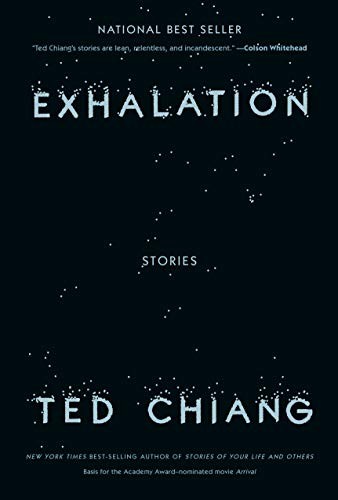
I read the title story of this collection twice in one sitting, once because I finished it and once because I didn’t believe a story about an artificial being cutting open its own brain could make me cry on a train. It did. I looked like a person having a small private crisis in seat 14C, and I was fine with that. Ted Chiang doesn’t write a lot, maybe one story every year or two, and after Exhalation I understand why: this is what happens when someone refuses to publish until the idea is actually finished thinking.
| Author | Ted Chiang |
| Published | 2019 |
| Genre | Literary science fiction, short stories |
| Format | Standalone collection, nine stories |
| Reception | Widely adored, award-magnet, occasionally called cold or overly cerebral |
| Our rating | 4.5/5 |
| Read it if | You want ideas that respect your intelligence and still find your heart |
| Skip it if | You need plot momentum and hate a story that pauses to think |
Nine machines that are secretly about grief
Here’s the thing about a Ted Chiang collection: there’s no throughline, no shared universe, no connective tissue except the shape of his brain. Each story picks up a single premise and turns it over and over like a stone until you can see every face of it. A device that lets you replay any moment of your life with perfect video accuracy. A parallel-worlds gadget that lets you text the version of yourself who made the other choice. Digital pets that you have to actually raise, for years, like they’re real, because to the people raising them they are. He takes the premise seriously all the way down, which almost nobody does.
The two big ones anchor the book. “The Merchant and the Alchemist’s Gate” opens it, a time-travel story written in the cadence of the Thousand and One Nights, where the traveler learns you cannot change the past, only understand it. And “Exhalation” itself, the story that gives the book its name, is a mechanical being in a mechanical universe performing an autopsy on its own working brain to figure out how thought happens, and discovering something about entropy that quietly wrecks you. I’m being vague on purpose. You want to walk into that one clean.
The one that’s perfect, and the one I skimmed
Look, I’ll just say it: “The Lifecycle of Software Objects” is the best novella in here and also the one where my attention wandered. Both things are true. It’s about digitally raised AI creatures called digients and the two people who spend a decade of their lives keeping them alive as the platform they live on dies around them. It’s the most emotionally honest thing anyone has written about what we owe the intelligences we create, and it earns every beat. It’s also long, deliberately slow, full of tech-industry procedural detail about servers and licensing and abandoned software, and there was a stretch in the middle where I caught myself reading faster than I should. So which is it, brilliant or a slog? I’ve decided it’s both, and that the slowness is the point, and I’m only about eighty percent sure I’m not just rationalizing my own impatience. That’s a genuine question I have about my own taste with this book.
Because that’s the knock on Chiang, right, the one you hear: cold, cerebral, more interested in the thought experiment than the people. And I get where it comes from. His prose is clean to the point of being clinical. Nobody in these stories has a quirky voice or a memorable way of talking. If you come to fiction for character and texture and mess, this can read like a very beautiful physics lecture.
But I think that read misses it completely. Take “The Truth of Fact, the Truth of Feeling,” which braids two stories, one about a future where lifelogging tech means you can search your own perfect memory, and one about a man in colonial Africa encountering written language for the first time. It sounds like a lecture on how technology reshapes memory. What it actually does is quietly gut you with a small moment where a father discovers he has been misremembering an argument with his daughter for years, that his memory has been protecting him, casting him as the reasonable one, and the footage proves he was the cruel one. There’s no villain. There’s just a man and a truth he’d been allowed to forget. I put the book down after that and stared at the ceiling for a while, thinking about arguments I’m certain I won that I have possibly been editing in my favor for a decade.
That’s the trick. The ideas are the delivery system. The payload is always some very human ache: guilt, free will, whether kindness matters if the outcome is fixed, what we owe the things we make. “Anxiety Is the Dizziness of Freedom,” the parallel-selves one, is ostensibly about a quantum gadget. It’s really about a woman deciding whether she gets to become a better person than the version of herself in the next world over. And “Omphalos,” the story where a scientific discovery threatens a literal creationist universe, sits with a kind of faith-in-crisis that Chiang, an atheist, writes with startling tenderness. He is fascinated by belief and he does not sneer at it. I found that genuinely moving and slightly surprising.
Do all nine land? No. A couple of the shorter pieces feel more like elegant sketches than full stories, ideas he wanted on the record. But the hit rate is absurd. When a collection has three or four stories you’ll be turning over in your head for months, you don’t dock it much for a couple that are merely very good.
He isn’t asking whether the future is coming. He’s asking who you’ll have been when it arrives.
About Ted Chiang
Chiang is the guy who has published maybe fifteen or so stories across his whole career and has probably the highest awards-per-word ratio in the genre. He worked for years as a technical writer, which you can feel in the surgical precision of his sentences, and he famously turned down a nomination once because he didn’t think the story was good enough. Who does that. He’s also the author of “Story of Your Life,” the novella that became the film Arrival, so if you cried at that movie, you’ve already met his brain. He writes slowly, publishes rarely, and every time he does, everyone who cares about science fiction stops what they’re doing. There is no filler in his bibliography because he apparently deletes the filler.
If this rearranged your head, read these next
- Stories of Your Life and Others by Ted Chiang, his first collection and the one with the Arrival novella, arguably even stronger than this one.
- Ted Chiang aside, try Exhalation on the page yourself via this Amazon listing, because some of these need to be read slowly, in print, alone.
- Klara and the Sun by Kazuo Ishiguro, for the same tender question about an artificial mind’s inner life, told even more quietly.
- The Left Hand of Darkness by Ursula K. Le Guin, for that same rare thing: hard ideas and a warm heart in the same book.
For your book club
- In “The Truth of Fact, the Truth of Feeling,” is the father better or worse off for finally seeing the accurate footage of his argument? Would you want perfect memory of your own conflicts?
- The time-travel story insists the past can’t be changed, only understood. Does that make the traveler’s journey pointless, or the opposite?
- The digients in “The Lifecycle of Software Objects” were made, not born. Do their creators owe them a future? Where’s the line between a product and a person?
- Chiang is an atheist writing “Omphalos” with real tenderness toward faith. Did that respect surprise you, and did it change how the story landed?
- Several stories argue that outcomes are fixed and choices still matter. Is that a comfort or a trap?
Where to go from here
If Exhalation lit up the part of your brain that wants big ideas and real feeling in the same book, keep going with our ultimate list of the best sci-fi books in existence, where a bunch of Chiang’s spiritual siblings are waiting.
I still think about the mechanical being and its own dying breath. Not the science of it. The tenderness. The way it wrote everything down anyway, for whoever might come after, knowing it wouldn’t be around to be thanked…