
A freshly dog-eared review
A Dragon Book That Trusts You to Feel Bad
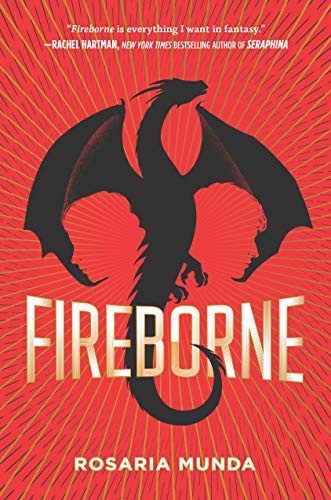
I picked up Fireborne expecting dragon fights and got a book about what you owe the people who murdered your family if the revolution decides they deserve a second chance. That’s not the pitch on the back cover, but it’s the actual book, and it wrecked me in a slower, meaner way than I expected. This is not a comfort read. This is a book that makes you sit with your own hypocrisy for three hundred pages.
| Author | Rosaria Munda |
| Published | 2019 |
| Genre | Political fantasy, dragon riders, YA crossover |
| Format | First book in the Aurelian Cycle trilogy |
| Reception | Well liked by fantasy readers who wanted more brains than romance, quieter buzz than its dragon-book peers, some readers bounce off the politics |
| Our rating | 4/5 |
| Read it if | you want dragon-rider school with an actual thesis about power and forgiveness |
| Skip it if | you came purely for dragon battles and romance and want the politics to get out of the way |
A revolution with a body count you’re supposed to remember
Here’s the setup, and it’s a good one. Annie and Lee grew up together in the aftermath of a revolution that overthrew a dragon-riding aristocracy called the Old Guard. Lee’s family was part of that aristocracy. Annie watched the new regime execute his parents when she was a kid, right in front of him, as part of the “cleansing” that came after the revolution won. And now, years later, both of them are training together to become dragonriders for the very government that killed his family, because the new regime needs riders and doesn’t care where they come from as long as they can pass the trials.
Lee is training under a false name. Nobody at the academy knows he’s the last surviving heir of the family they slaughtered. Annie knows. She’s known the whole time. And she’s decided to be his friend anyway, or maybe she just never stopped being his friend, which is somehow worse and more interesting.
I want to be clear about what Munda is doing here because it’s smarter than the average dragon-school setup. This isn’t Divergent with dragons, even though the trial structure and the found-family dorm dynamics will feel familiar if you’ve read a lot of YA. The dragons themselves are almost secondary. What the book is actually asking is whether a revolution that kills children for their parents’ crimes is any better than the aristocracy it replaced, and it asks that question through two kids who are best friends and also, structurally, on opposite sides of a knife.
Where it earns it and where it drags
The friendship between Lee and Annie is the whole book, and it’s genuinely good. Not romance-good, though there’s a slow simmering thing there too. Good in the way that a friendship between a survivor and the child of the people who hurt her is supposed to feel wrong and doesn’t, because Munda actually does the work of making you understand both of them. Annie is furious and practical and has spent her whole life clawing her way up from nothing, and she is completely unwilling to be noble about her rage, which I loved. She doesn’t forgive Lee’s family. She barely forgives Lee. The book doesn’t ask her to.
Lee is trickier and honestly the weaker of the two POVs for me. His guilt is the engine of a lot of his chapters, and there’s a stretch in the middle of the book, once the political maneuvering with the new government’s leaders kicks in, where his sections slow to a crawl. I found myself skimming a little through some of the council-room scenes, waiting to get back to Annie or back to the dragons. That’s my one real complaint. The politics are the point of the book, I get that, but Munda occasionally tells us the stakes instead of dramatizing them, and a few chapters read like table setting for book two.
The dragon stuff, when it happens, is terrific. The training sequences have real physical stakes, kids die in this book, actually die, in ways that are not softened for the reader. There’s a scene at the trials that still sits with me, the way fear and ambition tangle together when you’re a teenager who has been told your worth is measured by how well you can bond with an animal that could kill you by accident. Munda writes flight like she’s actually thought about wind and weight and fear, not just “and then they soared.”
I read most of this on a long train ride, which turned out to be the right setting for it. There’s something about being stuck in a seat with nowhere to go that matches the book’s mood, the sense of being trapped in a system you can see the flaws in but can’t escape. I remember getting to the reveal of what actually happened the night of Lee’s parents’ execution and having to just stare out the window for a minute. Not because it was shocking exactly, more because it made me recalibrate who I’d been rooting for.
Am I overrating this because I have a soft spot for morally complicated childhood friendships? Maybe. I’ll own that. But I think the ending, which does not let anyone off easy, earns the rating on its own.
The people who win a revolution get to write the word “justice” over whatever they do next.
About Rosaria Munda
Rosaria Munda studied classics, which tracks, because Fireborne reads like someone who has spent real time with Greek tragedy and Roman political collapse and decided to smuggle all of it into a YA dragon book. She’s talked about being interested in revolutions that eat their own children, which is Fireborne in one sentence. This was her debut novel, which is honestly a little annoying, because most people don’t write something this structurally confident on their first try.
If this made you distrust every revolution in fiction, read these next
Fireborne is the first of a trilogy, so obviously start with Flamefall and Bloodmarked if you want the whole arc, the second book especially pays off a lot of what feels slow here. Beyond the series itself, try An Ember in the Ashes by Sabaa Tahir for another YA fantasy that treats its violence and its empire with real weight instead of softening it. The Poppy War by R.F. Kuang is the adult, much darker cousin of this book’s central question about what revolution costs and who pays it. And if you want the dragon-training-academy structure without quite as much political grief, Fourth Wing scratches that itch, though it’s a much lighter, horn ier read than Fireborne.
For your book club
- Annie knows who Lee really is and says nothing. Is that loyalty, cowardice, or something else entirely?
- The new regime executed children for their parents’ crimes. Does anything in the book actually justify that, or does Munda want you to sit with the fact that nothing does?
- Would you have told the truth about Lee’s identity if you were Annie? What would it have cost you either way?
- How does the dragon-bonding trial system mirror the class systems the revolution was supposed to destroy?
- Who do you actually trust by the last page, and did that change from where you started?
Want more books that argue with you
If you like fantasy that picks a fight with your assumptions instead of just entertaining you, check out more of our book reviews for other titles in the same vein.