
A freshly dog-eared review
The Guy Who Got Rich and Never Forgave Himself
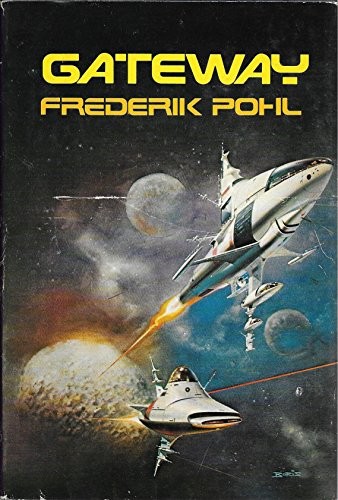
I went into Gateway expecting a spaceship book. Aliens, faster-than-light travel, the usual chrome and stars. What I got instead was a man lying to his robot therapist for 300 pages while I slowly figured out he was one of the most quietly awful narrators I’ve ever rooted for. I finished it on a bus and sat there past my stop.
| Author | Frederik Pohl |
| Published | 1977 |
| Genre | Science fiction (psychological, hard-ish, deeply weird) |
| Format | Book one of the Heechee Saga (four main novels, plus a short story collection) |
| Reception | Won the big three awards its year (Hugo, Nebula, Locus); still regarded as one of the strongest SF novels of the 70s, though some find the therapy frame divisive |
| Our rating | 4.5/5 |
| Read it if | You want sci-fi that’s actually about a person, and you don’t need everything explained |
| Skip it if | You want action, answers, or a hero you can cleanly like |
Humanity found a parking lot full of alien cars and no manual
Here’s the premise, and it’s one of the best in the genre. Somewhere out past Venus, people discover an abandoned asteroid station left behind by a vanished alien race everyone calls the Heechee. Inside: hundreds of small starships, fully fueled, pre-programmed to fly to destinations nobody understands. You climb in. You press the button. You go… somewhere. Maybe you come back with a fortune in alien tech and a lifetime of wealth. Maybe you come back with nothing. Maybe you come back cooked, or crushed, or aged forty years, or you just never come back at all.
So it’s a lottery. A death lottery run out of a rusting asteroid, and the people who play it are the desperate ones, the ones with nothing left to lose on Earth, which in Pohl’s future is a food-riot dystopia where the rich eat actual meat and everyone else eats reconstituted oil-shale gunk.
Our man is Robinette Broadhead. Rob. He wins a food lottery back home, buys a one-way ticket to Gateway, and then… mostly doesn’t go. He hangs around the station. He gets in relationships. He picks flights and backs out. He’s terrified, and the genius of the book is that Pohl makes his cowardice completely understandable and also, eventually, unforgivable.
Two timelines, one deeply unreliable coward, and a machine that keeps calling him on his nonsense
The structure is what makes this thing sing. Half the book is Rob on Gateway years ago. The other half is Rob in the present, rich now, safe now, in psychoanalysis with an AI therapist he nicknames Sigfrid von Shrink. And you spend the whole novel wondering: if he made it out with a fortune, why is he such a wreck? What happened out there that he won’t say?
Pohl doles it out slow. And the Sigfrid sessions are the best part of the book, which is a wild thing to say about a sci-fi novel from 1977. Rob deflects, jokes, storms out, sabotages his own therapy, and this patient machine just keeps steering him back toward the thing he can’t look at. There’s a version of this book that’s all spaceships. This is not that book. This is a book about a man who cannot forgive himself and won’t tell you why.
The retro details are a hoot, too. Pohl breaks up the chapters with these little classified ads and mission-report snippets and lecture transcripts from Gateway, and they’re often funnier and grimmer than the main text. Ads for used Heechee equipment. Notices about prospectors who didn’t come back. It builds the world sideways, and I loved it. I kept stopping to read them out loud to my partner, who did not ask for this.
Now, the criticism, because I promised myself I’d be honest. Rob is a hard hang. He’s petty, he’s cruel to the women in his life (his treatment of Klara in particular curdles as the book goes on), and there’s a stretch in the middle where the on-station drama starts to feel like a soap opera with worse plumbing. Some of the sexual politics are very much 1977, and not in a way that’s doing anything clever with it. I questioned my own taste around the halfway mark, honestly. I kept thinking, am I calling this a masterpiece because it’s genuinely great, or because the ending is about to save it? Bear with me, because the ending does save it.
The last twenty pages recontextualize everything. The reason Rob is broken, the thing that happened on his final flight, the actual physics of his guilt: it’s one of the cruelest, most precise gut-punches in science fiction, and it turns the whole psychoanalysis frame from a gimmick into the entire point. I won’t spoil it. I’ll just say that when Sigfrid finally gets Rob to say the thing, out loud, I put the book down and stared at a wall. The horror isn’t an alien. The horror is math. The horror is what happens to time near a certain kind of object, and what Rob had to choose, and the fact that he lived.
That’s the book. A guy who won it all and is being slowly eaten alive by the price.
The Heechee never appear, and that’s the trick: the void they left behind is just big enough for one man to fill it with his own guilt.
About Frederik Pohl
Pohl was one of those guys who was around for basically the entire history of the genre. He started as a teenage fan in the 1930s, became an agent, an editor (he ran Galaxy magazine and championed a ton of writers who’d go on to be legends), and kept writing well into his 90s. His earlier satirical stuff with C.M. Kornbluth, especially The Space Merchants, skewered advertising and consumer capitalism decades before it was fashionable, and you can feel that same sardonic anti-corporate streak all through Gateway’s food-riot Earth. He blogged into his eighties and won a Hugo for the blog, which delights me. He died in 2013. Gateway was his mid-career career-topper, the one where the satirist grew a devastating emotional core.
If this one got under your skin, read these next
- The Space Merchants by Pohl and Kornbluth — his other classic, meaner and funnier, if you want the satire without the heartbreak.
- Rendezvous with Rama by Arthur C. Clarke — the other great “humans explore incomprehensible alien object” book; colder and more awestruck where Gateway is warm and wounded.
- Roadside Picnic by the Strugatsky brothers — aliens leave junk behind, desperate people risk their lives scavenging it. Basically Gateway’s grim Soviet cousin, and it’s magnificent.
- Solaris by Stanislaw Lem — if it was the psychology and the unknowable-alien dread you loved, Lem does it with a scalpel.
You can grab Gateway by Frederik Pohl on Amazon here if you want to see the button-pressing lottery for yourself.
For your book club
- Rob is wealthy and safe by the present-day timeline, yet completely destroyed. Does the book earn that outcome, or does it feel like Pohl punishing his narrator to make a point?
- Sigfrid the AI therapist is one of the earliest sympathetic machine characters in SF. What does the book gain by making the confessor a machine instead of a human?
- How does Rob treat Klara and the other women, and does the novel seem aware of how badly he behaves, or is it a blind spot of its era?
- The Heechee never appear. Would the book be stronger or weaker if we ever met them or understood their ships?
- Gateway’s Earth runs on scarcity and a lottery economy. How much of that 1977 dystopia feels dated, and how much feels like a forecast?
Where to go from here
If Gateway made you want more of the good stuff, the vintage classics and the genuinely strange ones, dig into our ultimate list of the best sci-fi books in existence. Gateway’s on there. So is half the stuff that ruined me.