
A freshly dog-eared review
Brian Robeson Ruined Me for Regular Camping Trips
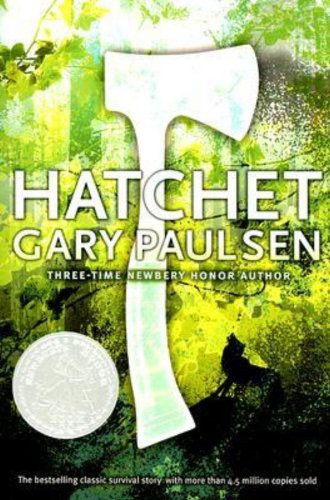
I reread Hatchet last winter during a week when I genuinely could not get warm, huddled under two blankets with tea going cold beside me, and I still felt embarrassed by how much I wanted Brian Robeson to just catch a fish already. That’s the whole trick of this book. It’s 195 pages of a kid failing to make fire, and somehow I could not put it down. I first read it in fifth grade because my teacher put it on a shelf labeled “if you liked Hatchet,” which felt like a dare, and I have thought about that stupid hatchet more times in my adult life than I’d like to admit.
| Author | Gary Paulsen |
| Published | 1987 |
| Genre | Survival fiction / middle grade adventure |
| Format | Standalone (spawned three sequels: The River, Brian’s Winter, Brian’s Return, plus Brian’s Hunt) |
| Reception | Newbery Honor book, a genuine classroom staple for decades, beloved by kids who never thought of themselves as readers |
| Our rating | 4.1/5 |
| Read it if | you want a lean, brutal, weirdly meditative survival story that respects a kid’s intelligence |
| Skip it if | you need a lot of plot, dialogue, or other characters to stay engaged |
A Plane Crash, a Hatchet, and Absolutely Nothing Else
Here’s the setup, and it really is this simple: thirteen-year-old Brian Robeson is flying to visit his father in the Canadian wilderness when the pilot has a heart attack mid-flight and dies. Brian, who has never flown a plane in his life, has to crash-land a small Cessna into a lake. He survives. The pilot does not. And then it’s just Brian, a hatchet his mother gave him as a gift before the trip (a gift he was almost too embarrassed to take), and the entire unforgiving Canadian wilderness for company.
That’s it. That’s the book. No sidekick, no villain, no love interest, no subplot back home getting resolved by satellite phone. Paulsen strips the story down to one kid’s body and one kid’s mind against hunger, cold, mosquitoes, a tornado, a moose that attacks him for no reason whatsoever, and his own useless self-pity. The whole novel is basically a slow burn of Brian getting slightly less stupid about survival with every failed attempt, which sounds boring on paper and is somehow the opposite of boring.
Why It Works (and the One Thing That Doesn’t)
What Paulsen does better than almost anyone writing for kids is make interior thought into plot. Brian’s brain won’t shut up, and that’s the engine of the whole book. He keeps circling back to “the secret,” the thing he saw his mother doing in a car with a man who wasn’t his father, the thing that’s tearing his parents’ marriage apart and that he can’t tell anyone. It’s never spelled out melodramatically. It just resurfaces at the worst moments, when he’s exhausted and starving and his guard is down, and it made me, a grown adult with no business crying over a middle grade book on a bus, tear up a little. That’s real grief sitting underneath a survival story, and it never gets sappy about it.
The survival details are the other half of why this book has lasted. Paulsen was an outdoorsman himself (more on that in a second) and it shows in the texture: the exact wrong way to try to start a fire, the specific stupid mistake of eating unripe berries and paying for it, the moment Brian realizes the “birds” he’s been hearing are actually foolbirds he can club for meat once he understands their patterns. None of it feels researched. It feels lived.
Now, the criticism, because I promised myself I wouldn’t just gush. The ending resolves too fast. After a hundred and eighty pages of incremental, hard-won progress, Brian finds the survival pack from the sunken plane and essentially levels up overnight, and then he’s rescued almost immediately after. It’s a real letdown structurally, like the last chapter of a video game where suddenly you have unlimited ammo and the final boss barely fights back. I remember feeling cheated by that even as a ten-year-old, though I couldn’t have articulated why at the time. And look, I’ll admit some of the prose is plain to the point of flatness. Paulsen isn’t trying to write beautiful sentences here. If you want lyrical nature writing, this isn’t it. It’s closer to a survival manual with a heartbeat, and I think that’s a feature, not a bug, but I know plenty of adult readers who find it thin on a reread. Maybe I’m too soft on it because of when I read it. I’ve wondered that.
The moose attack chapter, though. No notes. A moose just rams him for absolutely no reason, twice, and it’s somehow the funniest and scariest thing in the whole book at once.
The wilderness doesn’t care whether you deserve to survive it, and Hatchet never pretends otherwise.
About Gary Paulsen
Gary Paulsen basically lived the premise of half his own books before he wrote them. He ran away from a genuinely rough childhood as a teenager, worked as a farmhand, trapper, and sailor, ran the Iditarod twice, and by his own account nearly died more times in the Alaskan wilderness than most of us will ever risk on purpose. He wrote fast and prolifically, over 200 books, a lot of them survival and outdoor fiction for kids who don’t usually see themselves as “readers.” Hatchet was one of three of his books to earn a Newbery Honor. He died in 2021, and honestly the guy earned every word of Brian Robeson’s competence because he’d clearly been Brian Robeson, badly, more than once in real life. You can grab a copy here: Hatchet on Amazon.
If This Wrecked You, Read These Next
My Side of the Mountain by Jean Craighead George, for the kid-alone-in-the-wilderness itch with a gentler, more self-directed runaway instead of a crash survivor. The Sign of the Beaver by Elizabeth George Speare, for another quiet survival story built on a boy learning skills he doesn’t have yet, with a friendship at the center this time. Brian’s Winter, Paulsen’s own alternate sequel imagining Brian never gets rescued and has to survive the actual Canadian winter, which is somehow bleaker and I mean that as a compliment. And if you want the adult version of this same obsession, Into the Wild by Jon Krakauer, minus the survival part, since that one doesn’t end well.
For your book club
- Brian keeps returning to “the secret” about his mother throughout the book. Why do you think Paulsen ties his emotional survival to his physical survival instead of keeping them separate?
- The ending resolves quickly once Brian finds the survival pack. Did that pacing choice bother you, or did it feel earned after everything before it?
- Brian starts the book as a fairly ordinary, somewhat spoiled thirteen-year-old. Pinpoint the exact moment you think he actually changes. Is there one scene, or is it gradual?
- Would this story hit differently if Brian were a girl, or if he were older, say sixteen or seventeen? What does his age specifically add?
- Paulsen refuses to give Brian a rescue that comes from his own cleverness alone (the pack is luck, not skill). What is the book saying about the role of luck versus grit in survival?
Still thinking about Brian out there
If Hatchet left you oddly rattled by how much you cared about one kid and a plane crash, you’re in good company. Check out more of our book reviews for more stories that get under your skin the same way.