
A freshly dog-eared review
Zade Meadows Broke My Moral Compass and I Let Him
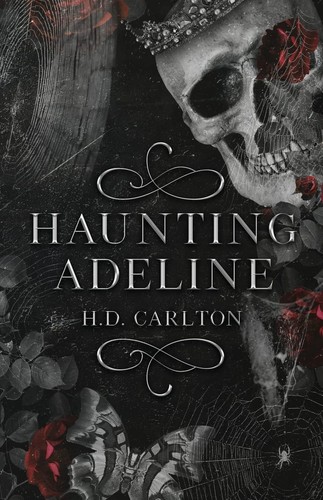
I read this book with the lights on. Not for atmosphere. For safety, which is a ridiculous thing to say about a paperback, but here we are. I like what I like and I am not going to sit here and explain my whole psychology to you. Haunting Adeline is a stalker romance where the stalker is the love interest and the book knows exactly what it’s doing to you.
| Author | HD Carlton |
| Published | 2021 |
| Genre | Dark romance / romantic thriller (stalker trope) |
| Format | Book one of the Cat and Mouse Duet (Hunting Adeline follows) |
| Reception | Wildly divisive. BookTok made it a phenomenon; plenty of readers were repulsed. Both camps are correct. |
| Our rating | 3.5/5 |
| Read it if | You want dark, you’ve read your content warnings, and morally gray is not gray enough for you. |
| Skip it if | Non-consent as a plot device is a hard no, or you need prose that behaves itself. |
A haunted house, a masked man, and a heroine who fights back
Here’s the setup. Adeline Reilly inherits her late great-grandmother’s manor, a genuinely creepy old place that may or may not be haunted (it is, in the low-key way these books do ghosts, more vibe than mechanic). Addie is a true-crime obsessive and a writer, which is the book winking at you before it’s even started. And then there’s Zade Meadows, who has been watching her. Following her. He’s not a monster who kills for fun, exactly. He’s a vigilante who hunts human traffickers and pedophiles, which is the book’s whole moral load-bearing wall: he does horrible things to horrible people, and then he turns that same terrifying attention toward a woman who did nothing wrong except exist near him.
That’s the trick of it. Carlton hands you a man who is objectively a nightmare and then spends the whole book building a case for why you’d let him in anyway. The trafficking-hunter angle is what lets a lot of readers rationalize the rest. Whether that rationalization holds is, genuinely, the argument this book has been having with itself and with the internet since 2021.
Addie, and I need to say this loudly, is not a doormat. She clocks that she’s being watched early. She’s furious about it. She sets traps, she talks back, she is nobody’s fainting damsel. That matters, because a passive heroine in a book like this would be unreadable. The push and pull between them (the cat and mouse of the series title, not subtle, not trying to be) is the engine.
What worked on me, and the part I can’t defend
Look, the thing Carlton does well is dread. There’s a masquerade sequence that a lot of people cite as the moment they either committed or bailed, and I understand both reactions completely. It’s the scene where the fantasy of “you can’t see who’s touching you” gets weaponized, and it is written to make your pulse do something. The book is at its best when it’s a thriller wearing romance’s coat: the not-knowing, the surveillance, the sense that Zade is three moves ahead of a woman who is genuinely clever.
I read most of this on a train, which was a mistake, because there is a certain kind of scene you do not want a stranger reading over your shoulder. I kept angling the phone toward the window. At one point a woman across the aisle glanced over and I did the thing where you scroll fast like you’ve been caught. That’s the effect. The spice is explicit and the darkest scenes carry real dubious-consent and non-consent content, and I’m not going to soft-pedal that for you: this is a book with a scene that is written as non-consensual, and the text frames it inside the romance. If that is a line for you, this is the wrong book, full stop, and there is no shame in closing it.
Now the part I’ll actually criticize, because loving a genre doesn’t mean lying about the craft. The prose is not good in the sentence-level way. It’s serviceable, sometimes clunky, and it leans on the same handful of descriptors until they go numb (Zade’s eyes, the “little mouse” pet name that starts as a chill and eventually becomes wallpaper). The pacing sags in the middle third when the plot mechanics (the trafficking investigation, the manor’s secrets) have to do actual load-bearing work and the book would rather get back to the tension between the two leads. And Zade, for all his menace, occasionally tips from terrifying into a wish-fulfillment fantasy so complete it deflates the danger. A stalker who is also emotionally available, devastatingly hot, morally aligned with the reader, and never once boring in a way that inconveniences you is, whatever else he is, a fantasy object. The book knows this. I’m not sure it always trusts you to know it too.
Here’s a tangent, bear with me. The reason this thing sold the way it did is that it’s honest about being a fantasy in a way “respectable” romance often isn’t. The whole appeal of the stalker trope, and I’ve thought about this more than is healthy, is total attention. Being seen so completely it’s frightening. It’s the same nerve the surveillance thriller hits, just pointed at the heart instead of the throat. Carlton didn’t invent that. She just refused to be embarrassed by it, and refusing to be embarrassed is a superpower in a genre everyone loves to sneer at.
Do I fully trust my own taste here? Not entirely. There’s a version of me that read this at twenty-two and would’ve called it the best thing ever, and a version that reads it now and notices every seam. Both of those people are in the room when I rate it.
This is a book about being watched, dressed up as a book about being loved, and the horror of it is that for long stretches it can’t tell the two apart. Neither can you. That’s the point, and it’s also the problem.
About HD Carlton
HD Carlton is an indie dark-romance author who came up through the self-published, BookTok-fueled machine rather than a big-five deal, and it shows in the best and messiest ways: fast, fearless, unbothered by gatekeepers, willing to go places traditional publishing would’ve red-penned into oblivion. She writes the extreme end of the genre on purpose and puts her content warnings up front, which I respect more than I respect a lot of “prestige” authors who dabble in darkness and then act coy about it. She built a devoted readership by giving people the exact intensity they came for and not apologizing for a second of it. Whatever you think of the books, that’s a real thing to have done.
If this wrecked you, read these next
- Hunting Adeline (HD Carlton) — the second half of the duet, and honestly you can’t stop at book one; the story isn’t finished, so consider this less a rec and more a warning about what you’re signing up for.
- Credence (Penelope Douglas) — darker, moodier, a snowbound cabin and a heroine unraveling; better prose, similar willingness to go where it hurts.
- Corrupt (Penelope Douglas) — if you want morally gray men and simmering vengeance with a bit more polish holding it together.
- Butcher & Blackbird (Brynne Weaver) — serial-killer romance that’s genuinely funny as well as dark, if you want the intensity dialed toward wicked fun instead of dread.
Grab a copy and see which camp you land in: Haunting Adeline on Amazon.
For your book club
- The book leans hard on Zade being a “good” killer (a hunter of traffickers) to make his stalking palatable. Does that framing work on you, or does it feel like a cheat code the book uses to skip a harder question?
- Addie is written as smart, defiant, and self-protective. Does her agency genuinely complicate the darker scenes, or does it end up as cover for them?
- Where’s your personal line in dark romance, and did this book cross it, walk right up to it, or stay comfortably inside? Be honest with the table.
- The stalker trope is about total attention. Why do you think that fantasy resonates so widely, and what does its popularity say (if anything) about what readers aren’t getting elsewhere?
- If the prose were sharper, would you rate it higher, or is the roughness part of why it hits the way it does?
Where to go from here
If you want more of the beautiful, unhinged, defiantly un-embarrassed end of the genre, we keep the good stuff on our romance and romantasy shelf. Come argue with me about morally gray men. I have opinions and I brought snacks.
3.5 out of 5, and I mean the half. It’s not the writing. It’s the nerve. It knew exactly what it wanted to be and it flinched at almost none of it, and I still can’t decide if that’s a feature or a warning, which is maybe the most honest thing I can say about a book that’s still living rent-free in the paranoid part of my brain…