
A freshly dog-eared review
Ten Kids, One Dead Body, Zero Alibis
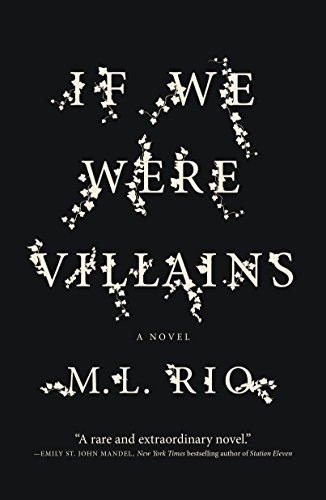
I read this book in one sitting on a train and missed my stop. Not “oh I got a little absorbed” missed my stop, actual conductor-announcing-a-station-I-didn’t-recognize missed my stop. That has happened to me exactly twice in my adult life and the other time I was reading a map wrong. So take that for what it’s worth, because I also think this book has some real problems, and I’m going to tell you about both.
| Author | M.L. Rio |
| Published | 2017 |
| Genre | Dark academia / literary mystery |
| Format | Standalone |
| Reception | A dark academia darling that built its audience slowly through word of mouth and TikTok years after release; beloved by a lot of readers, side-eyed by others as overwrought |
| Our rating | 4/5 |
| Read it if | you liked The Secret History and wanted it with more Shakespeare and less Nietzsche |
| Skip it if | you find theater kids insufferable in real life, because you will find them insufferable here too |
Seven Actors, One Corpse, and a Decade of Silence
Here’s the setup. Oliver Marks gets out of prison after ten years and immediately sits down with the detective who put him away, ready, finally, to tell the truth about what happened at Dellecher Classical Conservatory back in his last year of school. Dellecher is one of those insular arts conservatories that only exist in books, where a small cohort of fourth-year Shakespeare students live and breathe and eat and sleep together, cast every year into the same seven roles: the hero, the villain, the tyrant, the temptress, and so on. Oliver was always cast as the sidekick. Never the lead. And that casting, it turns out, is basically the whole book in miniature.
Then one of them dies. I won’t tell you which one or how, because the reveal is genuinely the best-paced thing in the book, but I’ll say this: you spend the whole first act watching these kids perform Julius Caesar and Macbeth at each other in real life, quoting Shakespeare instead of just talking like normal people, and you think, okay, this is a gimmick. And then the gimmick becomes the point. These kids have been given so much language for betrayal and ambition and murder, so many centuries of other people’s words for exactly this situation, that when it actually happens to them they can’t tell anymore where the play ends and they begin.
The Best Thing About This Book Is Also the Thing I’d Cut in Half
Look, I need to say the obvious comparison out loud because everyone else already has: this is Donna Tartt’s The Secret History with a theater department instead of a classics department, and Rio knows it, and mostly earns it. The insular campus, the closed group of beautiful damaged kids, the murder confessed on page one so the whole book is inevitability rather than whodunit. If you’ve read Tartt you will clock the DNA within about twenty pages. I don’t think that’s a flaw exactly. I think it’s more like watching a very talented cover band. The songs aren’t new but the playing is good enough that you stop caring.
Where it actually distinguishes itself is the Shakespeare. Not as decoration, as structure. The book is broken into acts. Characters talk in verse when they’re drunk or scared or lying, and Rio is skilled enough that it never quite tips into parody, though it gets close a few times. There’s a scene after a performance of Caesar where the cast is still half in character, still quoting lines about knives and friendship at each other in the dark, and it’s genuinely unsettling in a way I didn’t expect a book about theater kids to manage. That’s the high point for me.
Now here’s my actual criticism, and I mean it: these characters can be exhausting. Everyone is beautiful, everyone is tortured, everyone speaks like they’re workshopping a monologue even when they’re just asking someone to pass the wine. Meredith in particular reads more like an idea of a femme fatale than an actual person for long stretches, and the romance between Oliver and Richard’s girlfriend never quite convinced me it wasn’t there mostly to raise the stakes rather than because these two people made sense together. I also think the back half sags. Once the death happens and the investigation starts, some of the momentum that made the first half so hypnotic gets replaced with a slower, more procedural unspooling that doesn’t always earn its length. I put the book down for two days around the two-thirds mark, which surprised me given how fast I’d been moving before that.
And I’ll admit, on a reread a year later, some of what wrecked me the first time felt more mannered than devastating. Am I sure I’m not just susceptible to pretty sentences about doomed young people quoting tragedies at each other? I’m honestly not sure. That’s a real question I ask myself about this book and I don’t have a clean answer.
But then you hit the ending, which recontextualizes almost everything you thought you understood about who did what and why, and it got me anyway. Second time around, knowing it was coming, it still got me.
Give young people enough tragedy and eventually they stop performing it and start living it.
About M.L. Rio
M.L. Rio actually trained in theater and holds a doctorate in Shakespeare studies, which explains why the verse-quoting never feels like a costume she borrowed for the occasion. If We Were Villains was her debut, written in her twenties, and it has the particular electricity of someone who has spent years steeped in exactly one obsession and finally found a container big enough to pour it into. She’s been quieter on the fiction front since, which has only made this book’s cult following grow hungrier for whatever she does next.
If This Wrecked You, Read These Next
- The Secret History by Donna Tartt, the obvious ancestor, colder and crueler but unmistakably the blueprint
- Bunny by Mona Awad, if you want the same insular-cohort claustrophobia turned feral and funny
- Vita Nostra by Marina and Sergey Dyachenko, for the feeling of language itself becoming dangerous
- Babel by R.F. Kuang, if what you actually wanted was the academic obsession dialed up with higher stakes
For your book club
- Do you think the Dellecher casting system (hero, villain, tyrant, temptress) actually shaped who these students became, or did it just give them language for who they already were?
- Oliver spends ten years in prison for something he may not have fully done. Why do you think he let that happen?
- Did the Shakespeare quoting throughout feel earned to you, or did it start to feel like a performance the characters were putting on for each other, and maybe for themselves?
- Which character do you think got the “role” that suited them least, and how did that mismatch drive the tragedy?
- The book argues that too much tragedy can stop feeling like fiction. Do you buy that, or is that a convenient excuse for what these kids did?
Still thinking about Dellecher?
Same. You can grab a copy of If We Were Villains here and see which cast member you’d have been. And if you want more books that will similarly ruin your sleep schedule, check out more of our book reviews.