
A freshly dog-eared review
A Body, a Manuscript, and Two Murders to Solve
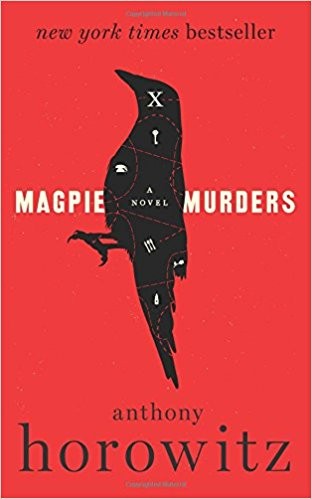
I read this book twice in one month and I am still not sure I’m smart enough for it. Not in a bad way. In the way where a magician does the trick right in front of you, explains half of it, and you still walk away going wait, how. Magpie Murders is a mystery novel with an entire other mystery novel stuffed inside it like a nesting doll, and Anthony Horowitz is having so much fun with the structure that it’s almost rude how well it works.
| Author | Anthony Horowitz |
| Published | 2016 |
| Genre | Mystery, metafiction, cozy-adjacent whodunit |
| Format | Book 1 of the Susan Ryeland / Magpie Murders series (followed by Moonflower Murders and Marble Hall Murders) |
| Reception | Widely loved by mystery readers and critics, adapted into a well-received TV series; a small but vocal contingent finds the structure gimmicky or the pacing baggy in the middle |
| Our rating | 4.2/5 |
| Read it if | you grew up on Agatha Christie and also enjoy watching an author show you how the sausage gets made |
| Skip it if | you want one clean mystery and find puzzle-box structure more exhausting than delightful |
A dead novelist, an unfinished manuscript, and a village that isn’t real (except it kind of is)
Here’s the setup, and I promise I’m not going to wreck it for you. Susan Ryeland is an editor at a small London publishing house. Her biggest asset is Alan Conway, a bestselling but deeply unpleasant crime writer whose Atticus Pund novels (think a gentler, more melancholy Poirot, working in 1950s England) have kept the company afloat for years. Susan sits down one evening with the manuscript for Conway’s ninth Pund book, also called Magpie Murders, and starts reading.
So do you. The entire middle chunk of this novel is that manuscript. A full, self-contained country house mystery about a dead housekeeper, a domineering matriarch, a village full of people who all had reasons to want someone gone, unfolds in front of you almost like Horowitz just handed you a separate Christie novel he wrote for practice. Then you come up for air and discover the manuscript is missing its final chapters. The solution to who killed the housekeeper is gone. And so, conveniently and horribly, is Alan Conway, found dead at the bottom of his tower.
Susan has to find the missing pages. Which means she has to find out who killed Alan Conway. Which means, and this is the part that got me, she has to start reading his own novel as a clue to his own murder, because Conway was the kind of vindictive, petty genius who apparently hid real people, real grudges, and real secrets inside his fiction.
Two mysteries, one spine, and a whole lot of Christie love
I want to be upfront about something. I picked this up expecting a clever gimmick and about sixty percent of a real mystery. What I got was two mysteries that actually stand on their own, which is the hard part nobody talks about. The Atticus Pund story is not a lazy pastiche with the good stuff withheld. It’s a legitimately well-constructed Golden Age mystery, complete with the tidy village, the anagram-heavy names (Conway loves an anagram, almost to a fault, and once you clock that habit you start hunting for it everywhere, which is exactly what Horowitz wants), and a detective who is dying and knows it, which gives the whole Pund thread a quiet sadness under all the puzzle-solving.
Then the frame story, Susan’s search for Conway’s killer, has its own rhythm entirely: sharper, funnier, more contemporary, full of publishing-house pettiness and a wine-soaked boyfriend named Andreas that I found more charming than I expected to.
Here’s the thing though. The book does sag. There’s a stretch in the middle, once you’re fully into the Pund manuscript and haven’t yet gotten the jolt of it ending mid-sentence, where it just reads like a competent but unremarkable village mystery, and I found myself checking how many pages were left in that section like I was waiting for a bus. Some readers I trust have told me they nearly put the book down right there. I get it. The trick only pays off if you push through the part that isn’t tricky yet.
And I’ll be honest about something else: I question whether I love this book because it’s genuinely one of the smartest mystery structures of the last decade, or because I’m a sucker for anything about editors and manuscripts and publishing houses, since that’s basically my whole personality. I read the first half on a plane to visit my sister, the kind of flight where you tell yourself you’ll just skim a chapter and then look up and you’ve missed the drink cart twice. I read the reveal of who actually killed Conway curled up on my kitchen floor at 1am because I refused to go to bed without knowing, and when the anagram of the killer’s motive clicked into place I actually said “oh come ON” out loud to an empty room. That’s the highest compliment I can give a mystery writer. Horowitz plays fair. Every clue is there. You just aren’t looking at it the way you should be.
The best mysteries don’t hide the truth from you. They just make sure you’re looking at the wrong sentence when it walks by.
About Anthony Horowitz
Anthony Horowitz is the rare writer who seems constitutionally incapable of writing a boring sentence, which is suspicious given how much he’s written. He created Alex Rider, wrote episodes of Midsomer Murders and Poirot, was hand-picked by both the Ian Fleming and Arthur Conan Doyle estates to write authorized continuation novels, and somehow still found time to invent an entire fake dead novelist with a fake back catalog just so he could kill him off in book one. He clearly loves the mystery genre the way some people love a difficult relative: intimately, critically, and with a habit of taking it apart just to see how it works.
If this wrecked your brain in the best way, read these next
Moonflower Murders, the sequel, does the same trick again with a different embedded manuscript, and somehow it’s just as satisfying the second time. The 7 1/2 Deaths of Evelyn Hardcastle by Stuart Turton if you want your puzzle box even more disorienting, with one murder solved from inside eight different bodies. Anthony Horowitz’s own Hawthorne series (starting with The Word Is Murder) if you want his metafiction trick pointed at himself, since he writes himself in as a bumbling narrator to a real detective. And if you just want the source material Conway is riffing on, go back to Agatha Christie’s The Murder of Roger Ackroyd, which pulls a structural trick of its own that this book is clearly in conversation with.
You can grab a copy here: Magpie Murders on Amazon.
For your book club
- Did you guess the anagram-based clues in Conway’s manuscript before Susan explained them, or did they only make sense in hindsight?
- Alan Conway is dead before the book even properly starts and we still get a strong sense of who he was. What does that say about how much of a person survives in what they write?
- Does the embedded Atticus Pund novel work as a mystery on its own, separate from the frame story around it, or does it need Susan’s investigation to justify its slower stretches?
- Susan is an editor investigating a death using manuscript pages as evidence. What does the book seem to be saying about the relationship between an author and the people who shape their work behind the scenes?
- Which killer’s motive did you find more satisfying: the one inside the novel, or the one in Susan’s real world? Why?
Want another one that messes with your head in a good way?
If you liked watching Horowitz build a trap door into his own book, check out more of our book reviews for other mysteries that play games with structure, memory, and who’s actually telling you the truth.