
A freshly dog-eared review
The Book About a Group Mind That Made Me Feel Lonely
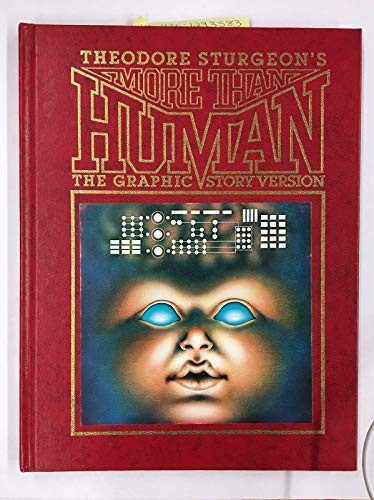
I read most of this book on a bus with a dead phone, which turned out to be exactly the right way to read it, because there was nothing to escape into except the prose. And the prose is where this book lives or dies. Here’s the thing about “More Than Human“: it is either going to feel like the most emotionally intelligent science fiction novel you’ve ever touched, or it’s going to feel like a smart man showing off. For me it was both, sometimes on the same page.
| Author | Theodore Sturgeon |
| Published | 1953 |
| Genre | Literary science fiction, psychological SF |
| Format | Standalone novel (fix-up of three novellas) |
| Reception | A canonized cult classic; won the International Fantasy Award, revered by writers, but genuinely polarizing for readers |
| Our rating | 4/5 |
| Read it if | You want SF that cares more about broken people than gadgets |
| Skip it if | You need plot momentum and hate figuring out who’s narrating |
Six damaged people who add up to one whole one
The premise, once you dig it out (and you do have to dig, Sturgeon does not hand it to you), is this: evolution’s next step isn’t a smarter individual. It’s a gestalt. A group organism made of separate humans who together form something more than the sum of them. There’s Lone, the idiot man in the woods who can pull thoughts out of people’s heads. There’s Janie, a girl who can move things with her mind. Two silent twins who teleport. A baby with Down syndrome whose brain works like a calculating machine, the “central control” of the whole thing. Sturgeon calls the idea “blesh,” a mashup of blend and mesh, and honestly that made-up word does more work than a lot of his sentences.
They find each other. They fail each other. They try to become one thing.
That’s the shape of it. The book is really about whether a person, or a person-made-of-people, can have a conscience, and what it costs to grow one. It sounds abstract. In practice it’s about loneliness, which is the actual subject Sturgeon was circling his whole career.
What works, what genuinely doesn’t, and the part that gutted me
Let me start with the criticism, because I don’t trust reviews that don’t have any. The middle section, the Gerry and Miss Kew stretch, drags. There’s a long therapy-couch sequence where a man is essentially being psychoanalyzed on the page, dredging up a buried memory, and I understand structurally why it’s there (the whole book is about a fractured mind reassembling itself, so of course the climax is a repressed memory surfacing), but as a reading experience it goes flat and talky. I checked out for a few pages. I came back. But I checked out.
The book is also a fix-up, stitched from three separately published novellas, and you can feel the seams. The first part, originally “Baby Is Three,” is the strongest thing in here by a wide margin, and I’ve since learned it’s the piece Sturgeon wrote first and built outward from. The other two sections orbit it with uneven gravity. The opening with Lone in the forest is gorgeous and strange. The closing section, introducing a brand new character named Hip well past the halfway mark, asks a lot of your patience.
So why four stars and not less? Because when this book is on, nothing else in 1950s SF is doing what it’s doing.
The moment that got me: early on, the idiot Lone is taken in by a farm couple, the Prodds, who are simple and kind and childless, and they treat this feral man-child with a tenderness he has never had a word for. And the way Sturgeon writes Lone slowly learning what warmth is, not learning to talk, just learning to be near people who don’t want to hurt him, I read that on the bus and had to look out the window for a while. It’s not sentimental. It’s worse than sentimental, it’s precise. Sturgeon writes damaged people better than almost anyone, and I think that’s because he clearly understood damage from the inside.
Here’s my tangent, bear with me. Sturgeon is famous for “Sturgeon’s Law,” the line that ninety percent of everything is crap. People quote it to be cynical. But if you read this novel you realize he meant it as a defense of science fiction, not an attack: yeah, ninety percent is junk, but so is ninety percent of literary fiction, so judge the field by its best. And “More Than Human” is him trying to make the ten percent. You can feel the ambition straining against the pulp-magazine machinery it was born in. Sometimes it wins. Sometimes the machinery wins.
Now let me question my own taste, because I should. I wonder if I love this book partly because it’s the kind of thing that flatters a certain reader, the one who wants their SF to be “real literature.” Is the difficulty actually depth, or am I mistaking density for meaning? I go back and forth. The prose can be lush to the point of murk. There are passages where I genuinely could not tell you what physically happened in the room. But then Janie will say something cold and funny and human, or the baby’s telepathic voice will come through, and I stop nitpicking, because no one else was writing children in SF like this. The kids in this book feel like actual kids: cruel, loyal, weird, wounded.
The ethics of some of it have dated, to be honest. There’s a casualness around the “idiot” and around the developmentally disabled baby-as-computer that lands differently now, and I don’t want to pretend it doesn’t. Sturgeon was radically compassionate for his era, and his era is still visible. Both things are true.
The great trick of this book is convincing you that the scariest kind of loneliness isn’t being alone. It’s being a piece of something that hasn’t figured out how to be whole yet.
About Theodore Sturgeon
Sturgeon was the outsider’s outsider of golden-age SF. He wrote gorgeous, aching, sexually frank stories in an era of ray guns and square jaws, and he paid for it with an unstable career and long dry spells, some of them near-total writer’s block that he wrote about with painful honesty. He’s the guy Kurt Vonnegut supposedly based Kilgore Trout on, the brilliant SF hack nobody reads. Which is a little unfair, because plenty of writers read him obsessively. He cared about love and loneliness and outsiders when the genre mostly cared about hardware. If you’ve only ever heard his name as a punchline about that “ninety percent” law, this novel is the correction.
If this one got under your skin, read these next
- “Flowers for Algernon” by Daniel Keyes — the other great SF novel about intelligence, disability, and heartbreak, and the closest emotional cousin to this one.
- “The Left Hand of Darkness” by Ursula K. Le Guin — if you want SF that treats otherness and connection with this much tenderness but a firmer hand on plot.
- “Childhood’s End” by Arthur C. Clarke — published the same year, also about humanity’s next evolutionary step, but colder and grander where Sturgeon is intimate and warm.
- “Sturgeon’s own short stories” — start with “A Saucer of Loneliness” or “The Man Who Lost the Sea.” Honestly, the short form is where he’s most consistently great.
You can grab a copy on Amazon here if you want to see which camp you land in.
For your book club
- The gestalt is “more than human,” but is it more humane? Does becoming part of something larger make the characters better people, or just more powerful?
- Sturgeon puts a developmentally disabled baby at the literal center of the group mind as its “brain.” Does that read as radical inclusion for 1953, as troubling, or as both?
- The book withholds its own premise for a long time. Did the confusion frustrate you or draw you in, and would the story survive being told plainly?
- The final section is really about the group organism developing a conscience. Do you buy that morality is what separates a monster from a person, in this book or in general?
- Which character felt most human to you, and does it matter that your answer might be one of the ones who barely speaks?
Where to go from here
If you want more SF that reaches past the machinery toward something stranger and more human, we put the best of it in one place: our running list of the best sci-fi books in existence. Sturgeon earned his spot on it by being difficult in exactly the right way.