
A freshly dog-eared review
London Ate My Childhood: On Municipal Darwinism
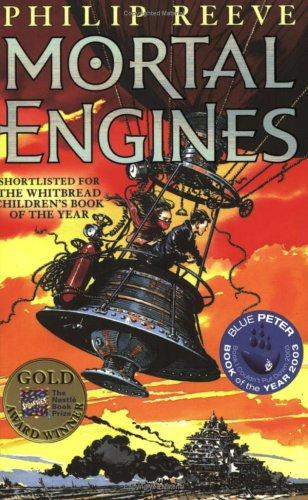
Here’s the thing about Mortal Engines: it opens with the city of London chasing down a little mining town across a dried-out seabed so it can eat it. Not metaphorically. Eat it. Swallow the whole town into its guts and strip it for parts. I read that first chapter standing up in a bookshop, meaning to put it back, and I did not put it back.
| Author | Philip Reeve |
| Published | 2001 |
| Genre | YA steampunk / post-apocalyptic sci-fi |
| Format | Book 1 of the Mortal Engines Quartet (4 main books, plus prequels) |
| Reception | Beloved by a devoted crowd, prize-winning, but sparse and brutal enough that plenty of readers bounce |
| Our rating | 4/5 |
| Read it if | You want big weird ideas, fast pacing, and a book that will actually kill people you like |
| Skip it if | You need lush prose, a warm hero, or you get attached easily and hate being punished for it |
A world that runs on cities eating cities
The premise is the whole reason to be here, so let me just say it plainly. Thousands of years after a war wrecked the planet, humanity rebuilt in the wrong direction: they put their cities on giant wheels and tank treads and set them loose to roll around hunting each other. Big cities eat small towns. This is called Municipal Darwinism, and everyone in London treats it as obviously correct, the natural order, a thing you’d have to be a soft-headed idiot to question.
Into this we get Tom Natsworthy, a lowly apprentice historian in London’s Guild of Historians, who idolizes the famous adventurer Thaddeus Valentine. Tom is not a hero. Tom is a slightly smug, slightly cowardly boy who has never once had a hard day. And then he foils an assassination attempt on Valentine by a scarred girl named Hester Shaw, and instead of getting a medal he gets thrown off the back of London by the very man he worships, and the plot goes off like a dropped tray of dishes.
Hester is the engine of the book, and she is a genuinely astonishing character to hand teenagers in 2001. Her face is a ruin, one eye gone, and Reeve does not soften it or reveal that she’s secretly beautiful underneath. She’s furious and blunt and driven by one thing: killing Valentine. I loved her instantly, which tells you something about me I’m not going to examine here.
What it does that almost nothing else does
Look, the reason Mortal Engines works is that Reeve commits. The Municipal Darwinism idea could have stayed a cute gimmick, a fun way to say “steampunk,” but he actually thinks it through as a politics, an economy, a religion. London worships its own hunger. There’s a whole belief system built around the traction city as a kind of god, and the villains aren’t cartoons, they’re true believers. When you meet the Anti-Traction League on the far side of the map, people who live in fixed cities and think the whole rolling-metropolis thing is an abomination, the book refuses to tell you flatly who’s right.
And then there’s Shrike. In some editions he’s Grike, a spelling change that still confuses me. He’s a Stalker: a dead man resurrected as a killing machine, all iron and green-glowing eyes, hunting Hester across the wasteland. On paper he’s a Terminator. In practice he becomes the most heartbreaking thing in the book, and the moment his actual history with Hester lands is the moment I stopped treating this as a fun romp. I was on a train when I hit that reveal and I remember physically lowering the book into my lap and staring out the window like a person in a film.
Now the criticism, because there’s a real one. Reeve’s prose is thin. Deliberately, I think, and it keeps the pages flying, but there are stretches where a huge event happens (a city falls, a person you cared about dies) and it goes by in about four sentences with almost no room to feel it. The book kills people with a casualness that genuinely shocked me the first time, and some of those deaths would have hit ten times harder with another paragraph of air around them. This is a book that is always accelerating, and occasionally I wanted it to just idle for a second and let me catch up emotionally. Fans will tell you the brutal economy IS the point, that the coldness mirrors the world, and honestly they might be right. I go back and forth. I’m going back and forth right now.
Small tangent. I saw the 2018 Peter Jackson-produced movie in a mostly empty theater and it is a fascinating disaster, a film that spent a fortune building the traction cities beautifully and then flattened Hester into a normal pretty action heroine with a tasteful little scar, which is the one thing the book absolutely refuses to do. If you only know Mortal Engines from the movie, you do not know Mortal Engines. The book is meaner and sadder and much stranger, and it’s better.
The other thing worth saying: this is book one of four, and Reeve is playing a long game. The quartet gets darker and more ambitious as it goes, and the ending of this first volume is not a tidy victory bow. It’s a gut-punch that opens a door. If that bothers you, the door only leads to more.
A civilization that has decided its own appetite is a virtue will always find something smaller to eat, and will always call that survival.
About Philip Reeve
Reeve spent years as an illustrator and a cartoonist before he broke through, which shows: the man draws the traction cities in your head so cleanly you can hear the treads. Mortal Engines was his debut novel, and it won the Nestlé Smarties Gold Award, the kind of thing that quietly turns a first-timer into a career. He’s a proper English weirdo in the best way, funny and morbid in the same breath, and he’s never stopped playing in this world (he later wrote prequels like Fever Crumb and, with Sarah McIntyre, a whole run of gleeful younger books such as Pugs of the Frozen North). What I like about him is that he clearly thinks children can handle grief, ambiguity, and a hero who’s kind of a wet blanket at the start. He’s right.
If this one got its hooks in you, read these next
- Leviathan by Scott Westerfeld, for readers who want the steampunk machinery and alt-history spectacle with a warmer, more adventurous heart.
- Railsea by China Mieville, a stranger cousin: trains hunting giant moles across a dirt ocean, weird in exactly the way Mortal Engines is weird.
- The Fever Crumb books by Reeve himself, if you want to stay in this universe and see how it all began before the wheels started rolling.
- His Dark Materials by Philip Pullman, for the same trust that young readers can carry heavy, morally serious stories.
You can grab a copy over on Amazon here if you want to see the London chase for yourself.
For your book club
- Municipal Darwinism is presented as monstrous, but is it really so different from how our own economies work? Where does the metaphor stop being fair?
- Tom starts the book worshipping Valentine and believing London is righteous. Did you find his change of heart earned, or too fast?
- Reeve keeps Hester’s scarred face genuinely disfiguring and never fixes it. Why do you think that mattered so much to him, and did it matter to you?
- Shrike is a killing machine we end up mourning. What is Reeve saying about memory, loss, and what makes a person still a person?
- The prose is fast and sometimes cold about death. Did that coldness serve the story, or did it cost the book its emotional weight?
Where to go from here
If a book that builds an entire brutal civilization out of one impossible idea is your thing, you’ll find a lot more of that energy on our best sci-fi books list. Fair warning: several of them will also kill someone you love.
Anyway. I still think about that first chapter. A whole city, hungry, rolling over the horizon after something smaller than itself, and everyone on board so proud of it…