
A freshly dog-eared review
Recursion Gave Me a Headache and I’m Not Even Mad
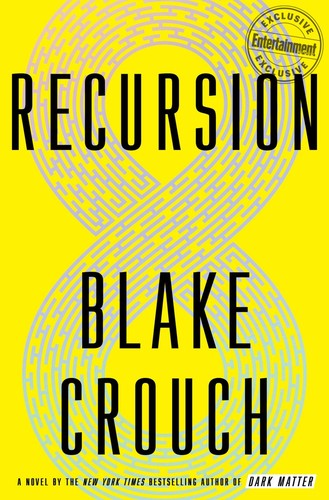
I read the last hundred pages of Recursion in a parking lot because I couldn’t make myself go inside and cook dinner. That’s the honest version. The slightly less flattering version is that I also, at one point, put the book down and stared at the ceiling and said out loud, to no one, “wait, so does ANY of this count.” Both of those things are true, and I think that tension is the whole book.
| Author | Blake Crouch |
| Published | 2019 |
| Genre | Sci-fi thriller, high-concept, with a big romance streak |
| Format | Standalone (thematic cousin to Dark Matter, but not a series) |
| Reception | Wildly popular (won its year’s Goodreads Choice sci-fi award) but genuinely divisive on the back half |
| Our rating | 4/5 |
| Read it if | You want a smart concept that moves like a freight train and don’t mind a plot that eats its own tail |
| Skip it if | You need airtight logic, or you get motion sick from repetition |
The premise that ruined my week (affectionately)
Okay. Here’s the setup, and I’ll keep the spoilers out of it because half the fun is watching the floor drop.
Barry Sutton is a New York cop who gets called to a ledge, where a woman is about to jump. She tells him she has “False Memory Syndrome”: she remembers an entire life, a husband, a kid, that never happened. Or did happen. Or is happening. She remembers it the way you remember your own phone number, except none of it is real, and it’s driving people to the roof.
Meanwhile, on a separate track, there’s Helena Smith, a neuroscientist trying to build a chair that can map and preserve memory. She wants to save her mother, who’s disappearing into Alzheimer’s. Noble. Small. Human. And then a billionaire with too much money and zero impulse control gets involved, and what Helena built to preserve a fading mother turns into something that can send you back into your own past and let you live it again from the inside.
That’s the engine. Memory is not a recording. Memory is a door.
And Crouch, to his enormous credit, does not sit on the idea. Some sci-fi authors find one great concept and then spend three hundred pages politely explaining it to you like a museum docent. Crouch grabs the concept by the collar and starts running immediately, and the first half of Recursion has this glorious escalating dread where every time you think you understand the rules, the rules get worse.
What works, what genuinely doesn’t, and the ceiling I stared at
Let me start with the good, because there’s a lot of it.
The prose is lean. Crouch writes short chapters, short sentences, cliffhangers stacked like Jenga blocks. You know that thing where you say “one more chapter” and it’s a lie? This is engineered, chapter by chapter, to make that lie happen to you. I am not immune. I read it over about a day and a half, mostly at a kitchen table, occasionally in a parking lot, once, embarrassingly, standing up in my hallway with my coat still on because I got to a chapter break and physically could not sit down first.
And there’s a real idea underneath the thriller machinery, which is the part that got me. This book is secretly about grief. It’s about the specific horror of remembering someone who is gone, and the fantasy (the actual, dangerous fantasy) of getting to go back and do it differently. There’s a stretch in the middle where a character keeps reliving the same window of time trying to save someone, and it curdles from hope into torture, and I found that genuinely upsetting in a good way. Crouch understands that a do-over is not a gift. A do-over is a trap with your own heart as the bait.
Now. The part nobody warns you about.
The middle sags. Hard.
Here’s the thing about a plot built on reliving timelines: at some point you, the reader, are also reliving them. There’s a stretch (you’ll know it when you hit it) where the story loops and loops and loops, and the emotional logic is that this is exhausting and hollow for the characters, which, fine, thematically consistent. But it’s also exhausting and hollow for me, and “the boredom is the point” is a defense I’ve never fully bought. I started skimming. I caught myself thinking “I get it, I get it, run the chair again,” which is not a thought you want a thriller to produce.
And then there’s the ending. I won’t spoil it, but I’ll say the criticism I’ve seen echoed everywhere is real: the concept starts writing checks the logic can’t fully cash. By the last act you’re accumulating so many “wait, but then wouldn’t” questions that the book has to basically outrun its own paradoxes, and it does outrun them, but only because Crouch keeps the pace so fast you don’t have time to file a complaint. Slow down and poke it and pieces fall off. A lot of readers rate the first half a 4 and the back half a 2, and honestly? I understand those people. I might BE those people on a different day.
Quick tangent, and bear with me: I think Dark Matter, Crouch’s other big one, is the cleaner book. Tighter, one central idea, less bloat. But Recursion is the more ambitious one, and I have a soft spot for the swing-for-the-fences mess over the polished single. Which, I’ll admit, might just be my own taste talking. I tend to forgive a book almost anything if it made me feel dread in a parking lot. That’s a bias. I’m aware of it. I’m keeping it.
The book’s real argument is quieter than its plot: that the past isn’t a place you can visit, it’s a wound you keep reopening because you can’t believe it won’t heal differently this time.
If that idea lands for you, you’ll forgive the plot holes. If it doesn’t, the plot holes are all you’ll see. That’s the whole divide, right there.
About Blake Crouch
Crouch is the guy who figured out how to make “big idea” sci-fi read like a beach thriller, and I mean that as a genuine compliment even when I’m complaining. Before Recursion he wrote the Wayward Pines trilogy (the one that became the twisty TV show) and Dark Matter, which is the book most people hand you first. His whole deal is taking one vertiginous what-if (parallel selves, memory, identity) and running it through a plot so propulsive you don’t notice you’re doing philosophy homework. He also clearly loves a research rabbit hole. You can feel him getting high off the neuroscience. Sometimes that’s the best part, and sometimes it’s the guy at the party who read one book about quantum mechanics. Usually the best part, though.
If this rearranged your brain, read these next
- Dark Matter, also by Crouch. The cleaner, tighter version of this exact feeling. Start here if Recursion’s loops wore you out.
- The Time Traveler’s Wife by Audrey Niffenegger. If it was the grief and the love-across-broken-time that got you, not the thriller mechanics, this is the aching literary cousin.
- Version Control by Dexter Palmer. Under-read, slow-burn, and it treats “what does messing with time do to a marriage” with more patience and less adrenaline. The anti-Crouch, in the best way.
- Sea of Tranquility by Emily St. John Mandel. For the same “memory and time are load-bearing” ache, written with a lighter, sadder hand.
Grab Recursion here if I’ve talked you into it: the paperback and Kindle editions are easy to find, and honestly the audiobook works great for this one because the pace never lets you drift.
For your book club
- The book suggests the past is not fixed. If you could relive one window of your own life, would you do it, knowing the “you” who lived it the first time gets erased? Is that even you anymore?
- Helena builds the chair to save her mother from Alzheimer’s, a genuinely loving act. At what exact point does the technology stop being merciful? Can you name the line?
- False Memory Syndrome, the way the book uses it, is basically grief you can’t verify. Have you ever remembered something so vividly that being told it didn’t happen felt like a personal attack?
- Does the romance at the center earn its weight, or does the book lean on it to paper over the plot’s logic problems? Be honest.
- Which was better: the first half or the second? And does your answer say more about the book or about how much you personally tolerate repetition?
Keep going
If Recursion left you hungry for more brain-bending, time-warping, identity-melting sci-fi, we rounded up the ones actually worth your weekend over on our best sci-fi books list. Fair warning: a couple of them will also ruin a dinner.
I keep thinking about the woman on the ledge in chapter one. She isn’t crazy. She just remembers a life she never got to keep. And I don’t think Crouch fully stuck the landing on what to do with that, but I also haven’t stopped thinking about her, so…