
A freshly dog-eared review
So It Goes: Why Vonnegut’s Time-Travel Book Still Wrecks Me
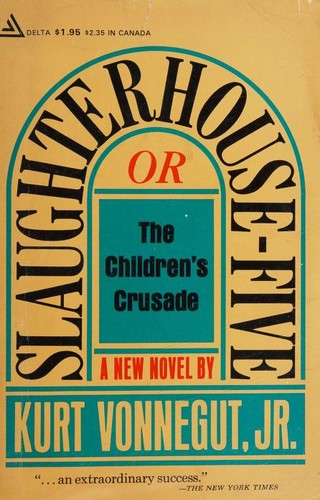
I have read this book four times and I still can’t tell you what it’s “about” in a sentence, which I think is the whole point. It’s an anti-war novel where the war is barely the plot. It’s science fiction where the aliens might be a nervous breakdown. It’s short, it’s slippery, and every time I get to the end I sit there for a second doing nothing. Not many books do that to me anymore.
| Author | Kurt Vonnegut |
| Published | 1969 |
| Genre | Anti-war satire / science fiction / whatever Vonnegut felt like |
| Format | Standalone novel, roughly 275 pages depending on your edition |
| Reception | A modern classic, taught everywhere, also one of the most challenged and banned books in America |
| Our rating | 4.5/5 |
| Read it if | You want a war book that refuses to make war look meaningful |
| Skip it if | You need a straight timeline and characters who grow and learn a lesson |
A guy comes unstuck in time, and Vonnegut just lets him
Here’s the setup, and I promise the weirdness is the good part. Billy Pilgrim is a soft, blinky optometrist from Ilium, New York, who survived the firebombing of Dresden in World War II as a prisoner of war. Except Billy has “come unstuck in time,” which means he ping-pongs through his own life with no warning. One paragraph he’s a POW freezing in a boxcar, the next he’s middle-aged and bored at his own anniversary party, the next he’s on the planet Tralfamadore where he lives in a zoo and gets mated with a movie star. He doesn’t control any of it. Neither do you.
And the thing that makes it work, the thing a lesser writer would have botched, is that Vonnegut never explains it. Billy just moves. You get whiplash on purpose. Every time somebody dies in the book, and a lot of somebodies die, the narrator says “So it goes.” That’s it. A bird gets shot: so it goes. A hundred thousand people burn in Dresden: so it goes. The first few times it reads like a shrug. By the fiftieth time it’s the saddest three words I’ve ever seen a writer repeat.
The real spine of it, though, is that Vonnegut was actually there. He survived Dresden in an underground meat locker, Slaughterhouse Number Five, which is where the title comes from. The whole first chapter is him, Kurt, telling you he’s been trying to write this Dresden book for twenty years and can’t, because there’s nothing intelligent to say about a massacre. Then he writes it anyway, sideways, through Billy and the aliens, because straight-on was impossible. That framing is the key to the whole thing.
The aliens are a gamble, and I go back and forth on whether it pays off
Look, I’ll be honest about the part that some readers bounce off, because I bounce off it a little too. The Tralfamadorians, the little plunger-shaped aliens who see all of time at once and believe every moment always exists, are either the most profound thing in the book or a cop-out, and I genuinely change my mind depending on my mood. Their whole philosophy is: ignore the bad moments, look at the good ones, nothing can be changed anyway, so it goes. On a bad day I read that as Vonnegut handing his traumatized narrator a comforting lie and calling it wisdom. On a good day I read it as the exact opposite, as Vonnegut showing you the seductive thing a broken mind reaches for, and quietly not buying it.
That tension is the argument I keep having with this book. Is Billy enlightened, or is Billy dissociating so hard he invented a planet? The novel never tells you. And I think my frustration is actually me wanting a cleaner answer than war deserves to give me. That’s on me, not on Kurt.
What absolutely works, no argument, is the Dresden material itself, precisely because Vonnegut refuses to make it a big cinematic setpiece. The bombing happens almost offstage. What you get instead are these small, unbearable images: the prisoners coming up out of the meat locker to find a city turned to “the surface of the moon,” and being marched out to dig corpses out of the rubble. There’s a moment near the end with a minor character named Edgar Derby, a decent middle-aged schoolteacher who survives the entire firebombing and then gets executed by a firing squad for taking a teapot from the ruins. A teapot. That is the entire absurdity of war compressed into one stupid, tiny object, and Vonnegut throws it away in a couple of sentences because building it up would be a lie about how death actually works.
Tangent, bear with me. The first time I read this I was nineteen and I thought it was a funny sci-fi book with a sad streak. I read it on a bus, half paying attention, and the aliens delighted me and the war stuff kind of washed over me. The last time I read it I was in my thirties and I had to put it down twice, and the aliens made me nervous instead of happy, and the war stuff was the only part that felt real. Same words. Same 275 pages. Totally different book. I don’t know a better argument for rereading things than that.
Is it flawless? No. Billy is deliberately passive, a piece of driftwood the plot happens to, and if you need a protagonist who wants something and chases it, you will find him maddening. Some of the Kilgore Trout science-fiction digressions feel like Vonnegut clearing his throat, funny but slack. And a couple of the Tralfamadore chapters, especially the zoo, tip into cute in a way that undercuts the grief around them. It’s a messy book. But I’ve come to think the mess is load-bearing. A tidy novel about a massacre would be an obscene novel about a massacre.
“So it goes.” He says it a hundred and some times, and it never once means the same thing twice.
About Kurt Vonnegut
Vonnegut (1922 to 2007) is the rare “important American author” who is also genuinely, mischievously funny, which is probably why so many people first read him at fifteen and never fully leave. He drew little doodles in his novels. He rated his own books with letter grades and gave this one an A-plus, which, fair. He really did live through Dresden as a POW, and he really did spend the rest of his life circling that experience, and you can feel that it cost him something. His stuff (Cat’s Cradle, Breakfast of Champions, Mother Night) tends to be short, wry, deeply humane, and allergic to pretension. He wrote like a man who had seen the worst thing and decided that jokes were a form of dignity. I trust that instinct more than almost any other in fiction.
If this one got under your skin, read these next
- Catch-22 by Joseph Heller — the other great absurdist WWII novel, funnier on the surface, just as furious underneath, and structurally just as slippery about time.
- Cat’s Cradle by Vonnegut — if you want more of this exact brain, this is his other masterpiece, about the end of the world and the comforting lies we build to survive it.
- The Things They Carried by Tim O’Brien — a different war, Vietnam, but the same trick of blurring what’s true and what’s told, and it will take the top of your head off.
- Johnny Got His Gun by Dalton Trumbo — no jokes here at all, just the rawest anti-war novel I know, for when you want the grief without the sci-fi cushion.
You can grab a copy on Amazon here if you don’t already have a beaten-up paperback of it somewhere, which honestly you probably should.
For your book club
- Do you read the Tralfamadorians as genuine aliens, or as Billy’s mind protecting itself from trauma? Does the book want you to decide?
- Why do you think Vonnegut refuses to write the firebombing itself as a big dramatic scene?
- What does the endless repetition of “so it goes” do to you by the end? Comfort, numbness, protest, or all three?
- Edgar Derby survives the massacre and is shot for taking a teapot. Why does Vonnegut give that death so few words?
- The Tralfamadorian philosophy says to ignore bad moments and only look at good ones. Is that wisdom or is it surrender, and does the novel take a side?
Where to go from here
If Vonnegut opened a door to weirder, smarter science fiction for you, keep walking through it. We put together our ultimate list of the best sci-fi books for exactly this feeling, the itch to find the next book that reorganizes your head a little. Slaughterhouse-Five is on there, obviously, but it’s got a lot of good company.