
A freshly dog-eared review
The Book That Made God the Villain and Never Apologized
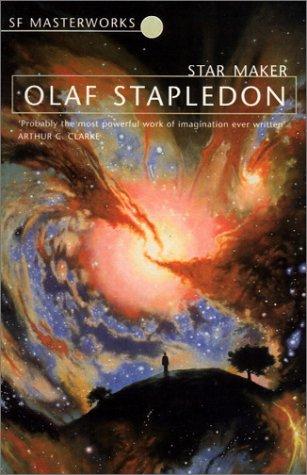
I have read a lot of ambitious science fiction and none of it, not one book, has ever made me feel as small as this one did. That is the point, and it is also the problem. Star Maker is a novel where the main character is the entire universe and the antagonist, sort of, is God. It should not work. For long stretches it barely does. And yet I think about it more than almost anything else I have ever read.
| Author | Olaf Stapledon |
| Published | 1937 |
| Genre | Philosophical / cosmic science fiction |
| Format | Standalone (loose companion to his earlier Last and First Men) |
| Reception | Revered by writers, quietly worshipped, genuinely divisive with actual readers |
| Our rating | 4/5 |
| Read it if | You want ideas over plot and don’t mind being humbled |
| Skip it if | You need characters, dialogue, or a heartbeat you can feel |
There is no hero, and the plot is: everything
Here’s the setup, and I want you to take it seriously because the book asks you to. A man walks out of his house one ordinary evening after some domestic disagreement, sits down on a hill, looks at the stars, and then leaves his body. That is it. That is the last human-scale moment in the whole book. His disembodied point of view goes flying off into space, and for the next two hundred or so pages it tours the cosmos.
He finds other worlds. He finds other minds. He merges with them, so the “I” of the narration keeps growing, first one traveler, then a small crew of souls, then something like a communal spirit made of thousands of races across billions of years. They watch civilizations rise and destroy themselves. They watch stars turn out to be alive. Eventually the assembled cosmic mind goes looking for the being that made all of it. The Star Maker.
So no, there is no protagonist in any way you would recognize. There is barely a scene. What Stapledon is actually doing is inventing an entire natural history of the universe, race by race, and narrating it like a very calm, very sad museum guide.
It sounds unbearable. Sometimes it is. Bear with me, because when it lands, nothing else is even close.
The best worst-paced book I love
Look, I will not lie to you about the reading experience. Large sections of Star Maker read like an encyclopedia entry for planets that do not exist. Stapledon will spend pages describing the sociology of a symbiotic species (fish-like creatures partnered with crab-like creatures, sharing one civilization) and there is no tension, no character, nobody to root for. It is exposition all the way down. I have started this book twice and bailed once. I am not going to pretend the failure was entirely mine.
And then. And then he gives you the Other Men, a race on a distant world whose dominant sense is taste, whose entire culture and religion and politics are built on flavor, and it is one of the strangest and most convincing pieces of alien imagining I have ever encountered. Their radio-transmitted taste-broadcasts, their flavor-based bigotry, their taste-god. It is 1937 and this man is doing worldbuilding that most modern space opera cannot touch.
The stars being conscious got me. That is the moment I put the book down on my chest and just lay there. The idea that a star is a slow, vast, living mind, that the whole galaxy is populated by beings we mistook for burning gas, and that they and the little planetary races are on opposite sides of a tragic misunderstanding. Nobody warns you that a novel about astrophysics is going to make you sad about the sun.
I read most of this on a series of grim winter train commutes, which turned out to be exactly wrong and exactly right. Wrong because you cannot skim it, and a jolting train is no place for prose this dense. Right because I would look up from a passage about a dying galaxy and see a fogged-up window and some guy asleep with his mouth open, and the contrast was almost funny. This enormous cold cosmic vision, and then: Tuesday.
Now the real criticism, the one the book’s fans do not like to admit. The characters are nothing. There are no people here. The narrator has no interiority beyond awe, the human wife he left on the hill is a device, and every “race” is a thesis wearing a costume. If you come to fiction for a human voice, for someone to love or argue with, this book will feel like reading a brilliant lecture from a professor who forgot you were in the room. And the philosophy occasionally curdles into something close to sermon.
Here is where I question my own taste. I gave this four stars. Part of me suspects I am rating the ambition and forgiving the tedium, that if a debut novelist handed me a plotless two-hundred-page tour of imaginary planets today I would not finish it. Am I grading Stapledon on a curve because he did it first, and because Olaf Stapledon influenced everyone who came after? Maybe. I have made peace with that. Some books earn a curve.
Because the ending is where it stops being a clever thought experiment and becomes something that has genuinely stayed lodged in me for years. The cosmic mind finally reaches the Star Maker. And the Star Maker is not loving. He is not cruel either. He is an artist. He regards his creation, our entire universe with all its suffering and striving, the way a mature artist regards an early work: with cold appreciation, seeing its flaws, and then he moves on to make better universes. We are a draft. We were never the point. That is the most terrifying and strangely dignified theology I have ever read in fiction, and Stapledon does not blink.
It is the only book I know that dares to imagine God as fully real and fully indifferent, and somehow makes that more moving than any comfort would have been.
About Olaf Stapledon
Stapledon was an English philosopher, not really a career novelist, and it shows in every line, for better and worse. He came to fiction late, in his forties, mostly to smuggle enormous philosophical ideas past readers who would never sit through a treatise. He was a pacifist who served as an ambulance driver in the First World War, which I think matters: a man who carried the dying does not write about cosmic scale casually. Writers revered him and general fame mostly ignored him, which feels correct. He wrote the most influential science fiction almost nobody has read. Arthur C. Clarke, Stanislaw Lem, and plenty of others treated him as a kind of secret source.
If this rearranged your sense of scale, read these next
- Last and First Men by Stapledon himself: the two-billion-year history of humanity that this book expands outward from. Same brain, same coldness, more human.
- Solaris by Stanislaw Lem: the other great novel about an intelligence too alien to talk to. It has actual characters, which helps.
- The City and the Stars by Arthur C. Clarke: Clarke openly loved Stapledon, and you can feel that vast-time-and-space awe running through it, with a plot attached.
- Blindsight by Peter Watts: if the cold indifference of the Star Maker thrilled you, this modern one goes at consciousness itself with the same nerve.
For your book club
- Does Star Maker even count as a novel, or is it something else wearing a novel’s clothes? Does the distinction matter to how you rate it?
- The Star Maker is neither good nor evil, just an artist improving his craft. Is that a more or less frightening idea of God than a cruel one?
- Stapledon gives us dozens of races but no real characters. Did that emptiness ruin the book for you, or free it to do something fiction usually cannot?
- The living stars and the planetary beings destroy each other through misunderstanding. What is Stapledon saying about how minds at different scales fail to see one another?
- Written in 1937 with fascism rising in Europe, how much of this cosmic despair reads as its moment, and how much feels timeless?
If you want to actually hold it, here it is on Amazon, ideally in an edition with a decent introduction, because you will want a hand to hold going in.
Where to go from here
Star Maker sits near the top of any serious conversation about the genre, so if you want to see where it fits and what else belongs beside it, wander through our best sci-fi books list and pick your next altitude.
I still do not know if I would recommend it to a friend without a warning label. But every time I look up at a clear night, some cold part of my brain whispers that they are awake up there, and that we were a draft, and I never quite forgive Stapledon for that, and I never stop being grateful either…