
A freshly dog-eared review
Lazlo Strange Ruined My Standards for Fictional Men
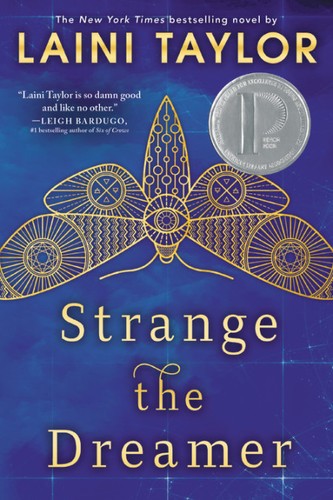
I read the first fifty pages of this book standing up in a kitchen because I couldn’t be bothered to sit down and lose momentum. That is not a normal thing I do. I am a sitter. But Laini Taylor writes prose that makes you forget your own legs, and I say that as someone who is deeply suspicious of “beautiful writing” as a selling point, because usually it means nothing happens for 400 pages. Here something happens. It just takes its sweet, luscious, occasionally maddening time.
| Author | Laini Taylor |
| Published | 2017 |
| Genre | YA fantasy / romantasy, slow-burn, mythic |
| Format | Book 1 of a duology (Muse of Nightmares is book 2) |
| Reception | Adored by the prose crowd, “too slow” to plenty of others; genuinely divisive |
| Our rating | 4.5/5 |
| Read it if | You want atmosphere, aching yearning, and a soft hero who reads |
| Skip it if | You need plot momentum by chapter three or florid prose makes you itch |
A war orphan, a lost city, and a name nobody can say right
Here’s the setup, no big spoilers. Lazlo Strange is a junior librarian, an orphan, a nobody who has spent his whole life obsessed with a mythical golden city that vanished from history. Even its true name got erased from the world’s memory, replaced by a word that just means “the absence of it.” He has nothing. He has a head full of fairy tales and a longing so big it’s almost embarrassing. And then, out of nowhere, a delegation from that impossible place rides into his city looking for help, led by a warrior god-killer called the Godslayer, and Lazlo does the most Lazlo thing imaginable: he talks his way onto the expedition because he happens to be the one person alive who studied the myth.
Meanwhile, above that lost city, there is a sky the color of blood and a citadel of blue-skinned children who survived something monstrous, and one of them, Sarai, walks through people’s dreams at night. That’s the two-hander. Dreamer below, dreamer above. You can see the collision coming from a mile off and Taylor makes you wait for it anyway, and honestly the waiting is half the point.
The prose is showing off and I forgave it (mostly)
Look, I need to be honest about the thing everyone argues about. This book is drenched. It is purple in places. Taylor never uses one image where three will do, and there are stretches, especially in the first third, where I wanted to gently put my hand on the page and say “we get it, the moth is a metaphor, keep moving.” If you bounce off ornate writing, you will bounce off this like a trampoline, and I don’t think you’re wrong to. That’s a real criticism and I’m not going to pretend the slowness is secretly a feature for everyone. For a lot of readers it is just slow.
But here’s the thing. When it works, it really works. The central romance is a dream romance, literally. Sarai and Lazlo meet in the space of sleep before they ever meet in the flesh, and it lets Taylor do something I rarely see done well: a love story built on being truly seen with no bodies in the way, no posturing, just two lonely people recognizing the same ache in each other. The yearning is the spice here. If you came for heat, know that this runs warm, not scorching. The intensity is emotional, not physical, and I found it more devastating for it.
And Lazlo. I have complicated feelings about being a grown adult who got a crush on a fictional teenage librarian, so let me reframe: what got me is that he is kind in a genre that usually equates interesting with cruel. No brooding assassin, no morally gray warlord with a body count and abandonment issues. Just a guy who reads too much and loves too hard and it turns out that is its own kind of magnetic. Every dark-romance instinct I have was fully bypassed by a boy who blushes. I did not see that coming and I question my own taste about it constantly.
I read the last hundred pages in one sitting on a delayed train, and the ending, that gut-punch cliffhanger, made me say something out loud that alarmed the man next to me. Taylor earns it. She spends 400 pages lulling you and then detonates. It’s the reason the duology exists and it’s the reason I bought Muse of Nightmares before I’d even fully processed what happened.
One tangent, because I can’t not. The mythology of the god-children, the gray horror of what happened in that citadel and why these blue kids are alive at all, is genuinely dark and morally thorny in a way the fluffy dream-romance packaging doesn’t advertise. There’s real cruelty in this world’s history, real questions about vengeance versus mercy, about whether the children of monsters owe anything to the people who fear them. That undertow is what keeps the sweetness from turning to sugar.
The best fantasy romance isn’t about a man who could destroy you. Sometimes it’s about a man who never would, and the terrifying softness of trusting that.
About Laini Taylor
Taylor came up through the Daughter of Smoke and Bone trilogy, which already told everyone she was going to write about impossible cities and doomed love and beauty stitched together with horror. She has bright pink hair, a background in art, and a very obvious refusal to write small. She is not a writer for people who want lean. She’s a maximalist, a world-builder who cares more about a single perfect sensory image than about pacing efficiency, and she has built a devoted readership precisely by not apologizing for that. You either sign the treaty with her sentences or you don’t. I signed.
If this wrecked you, read these next
- Daughter of Smoke and Bone by Laini Taylor. Same author, same lush ache, more forward momentum if the slowness here frustrated you.
- The Night Circus by Erin Morgenstern. If you fell for the atmosphere over the plot, this is your next drug. Dreamy, slow, gorgeous, barely a story and proud of it.
- A Study in Drowning by Ava Reid. Bookish outsider heroine, misty melancholy, a romance built on the mind first.
- Uprooted by Naomi Novik. Denser, thornier, but that same fairy-tale-turned-dangerous texture.
You can grab Strange the Dreamer on Amazon here if you want to see whether you sign the treaty too.
For your book club
- Lazlo is kind where the genre usually rewards cruelty. Did that make him more romantic to you, or less interesting? Be honest.
- The romance blooms entirely inside dreams before the characters meet in reality. Does a love built on that foundation feel true, or too easy?
- The god-children are the descendants of monsters. What does the book seem to believe about inherited guilt and whether mercy is owed?
- Taylor’s prose is famously lavish. Did the style pull you deeper or hold you at arm’s length, and where exactly did that flip for you?
- That final twist recontextualizes the whole book. Did it feel earned, or like a cliffhanger designed to sell the sequel?
Where to wander next
If mythic, aching, slow-burn romantasy is your poison, I’ve got a whole stack of it waiting on our romance and romantasy shelf. Go get lost.
I keep thinking about that kitchen. Standing there. Not sitting down. Some books just don’t let you…