
A freshly dog-eared review
Steampunk Gremlins, Golden Killers, and a World I Didn’t Trust Yet
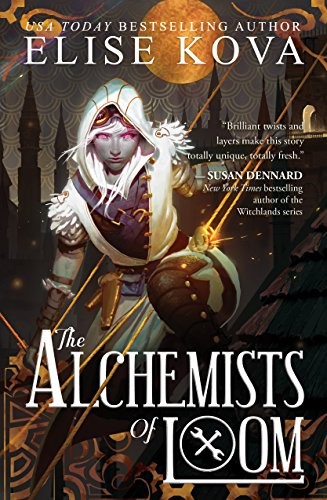
Here’s the thing about this book: it handed me one of the most electric character introductions I’ve read in ages, and then spent a hundred pages making me work harder than I wanted to just to stay oriented. I loved it and I side-eyed it, sometimes in the same chapter. That tension is basically the whole experience, and I think it’s why nobody I know agrees on this one.
| Author | Elise Kova |
| Published | 2017 (Keymaster Press) |
| Genre | Steampunk fantasy, enemies-to-lovers, dragons vs. machines |
| Format | Book one of the Loom Saga trilogy (complete) |
| Reception | Well liked but genuinely divisive; a steady mid-3s to low-4s on Goodreads, adored by some, bounced off by others |
| Our rating | 3.5/5 |
| Read it if | You want a fierce heroine, a golden assassin, and a world with actual gears in it |
| Skip it if | You need your worldbuilding spoon-fed and your pacing smooth from page one |
Two continents, one very angry mechanic, and a killer made of gold
Let me set the table without wrecking anything for you. The world of Loom has been conquered by the world of Nova. Loom runs on machines, wrenches, ingenuity, grease under the fingernails. Nova runs on Dragons, who are not scaly lizards but arrogant magic-users with scales in their blood and a nasty habit of treating Loom like a colony to be strip-mined. Our girl is Arianna, a Rivet (read: brilliant engineer and general chaos agent) with a past that keeps trying to catch up to her. She gets pulled into a plan to strike back at the Dragon King, and to do it she has to babysit a naive young inventor named Cvareh who is, awkwardly, one of the Dragons she’d normally love to gut.
And then there’s Florence. Sweet, deadly Florence. A Harmony (someone who works with powder and firearms) who I would walk into traffic for.
The setup is a heist-ish, chase-ish, road-trip-ish thing stacked on top of a bigger rebellion, and Kova clearly loves the machinery of it all, both literal and plot-wise. When it clicks, it really moves.
The good, the grinding gears, and the one intro I still think about
I read this on a delayed flight, the kind where they keep pushing the boarding time back in fifteen-minute insults, and I remember the exact moment the book grabbed me because I looked up expecting to have missed an announcement and forty minutes had just vanished. That was the golden-blood assassin sequence early on, the White Wraith stuff, the version of Arianna that moves through a job like she’s the only person who’s ever understood physics. Kova writes competence-as-charisma better than almost anyone working this lane. When Ari is on the page being terrifyingly good at her job, the book is genuinely thrilling.
Florence and Arianna’s relationship is the real heart here, and I’ll die on that hill. It’s mentor and protege and found-family and something fiercely protective all at once, and it’s more convincing than the romance the marketing wants you to buy. Speaking of which: the Cvareh and Arianna enemies-to-lovers thread is fine. It’s fine! But it’s a slow burn that occasionally reads as “two people who haven’t been given enough scenes alone to earn the heat yet.” Book one plants it more than it delivers it. Your patience may vary.
Now the part I promised I’d be honest about. The opening third of this book is a workout. Kova throws you into Loom’s vocabulary (Rivets, Harmonies, Rasters, Chimera, Fenthri, the whole guild-caste apparatus) with very little hand-holding, and I spent a good stretch feeling like I’d walked into the middle of a conversation between people who’d known each other for years. Some readers find that immersive. I found it, at first, genuinely alienating, and I don’t think it’s snobbery to say a book should trust its worldbuilding enough to let a newcomer breathe. Once the pieces snapped into place (and they do), it was worth it. But I understand every single one-star reviewer who tapped out at the 20% mark, because for about ninety pages I was one wrong mood away from being them.
Quick tangent, bear with me. The magic system here runs partly on harvested body parts from the Dragons, organs that grant abilities, and it’s grisly in a way I did not expect from the pastel-ish cover I was staring at. There’s a body-horror streak running under the steampunk gloss that I actually loved, because it gives the “machines vs. magic” theme real teeth. Loom doesn’t just resent Nova. Loom takes Nova apart and uses the pieces. That’s a nasty, brilliant image and it does more thematic work than a dozen speeches about oppression could.
Do I trust my own read on this? A little, no. I bumped it up half a star after I sat with it, because the stuff that annoyed me in week one (the density, the cold open into jargon) is exactly the stuff other people list as the reason they adore it. I might just have wanted an easier book that day. The plane was late. I was cranky.
A world that files its heroes down into tools and then acts surprised when the tools learn to cut back.
The other honest ding: the pacing sags in the middle stretch of the journey, and a couple of the setpiece action scenes are choreographed so tightly that I lost the geography of who was where. But the last act pays off the setup with real momentum, and the final pages made me actually order book two, which is the only proof of a first-in-series that counts.
About Elise Kova
Kova is one of those authors who came up fast and prolific, a self-publishing and hybrid success story who writes across YA and adult fantasy and romance like she’s allergic to being pinned down. She’s best known to a lot of readers for her Air Awakens series, and she has that specific energy of an author who is deeply, unapologetically online with her readers, runs her career like a small business, and clearly writes the books she personally wants to read. You can feel that ownership in Loom. It’s a weird, specific, uncompromising world, and it does not read like it was designed by committee to chase a trend. I respect that even in the chapters that frustrated me.
If this one got its hooks in you, read these next
- The Air Awakens series by Elise Kova, if you liked her voice but want an easier on-ramp and a more front-loaded romance.
- The Burning God / The Poppy War by R. F. Kuang, if the body-horror and colonized-world anger was the part that lit you up and you want it turned all the way to eleven.
- Six of Crows by Leigh Bardugo, if what you really wanted was the heist-crew, competence-porn, ragtag-team dynamic that Ari and Florence hint at.
- The Gilded Wolves by Roshani Chokshi, for another lushly-built, jargon-forward world where the setting is basically a character.
And if you want to grab it, here it is on Amazon. Fair warning again: give it a hundred pages before you decide.
For your book club
- Loom harvests power from the bodies of its oppressors. Is that righteous resistance, horror, or both, and does the book want you to be comfortable with it?
- Arianna and Florence versus Arianna and Cvareh: which relationship did the book actually earn by the last page, and which one is it just promising?
- Did the dense, jargon-heavy opening pull you in or push you out, and does an author owe a newcomer an easier door?
- The Dragons are conquerors but Cvareh is sympathetic. How does the book handle the individual-versus-system tension, and does it let anyone off too easy?
- Arianna’s competence is a huge part of her appeal. Is a hero who is the best at everything more fun or less interesting, and where’s your personal line?
Where to wander next
If gears, blood-magic, and worlds that fight over what technology even means are your thing, you’ll find a whole shelf of neighbors on our best sci-fi books list, where the line between magic and machine gets blurry in all the right ways…