
A freshly dog-eared review
The Fairy Tale That Wants to Eat You Alive
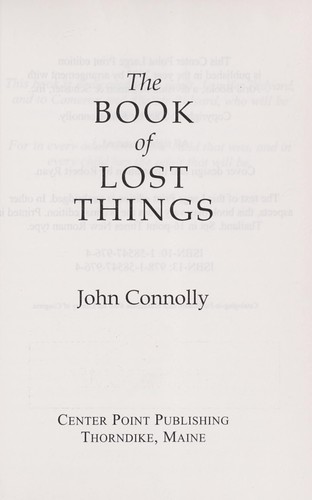
I read this book during a week I was sleeping badly, and I do not recommend that combination unless you want to lie awake at 2 a.m. thinking about a woodsman with an axe and a boy who won’t stop grieving. This is a fairy tale in the oldest, meanest sense of the word, the kind before Disney sanded off the teeth. It is also, somehow, one of the tenderest books about losing a parent I have ever read. I did not expect to cry at a scene involving a knight made of glass. I am still a little embarrassed about that.
| Author | John Connolly |
| Published | 2006 |
| Genre | Dark fantasy / literary fairy tale |
| Format | Standalone (loosely followed by a 2020 sequel, “The Land of Lost Things”) |
| Reception | Widely loved as a crossover classic, though some readers find the back half meandering and the violence more than they bargained for |
| Our rating | 4.3/5 |
| Read it if | You want Grimm’s fairy tales with the blood left in, and a grief story that actually earns its ending |
| Skip it if | You need your fantasy tidy, your violence off-page, or your child protagonists to stay children |
A Boy, a Dead Mother, and a Book That Starts Whispering
Here’s the setup, and it’s deceptively simple. David is twelve, living in London during the Blitz, and his mother has just died slowly of an illness that Connolly does not soften for anyone. His father remarries fast, a new baby arrives, and David is left with a stepmother he resents and a house that feels like someone else’s life. Grief does something to David that grief does to a lot of kids: it turns inward and gets strange. He starts hearing books talk to him. Literally. The old fairy tale collection in his room whispers, and the cracks between his world and another one start to widen, especially around a crumbling wall at the bottom of the garden.
Then his half-brother’s crib is empty one night, and David goes through the wall after him.
What’s on the other side is not Narnia. It’s not even really for children, whatever the cover art might promise you. It’s a version of Europe’s oldest stories with the moral cushioning stripped away: Little Red Riding Hood’s wolf has produced an entire lineage of wolf-men who’ve built a court and a throne. Snow White’s dwarfs are a Marxist labor collective squabbling over an obese, useless princess they can’t bring themselves to finish grieving. There’s a huntress who collects the fused, monstrous bodies of children and animals like trophies. And there’s the Crooked Man, whom I will not spoil beyond saying he is one of the better and creepier bogeymen I’ve encountered in any book, adult or otherwise, and he wants something specific from David that made my stomach drop when I finally understood what it was.
Where It Actually Lands, and Where It Wobbles
Look, the thing Connolly does best here is refuse to let the fairy tale logic protect anyone. Most books that riff on Grimm nod at the darkness and then retreat into whimsy. This one keeps walking toward the dark. David gets hurt. People he likes die, and stay dead, and it matters. The Woodsman, one of the only steady adult presences David finds, is exactly as morally complicated as an adult in a war-torn fairy realm should be, and Connolly resists making him either pure guide or secret villain. He’s just a man doing his best in an awful place, which is somehow more moving than either extreme would have been.
The prose has this fable cadence, short declarative sentences building into longer ones, and it works because it never winks at you. Connolly clearly loves the source material (the man has said in interviews he was obsessed with fairy tales as a kid recovering from his own losses) and that love shows up as respect rather than pastiche. The Loups, the wolf court, genuinely unsettled me. Not because wolves in suits is a wild concept, but because of how matter-of-fact the cruelty is once you’re inside their world. Nobody comments on how strange it is. That’s the fairy tale trick, and it works.
Here’s my real criticism, though, because I promised myself I wouldn’t just gush. The middle third sags. David goes from encounter to encounter in a way that starts to feel episodic rather than propulsive, like Connolly had a list of fairy tales he wanted to subvert and needed a boy to walk past each one. The huntress sequence is fantastic. The seven dwarfs bit is funny but tonally whiplashy, genuinely comic in a book that otherwise commits hard to dread, and it took me out of the spell for a chapter or two. I also think some readers go in expecting a children’s book because of how it’s shelved and marketed, and the violence (there is real violence, on children, described plainly) catches them off guard in a way that colors the whole reading experience sourly. That’s a fair complaint even if I don’t fully share it.
And I’ll admit something. On a second read, years later, some of the allegory felt a little more visible to me than it had the first time, grief as monster, stepmother as evil queen, the whole machinery a bit exposed under the floorboards. I don’t think that’s a flaw exactly. Fairy tales are supposed to be legible allegories. But I wonder sometimes if my first reaction was partly the ambush of a sad week meeting a sad book at exactly the right moment, and whether I’m rating the book or rating that convergence. I’ve decided I don’t actually need to untangle that to know it’s good. I just wanted to flag it.
The ending, though. The ending got me both times, and it earns its ache without resorting to a cheap twist. David has to choose what kind of story he’s going to let his life become, and the book trusts you to understand what that means without spelling it out in block letters.
Every fairy tale is a door left ajar for the thing you’re most afraid of, and also, somehow, for the thing you need.
About John Connolly
Connolly is an Irish writer best known for the long-running Charlie Parker crime series, so this book is a bit of an outlier on his shelf, though maybe not as much as it first appears. He’s always been a writer who lets darkness sit in the room rather than clearing it out for the reader’s comfort, and “The Book of Lost Things” reads like the fairy tale he needed to get out of his system, drawn partly from his own childhood grief and his lifelong appetite for the Brothers Grimm in their original, uncleaned form. He’s funny and self-deprecating in interviews in a way that doesn’t show up much in his fiction, which tends to be serious even when it’s playful.
If This Wrecked You, Read These Next
“Uprooted” by Naomi Novik, for another fairy tale that takes its horror seriously without losing its heart. “Boy, Snow, Bird” by Helen Oyeyemi, if you want the Snow White bones picked apart with literary precision. “Bird Box” by Josh Malerman for a different flavor of dread wrapped around a parent-child bond. And if you want more Connolly darkness with none of the fairy tale trappings, the early Charlie Parker novels, starting with “Every Dead Thing,” will show you the same unflinching instinct aimed at crime fiction instead.
For your book club
- David’s grief manifests as literal monsters. Which character or creature do you think represents which part of his grief, and did that mapping feel earned or too neat?
- The book strips the comfort out of familiar fairy tales. Which retelling unsettled you the most, and why do you think Connolly chose that story to subvert?
- The Woodsman refuses to be simply good or simply compromised. Do you think that ambiguity strengthens the book’s themes, or did you want a clearer moral center?
- How did the violence toward children in this book sit with you, especially given how it’s often shelved as YA or crossover fiction?
- What do you make of the ending David chooses. Is it a triumph, a resignation, or something else entirely?
Still thinking about it too?
If this one got under your skin the way it got under mine, you can grab a copy here on Amazon and see for yourself, or go dig through more of our book reviews for something equally hard to shake.