
A freshly dog-eared review
Clarke Built a Perfect City and Then Got Bored of It
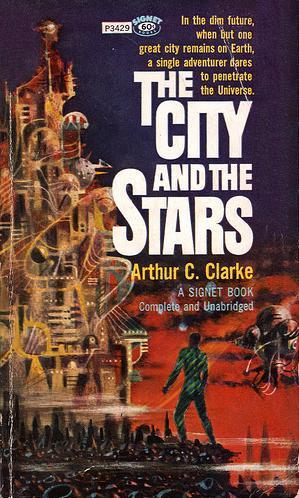
I have read a lot of sci-fi that is smarter than its characters, but this is the book that made me realize I don’t always mind. Clarke gives me a billion-year-old city run by a machine, a boy who is the first genuinely new person born there in forever, and roughly one and a half emotions total. And somehow I finished it stunned. Here’s the thing: nobody comes to Clarke for the people. You come for the size of the idea, and this one is the size of the sky.
| Author | Arthur C. Clarke |
| Published | 1956 (a rewrite of his 1948 novella Against the Fall of Night) |
| Genre | Far-future science fiction, closer to cosmic fable than space opera |
| Format | Standalone, one book |
| Reception | A quiet Clarke classic; adored by hard-SF and Big Dumb Object people, considered cold and plotless by others |
| Our rating | 4/5 |
| Read it if | You want awe over character, and you like the feeling of a curtain being pulled back on the whole universe |
| Skip it if | You need a protagonist with an interior life, or you bounce off books where nobody really changes |
A boy, a city that never dies, and one very locked door
The setup is one of my favorites in all of old science fiction, and I will die on this. Billions of years from now there is a city called Diaspar. It is the last city on Earth, sealed off, self-repairing, running on machines so old their makers are myth. Nobody is born here in the way you and I understand it. People are stored as patterns in the city’s memory and cycled back into physical bodies for a while, live for a thousand years or so, then dissolve back into the archive to wait their next turn. It is immortality by filing cabinet. And it works so well that everyone in Diaspar is terrified of the outside. They believe the desert beyond the walls is death, that the stars were a place humanity got beaten so badly it crawled home and locked the door.
Into this comes Alvin. He is a Unique, which means he has no past lives in the archive. He is the first brand new human in the city in god knows how long. And Alvin has the one trait Diaspar spent a billion years engineering out of people: he wants to know what is outside.
That is the whole engine. A restless kid in a paradise built specifically to have no restlessness in it. Clarke does not overcomplicate it and honestly I respect that.
What it does that almost nothing else does, and where it left me cold
Look, the thing Clarke is genuinely great at is the reveal. Not the twist, the reveal. The slow pull-back where you learn the world is bigger and stranger and older than you thought, and then bigger again. When Alvin finally gets out of Diaspar (I won’t say how, it is a lovely bit of problem-solving) and finds Lys, the other surviving human community, the whole book tilts. Lys is everything Diaspar isn’t: pastoral, telepathic, mortal, warm, small. Two halves of humanity that each decided the other half’s survival strategy was cowardice. That contrast is the best idea in the book and Clarke knows it.
And then it gets bigger again. There is a sequence with a machine called the Central Computer, and a stretch where Alvin goes looking for the truth behind the myth that scared everyone into hiding, and the scale just detonates. We are talking about the actual history of galactic civilization, why the stars emptied out, what humanity was really running from. I read the last third of this in one sitting on a couch at 1am with a cold cup of tea I forgot about, and I remember the specific feeling of the room getting quieter around me as the map of the story kept expanding. That is the Clarke drug. When it hits, nothing else hits like it.
Now the part I have to be honest about. The people are cardboard. Alvin is curious and stubborn and that is more or less his entire character sheet. His sort-of friend Khedron the Jester, who exists in Diaspar as a deliberately built agent of chaos, is a fascinating concept and a flat person. There is a romance-adjacent thread with a woman from Lys named Alystra that has all the heat of a lukewarm bath. Clarke writes emotion the way I write French: technically correct, no music. Characters announce feelings rather than having them. Nobody argues in a way that feels like two real people who want different things; they exchange positions.
And I will question my own taste here, because I gave this a 4 and I have handed lower scores to books with far better characters. Am I grading Clarke on a curve because the ideas are so good? Maybe. Probably. If a debut author handed me this today with this dialogue I might be meaner about it. But there is a specific pleasure this book delivers that better-written novels often can’t, and I am not going to pretend I didn’t feel it just to look like a tougher critic.
Small tangent. The reason this book reads oddly smooth compared to a lot of 1950s SF is that it is Clarke rewriting his own younger self. Against the Fall of Night came first, in the forties, and he was never satisfied with it, so he rebuilt the whole thing bigger and cleaner as The City and the Stars. You can feel that. It has the confidence of a guy who already made the mistakes once and came back to do it right. It is the least clumsy old-Clarke I have read.
The prose itself is plain, almost bare, and I mean that as praise. He does not decorate. When he wants you to feel the age of Diaspar he just tells you the machines have been running so long that the concept of them stopping is unthinkable, and somehow that flatness makes it land harder. He is describing eternity in an accountant’s voice and it works.
The real subject here isn’t the far future. It’s the choice between a safe forever behind walls and a terrifying, mortal, open sky, and Clarke is not subtle about which one he thinks is worth dying for.
About Arthur C. Clarke
Clarke (1917 to 2008) was the one of the big three midcentury SF writers who actually sounded like an engineer, because he basically was one. He wrote a paper proposing geostationary communication satellites years before anyone launched one, which is the kind of flex most novelists don’t get. He is most famous for 2001: A Space Odyssey and Rendezvous with Rama, and if you have noticed a pattern, yes, his signature move is the vast mysterious object that dwarfs the humans crawling around inside it. He spent most of his life in Sri Lanka, loved the ocean and diving almost as much as space, and had a lifelong faith that the universe was fundamentally knowable and mostly indifferent to us. His books feel like that faith. Cold, clear, and weirdly comforting.
If this cracked something open, read these next
- Rendezvous with Rama by Clarke. Same DNA, more disciplined. A giant alien ship enters the solar system and humans get one shot to explore it. Peak Big Object Clarke.
- The Last Question by Isaac Asimov. A short story, not a novel, but it does the entropy-and-eternity thing this book gestures at, and does it in a handful of pages that will stay with me forever.
- Nightfall by Asimov (the story, or the later novel). Another one about a civilization built on a terror of what’s outside, and what happens when the lights finally go out.
- The Dying Earth by Jack Vance. If you want the far-future-Earth-as-myth vibe but with gorgeous, sly, wicked prose and actual personalities. The stylistic opposite of Clarke, same time zone.
For your book club
- Diaspar’s people are functionally immortal but stopped being curious. Is that a fair price? Would you take the deal?
- Diaspar (walled, deathless, fearful) versus Lys (open, mortal, telepathic). Which one is actually more human, and why did we split into both?
- Alvin never really changes as a person; the world changes around him. Does that make him a bad protagonist, or is he more of a lens than a character?
- The whole city was engineered to feel no urge to leave. How much of your own comfort is architecture someone built to keep you in place?
- Clarke rewrote this book decades after the first version. If you had one novel you’d published young, would you rebuild it or leave it alone?
Want the whole sky?
If the scale of this one got its hooks in you, I put together everything I think is worth your time over on our best sci-fi books list, from the cosmic-awe stuff like this to the weird, human, messy corners of the genre. And if you just want to grab this one, here it is on Amazon. Read the last third at night. Trust me on the tea.
I keep thinking about that locked door. A whole species deciding the stars weren’t worth it, building a perfect box, and then producing exactly one kid who couldn’t stop looking up…