
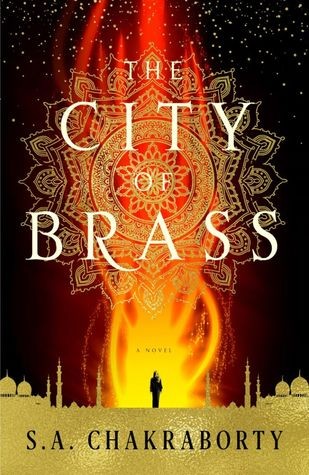
The City of Brass Review: Djinn Politics and a Heroine Who Bluffs for a Living
Nahri survives Cairo by telling wealthy people exactly the lie they want to buy. Then she accidentally summons a djinn and discovers that the magical world is full of older, richer liars. That is when The City of Brass hooked me. The names, factions, and inherited grudges arrive fast enough to require attention, and the middle occasionally sinks under them. Still, I will take this quarrelsome, politically compromised city over another polished fantasy capital built only to hold a throne room.
| Author | S.A. Chakraborty |
| Published | 2017 |
| Genre | Adult epic / historical fantasy |
| Format | Book 1 of the Daevabad Trilogy |
| Best for | Readers who want dense worldbuilding, court politics, and morally grey everyone |
| Our rating | 4/5 |
Where it came from, and why it mattered
Chakraborty famously started the Daevabad world as historical fan fiction, and you can feel that lineage in the best way: a writer messing around in a period she loves until the messing-around turned into something enormous. The novel opens in eighteenth-century Cairo, where a young con artist named Nahri fleeces Ottoman nobles with fake exorcisms: until one of her cons accidentally summons Dara, a scarred, ill-tempered djinn warrior who informs her that the magical heritage she’s been faking is, inconveniently, real. From there the story pulls her toward Daevabad, the hidden brass-walled city of the djinn, and into a centuries-old grudge match she never asked to inherit.
Its arrival was part of a genuine shift in commercial fantasy: a wave of writers drawing on the mythologies and histories the genre had spent a century ignoring. What separates The City of Brass from the “diverse setting as set dressing” crowd is that the culture isn’t a coat of paint. The theological fault lines, the six competing tribes, the fraught history between full-blooded daeva and the mixed-blood shafit. These aren’t flavor, they’re the actual engine of the plot.
The honest assessment
Let’s start with what’s genuinely great. The worldbuilding is the headline, and it deserves the billing. Daevabad is dense with history, faction, and grievance, and Chakraborty refuses to flatten any of it into a tidy good-versus-evil chart. The central conflict (purebloods lording power over the half-human shafit) is treated as a live moral problem rather than a lesson, and the book is smart enough to let sympathetic characters hold ugly opinions. That’s rare, and it’s the thing that lifts this above competent debut into memorable one.
Now the honest part. This book is dense, and it does not hold your hand. The first hundred pages throw tribes, titles, and untranslated vocabulary at you faster than most readers can file them, and there’s a real learning curve before the geography of Daevabad clicks into place. The two point-of-view threads are also unequal: Nahri’s chapters crackle, but Prince Ali (the earnest, faith-driven second son of the ruling family) is the more divisive figure. Some readers find him the moral heart of the book; others find him a lecture that keeps interrupting the fun. Both camps have a point.
The most-debated element, though, is Dara. He is written as magnetic, ancient, and dangerous, and the narrative frames him as a romantic lead, while also making it fairly clear he has done monstrous things. Depending on your tolerance, that’s either the book’s boldest move (a love interest you’re not supposed to fully trust) or its blind spot (a genocidal warrior handed a lot of swoony lighting). I lean toward the former, but I understand the reader who slams the book shut. This is not a comfort read dressed up in gold leaf.
Chakraborty’s real subject isn’t magic at all. It’s inheritance: the way a city can hand you its oldest hatreds along with its throne, and call it a birthright.
The reading experience
Once it grips, it grips. The middle third (Nahri navigating the poisonous etiquette of the royal court while old loyalties tighten around her) is court intrigue at its most propulsive, and the climax escalates hard enough that finishing without the sequel on hand feels like a small act of self-harm. Be warned that this is unmistakably book one of three; it ends on a genuine cliffhanger rather than a clean resolution. If you like your fantasy to conclude, know what you’re signing up for. If you like your fantasy to continue, the good news is the trilogy sticks the landing better than most.
Who should read it, and what to read next
Read this if you want maximalist, politically thorny epic fantasy and you don’t mind doing some cognitive lifting early. Skip it if you want breezy pacing, a standalone, or a hero you can root for without reservations. Fans of N.K. Jemisin’s layered worldbuilding or the moral murk of Robin Hobb will feel at home here; readers who loved the folklore-forward feel should look toward Shannon Chakraborty’s later Amina al-Sirafi (same author, new pen surname) or the Silk-Road textures of works like The Bird King.
Want a copy? Check the latest price on Amazon.
Keep exploring the genre
If Daevabad whets your appetite for world-first fantasy, we’ve mapped the whole landscape (old giants and modern conjurers alike) in our full 60 best fantasy novels list, a good place to find your next obsession once the trilogy has you spoiled for ordinary worlds.