
A freshly dog-eared review
Terry Pratchett Before He Figured Out Discworld
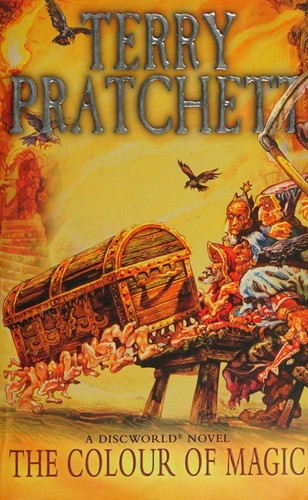
Here’s a thing almost no Discworld fan will tell you at a party but every single one believes: The Colour of Magic is not very good. I say that as someone who has read most of the series twice. It is scrappy, it is uneven, it reads like a man doing brilliant impressions of himself before he became himself. And I still grin like an idiot every time I open it.
| Author | Terry Pratchett |
| Published | 1983 |
| Genre | Comic fantasy, satire |
| Format | Book 1 of Discworld (41 novels) |
| Reception | Beloved series, but this specific book is widely called its weakest opening; fans routinely tell newcomers to start elsewhere |
| Our rating | 3.5/5 |
| Read it if | You want to watch a genius warming up, or you’re a completist who needs to start at book one |
| Skip it if | This is your first Pratchett and you want to know why people are obsessed. Start with Guards! Guards! or Mort instead |
A tourist, a coward, and a box with teeth walk onto a flat world
The setup is gorgeous nonsense. The Discworld is a flat disc balanced on the backs of four elephants who themselves stand on the shell of a giant turtle, Great A’Tuin, swimming through space. Pratchett states this with a completely straight face and then never once winks about it, which is the whole trick.
Into the twin city of Ankh-Morpork arrives Twoflower, the Disc’s first tourist. He has a camera (a small box with a tiny demon inside who paints the pictures), he has an alarming amount of gold, and he has absolutely no sense of danger because he genuinely believes people are lovely. Attached to him, mostly against his will, is Rincewind: a failed wizard who knows exactly one spell (that he’s too scared to say), who runs from everything, and who is arguably the most sensible person in the entire book.
And then there’s the Luggage. A travel chest made of sapient pearwood that walks on hundreds of little legs, follows Twoflower with doglike devotion, and eats anyone who threatens him. The Luggage is the best character Pratchett invented this early and he knew it, because it outlives its own book by decades.
The plot, such as it is, is these three lurching from one peril to the next. That’s the thing I have to be honest about.
Four short stories in a trench coat pretending to be a novel
Look, this book has a structural problem, and it’s not a small one. The Colour of Magic is really four loosely stitched novellas: the Ankh-Morpork arrival, a parody of Fritz Leiber’s sword-and-sorcery, a temple-and-dragon riff, and a bit at the literal edge of the world. Every time you settle into one, it ends and a new one starts, and the momentum resets to zero. The book doesn’t build. It just keeps beginning.
The second section, the dragon one, is where I personally start checking how many pages are left. The Wyrmberg stuff, with dragons that only exist while someone imagines them hard enough, is a clever idea that goes on about forty percent too long. Early Pratchett hadn’t yet learned that a good gag needs to get out of the room before people stop laughing.
So why do I keep this thing on my shelf at eye level?
Because the jokes that land, land like a piano. The opening pages, where the two most feared swordsmen in the city watch Ankh-Morpork start to burn and one of them just wants to know if the other person is going to finish their drink, is the funniest cold open in fantasy. The Broken Drum tavern (later the Mended Drum, after it burns down, which is exactly the kind of throwaway logic that makes me happy) is introduced with a single line about it being the kind of place where the bouncers throw people in. And Death shows up, not as a metaphor, as a working character with a scythe and a job and a growing personal grudge against Rincewind for repeatedly failing to die on schedule. Death being annoyed is a bit Pratchett would spend the next thirty years perfecting, and you can see the very first spark of it here.
I found my copy in one of those tiny secondhand shops in York, the kind with a cat and no room to turn around, and I remember the woman at the till telling me, unprompted, “start with a different one, love.” I ignored her. I read it on the train home in one go and I understood exactly what she meant by the time we hit Doncaster. It’s a debut. It has debut written all over it. The prose is busier than his later stuff, the footnotes try slightly too hard, the parody assumes you’ve read a lot of 1970s fantasy that most people now haven’t.
And here’s where I question myself, because maybe I’m being unfair. Maybe I only think it’s messy because I’ve read Reaper Man and Small Gods and I’m judging a 1983 first novel against a man at the absolute peak of his powers. That’s not really a fair fight. If this were the only Pratchett book that existed, I might call it a scrappy, inventive, genuinely funny little oddity and rate it higher. It’s the shadow of what came after that makes it look thin. That’s a compliment disguised as a criticism, which is a very Discworld thing to be.
What I can say without hedging: the imagination is already total. The turtle, the tourist, the sentient Luggage, a city so corrupt it’s basically a functioning ecosystem of crime. Nobody else was building worlds like this in the comedy aisle. He just hadn’t figured out how to steer one yet.
This is Pratchett sketching in pencil what he’d later paint in oils. Worth seeing the pencil lines, if only to know they were always there.
About Terry Pratchett
Terry Pratchett (1948 to 2015) was a former journalist and press officer for the nuclear power industry, which explains a lot about how comfortable he was staring directly at absurdity. He wrote Discworld for over thirty years and turned what started as a genre spoof into one of the sharpest ongoing commentaries on power, belief, bureaucracy, and human decency in modern fiction. He was diagnosed with early-onset Alzheimer’s in 2007, wrote openly and furiously about it, campaigned for the right to die, and kept producing books nearly to the end. He was knighted, and being Pratchett, he forged himself a sword out of meteoric iron to mark the occasion. There is no more Pratchett line than that in his entire life.
If this one didn’t grab you, go here next
- Guards! Guards! by Terry Pratchett The best true entry point. Actual plot, actual characters you’ll die for, and the moment the series becomes The Series.
- Mort by Terry Pratchett Death takes an apprentice. Funny and quietly devastating, and it’s where a lot of longtime fans say they fell in love.
- Good Omens by Terry Pratchett and Neil Gaiman The apocalypse as a buddy comedy. If you want Pratchett’s voice with a co-pilot, this is it.
- The Hitchhiker’s Guide to the Galaxy by Douglas Adams The obvious cousin. Same species of cosmic shrug, pointed at space instead of a turtle.
You can grab a copy over on Amazon here if you want to see the pencil sketch for yourself.
For your book club
- Does it matter that the book is really four stories stitched together, or did the loose structure work for you? Would a tighter plot have made it more or less fun?
- Rincewind is a coward who survives by running. Is that a refreshing hero, or does it keep you from caring what happens to him?
- The Luggage has no dialogue and arguably more personality than the humans. How did Pratchett pull that off?
- If this were the only Discworld book you’d read, would you seek out more? Be honest.
- Where do you draw the line between a book being “dated” and a book being “of its time”? Which side does this land on for you, and why?
Want the world beyond the turtle?
If flat worlds on the backs of elephants got your brain going, we pulled together everything else worth reading in our best sci-fi books list. Fair warning, you’ll leave with a longer to-read pile than you came with.