
A freshly dog-eared review
Green Monsters, Blind Britain, and One Very Lucky Eye Bandage
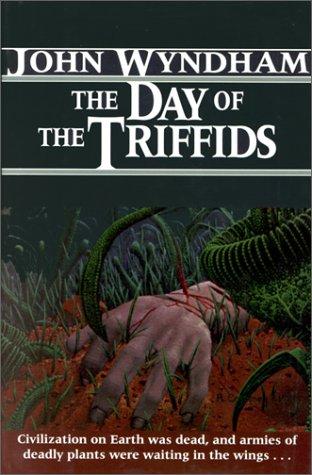
Here’s the thing about killer plants: on paper it sounds like a Saturday matinee you’d fall asleep during. Man-eating shrubbery. Come on. But I read the first chapter of this on a train with a migraine coming on, eyes half shut against the window, and by the time Bill Masen takes his bandage off in a silent hospital I had genuinely forgotten I felt sick. That’s the trick of this book. The monsters are almost beside the point.
| Author | John Wyndham |
| Published | 1951 |
| Genre | Post-apocalyptic science fiction, cozy catastrophe |
| Format | Standalone novel |
| Reception | A genuine genre landmark, beloved and endlessly reprinted, though modern readers wince at its 1950s attitudes |
| Our rating | 4/5 |
| Read it if | You want apocalypse fiction that’s more about people than explosions |
| Skip it if | You need constant action and can’t stomach dated gender politics |
A blind world and a man who kept his eyes covered
The setup is so clean it’s almost annoying. Bill Masen wakes up in a hospital bed with his eyes bandaged after an injury. The night before, the whole world stayed up to watch a spectacular meteor shower (green streaks across the sky, gorgeous, everyone out on their lawns). Bill, stuck in his bed, bitterly missed it. And that’s the whole engine of the plot: the one thing that saved his sight was the thing he was resenting. He wakes up, nobody comes, the ward is too quiet, and he eventually pulls the bandages off himself to find that nearly everyone on Earth has gone blind overnight.
That’s it. That’s the disaster. Wyndham lets the meteor shower do the killing before the book even starts.
The triffids, the tall walking carnivorous plants with a whip-sting that blinds and then kills, were already there before all this. People farmed them for their oil. Nobody worried about them much because, well, a plant can’t hunt a person with eyes. Take away the eyes and suddenly the maths change. Wyndham’s cruelty as a plotter is that he arms the apocalypse in advance and then just flips one switch.
I’ll be honest, I went in assuming the plants would be the whole show. They’re not. They stalk around the edges of the story like a slow, patient rumor. The real horror is a London where a sighted man is a resource to be fought over, and a woman standing on a windowsill because she can’t bear another day of the dark.
What works, what drags, and the bit I can’t shake
What Wyndham is astonishingly good at is the texture of collapse. Not the bang, the after. Bill walking through central London and it being wrong in tiny ways first: a man feeling his way along railings, a smell, a piano playing somewhere with nobody to hear it correctly. There’s a moment where he watches a blind man methodically rob a shop and it’s not villainous, it’s just survival, and Bill can’t decide whether to help or run. The book is full of those small moral snags. It’s less “how do we kill the plants” and much more “what do the sighted owe the blind when there’s no world left to enforce the answer.”
And then there’s Josella. I braced for the standard 1951 love interest and, look, she partly is one. But the scene where Bill finds her being kept on a leash (literally, a rope) by a blind man who has claimed her as his eyes, and the ugliness of what that arrangement implies, that lands harder than most modern thrillers manage. Wyndham doesn’t flinch from how fast civilization’s manners peel off.
Now the criticism, because there’s a real one. The middle sags. Once the immediate shock wears off, the book turns into a series of debates. Groups of survivors sit around and argue philosophy: should the sighted shackle themselves to teams of the blind out of decency, or cut loose and rebuild? It’s genuinely interesting for a while and then it becomes talky in a way that stalls the momentum stone dead. There’s a stretch in the countryside where I checked how many pages were left, which is never a good sign. Wyndham had ideas he wanted to litigate, and sometimes the novel pauses to let him.
The other thing, and I can’t pretend otherwise, is the gender stuff. The women are brave and capable, to be fair, but they’re also constantly being assigned to breeding-and-homemaking futures by very reasonable-sounding men, and the book treats this as sensible planning rather than something to interrogate. One character lays out a whole polygamous repopulation scheme with the calm of a man discussing crop rotation. It’s very 1951. Your mileage will vary on how much it grates. It grated on me and I still loved the book, which is the kind of contradiction I’ve made my peace with.
Here’s my tangent, bear with me. This book basically invented a whole British subgenre that a critic later called the “cozy catastrophe,” where the end of the world is oddly comfortable for the middle-class narrator who gets the run of an empty country. And people say that like an insult. But I think the coziness is the point and the trap. Bill gets a nice house, canned food, a partner, freedom from his job. The book keeps dangling that comfort and then reminding you it’s built on a graveyard. The triffids are the thing that won’t let him settle. They’re patient. They wait by the fence.
I question my own taste here, honestly. Is this a great novel or am I just a sucker for empty-city imagery and a well-kept English lawn gone feral? Some of both, probably. But the last image of the book, Bill and his people looking across the water at the massed triffids waiting on the mainland, planning a long war they’ll have to win generation by generation, that stayed with me for days. It’s not a victory. It’s a chore that will outlive everyone. That’s a bleaker, braver ending than the genre usually allows.
The end of the world doesn’t arrive with a bang here. It arrives because everyone looked up at something beautiful, and the one man who couldn’t got to keep his eyes.
About John Wyndham
Wyndham (full name a comically long John Wyndham Parkes Lucas Beynon Harris, which he chopped into different pen names his whole career) was an Englishman who’d been kicking around the pulps for years before this book made him. He’d served in the war, he was already middle-aged, and he had this deeply English knack for imagining catastrophe as something that happens to sensible people who’d really rather be having tea. He hated the label “science fiction” for what he did and preferred “logical fantasy,” which tells you a lot: he cared less about the gadget and more about how ordinary Brits would behave when the rules dissolved. He went on to write The Midwich Cuckoos and The Chrysalids, but Triffids is the one that stuck a flag in the ground.
If this one got under your skin, read these next
- The Chrysalids by John Wyndham — his best book, honestly, a quieter and more emotionally devastating story about mutation and intolerance in a post-nuclear farming community.
- The Death of Grass by John Christopher — the nastier, less cozy cousin, where a blight kills all grass crops and a very civilized man discovers exactly how quickly he’ll murder to feed his family.
- Station Eleven by Emily St. John Mandel — the modern inheritor of the “quiet, human, after-the-collapse” mood, if you want the emotional payoff without the 1951 attitudes.
- The Road by Cormac McCarthy — for when you want the coziness stripped out entirely and just the walking and the dread left behind.
For your book club
- Wyndham makes blindness the true catastrophe and the plants almost a footnote. Did the triffids even need to be in this book, or are they doing something the loss of sight alone couldn’t?
- The “cozy catastrophe” critique says the book makes the apocalypse too comfortable for its narrator. Fair, or is that comfort deliberately being weaponized against us?
- Several survivor groups propose wildly different moral systems (shackle the sighted to the blind, or cut loose and rebuild). Whose plan would you actually join, and does the book stack the deck toward one answer?
- How much do the book’s 1950s gender attitudes damage it for you, and can a novel be a classic and genuinely dated at the same time?
- The ending refuses a clean win and leaves Bill facing a war that will take generations. Did that feel honest or like a cop-out, and what would a “happy” ending have cost the story?
Where to go from here
If empty cities and patient monsters are your thing, you’ll want the deeper cut. Grab a copy on Amazon here, and then go get properly lost in our full list of the best sci-fi books ever written, where this one absolutely earns its spot near the front.