
A freshly dog-eared review
The Baby-Sacrifice Fantasy That Made Me Cry Over a Swamp Monster
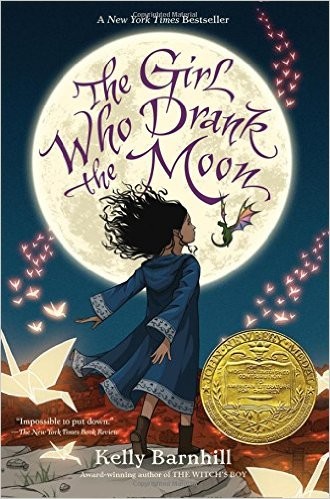
I bought this book because of the cover. I want that on record before anything else, because it feels like a confession. A girl in a rowboat, a giant winged thing curled around a moon, a whole forest holding its breath. I judged this book by its cover and for once the universe rewarded me instead of punishing me, because “The Girl Who Drank the Moon” turned out to be one of the strangest, tenderest fantasy novels I’ve read as an adult pretending it’s fine that I still read middle grade for fun.
| Author | Kelly Barnhill |
| Published | 2016 |
| Genre | Middle grade fantasy |
| Format | Standalone (companion novella “The Witch’s Guide to Magical Combat” exists in the same world) |
| Reception | Won the Newbery Medal, widely loved, though some readers find the prose overworked and the multiple POV threads slow to braid together |
| Our rating | 4/5 |
| Read it if | you want fantasy that trusts kids with grief, memory, and moral complexity instead of flattening it |
| Skip it if | you need fast plotting from page one or you find whimsical-omniscient narration precious rather than charming |
A town that sacrifices a baby every year, and nobody thinks that’s weird
Here’s the setup, and I still think it’s one of the best premises in modern fantasy. Every year, the people of the Protectorate leave their youngest baby in the forest as an offering to the witch who lives there, because if they don’t, she’ll come take one anyway. That’s the story they tell themselves. It’s the story that keeps the Elders in power and the whole miserable ritual running like a machine nobody questions.
Except there is a witch, Xan, and she’s not the monster. She’s an old woman who finds the abandoned babies every year, heartbroken that this town keeps leaving children to die, and carries them across the forest to loving families in the Free Cities, feeding them starlight to keep them alive on the way. One year, distracted and grieving, she feeds a baby moonlight by accident instead, and that baby becomes enmagicked, filled to the brim with power she doesn’t understand. Xan can’t bear to give her away, so she keeps her, names her Luna, and raises her alongside a tiny dragon named Fyrian and a swamp monster named Glerk who may be older than language itself.
Meanwhile back in the Protectorate, a young man named Antain starts asking the question nobody’s supposed to ask: what if the witch isn’t real, or isn’t evil, and we’ve been sacrificing babies for nothing. And somewhere in the shadows, a woman known as the Sorrow Eater is doing something that made my skin crawl in a way I did not expect from a book with a dragon who thinks he’s enormous and is actually the size of a cat.
What actually got me, and where I think it wobbles
Look, I need to talk about the sorrow first because it’s the engine of this whole book. Barnhill built a fantasy world around the literal weight of grief, where sorrow is a substance that can be extracted, hoarded, and fed on, and once I understood what the antagonist was doing with all that harvested grief I had to put the book down for a second. Not because it was scary in a jump-scare way. Because it was scary in a “oh no, I recognize this” way. There’s a stretch where you realize an entire town has been kept in a fog of manufactured sadness, their grief cultivated like a crop, and it reframes the whole “sacrifice a baby every year” premise into something much darker than a simple monster story.
Luna is a wonderful protagonist, her magic sealing itself away inside her until her thirteenth birthday, which gives the book a slow-burn dread. You know it’s coming. You don’t know what it’ll look like when it arrives. And when it does, thirteen years of locked-away power finally cracking open is one of the best “chosen kid comes into her power” sequences I’ve read, partly because Barnhill doesn’t let it be triumphant. It’s disorienting and a little violent, and Luna doesn’t handle it gracefully.
Now the criticism, because I promised myself I’d be honest and not just gush. The structure is a lot. Barnhill jumps between Luna and Xan in the forest, Antain and his wife in the Protectorate, the Sorrow Eater’s scheming, and a swamp monster’s philosophical musings on the nature of story itself, and for the first third of the book I kept losing the thread of who I was supposed to be worried about. My book club (yes, I brought this to book club, yes, half of them thought I’d lost it bringing a “kids book,” yes, I was right and they were wrong) had genuinely split opinions on whether the multiple threads paid off or just diluted the tension. I land on “mostly paid off,” but “mostly” is doing real work in that sentence.
And the prose. Barnhill writes in a fable-voice, omniscient and a little arch, and it’s gorgeous about seventy percent of the time and precious the other thirty. There’s a version of me that finds Glerk’s monologues about story and memory to be the emotional backbone of the book. There’s another version, tired and cranky on a Tuesday, who found some of those passages a little much, like the book didn’t trust me to feel the sadness without being told twice how sad it was.
I read most of it curled up during a rainstorm that knocked the power out in my apartment for an evening, reading by a camping lantern because of course that’s when I’d pick this book. Something about a story built on darkness and light and a woman who literally feeds children moonlight, read by actual lamplight with the electricity out, felt like the universe setting the mood on purpose. I’m aware that’s a coincidence. I choose to believe it wasn’t.
This is a book about how the stories we’re told to keep us obedient are rarely the stories that are true, and how much cruelty can hide inside “this is just how we’ve always done it.”
About Kelly Barnhill
Kelly Barnhill is a Minnesota writer who spent years teaching and working odd jobs before her fiction career took off, and you can feel that hands-in-the-dirt practicality underneath all the fairy tale gauze in her books. She’d already written a handful of well-regarded fantasy novels for kids before “The Girl Who Drank the Moon” won the Newbery Medal in 2017 and made her a much bigger name almost overnight. She writes fantasy that doesn’t condescend to children, doesn’t sand off the scary parts, and clearly believes kids can hold grief and moral ambiguity without being traumatized by it. I respect that more than I respect most adult fantasy that’s scared to let anything actually hurt.
If this wrecked you (or charmed you), read these next
Grab a copy here if you want to see for yourself, and then chase it with any of these.
- “The Girl Who Circumnavigated Fairyland in a Ship of Her Own Making” by Catherynne Valente, for that same lush, narrator-as-character fable voice.
- “Spinning Silver” by Naomi Novik, if you want the grown-up version of this same fairy-tale-logic-made-literal trick, with debt and magic as interchangeable currencies.
- “The Ogress and the Orphans” by Kelly Barnhill, her more recent one, for the same “a town believes a lie about who the monster is” setup, more pointed about modern politics.
For your book club
- The Protectorate keeps sacrificing babies because “that’s how it’s always been done.” What real-world systems does that logic remind you of?
- Xan, Glerk, and Fyrian form a strange found family in the woods. Does the book earn their bond, or did you want more time with them before the plot sped up?
- The Sorrow Eater literally feeds on grief. What do you think Barnhill is saying about who benefits when a community stays sad and afraid?
- Luna’s magic is sealed away until her thirteenth birthday. Did the slow reveal work for you, or did you want her powers unlocked sooner?
- Antain is the one person willing to ask “what if the witch isn’t evil.” What does it cost him to ask that question, and was it worth it?
Still thinking about the forest, the fog, and that swamp monster’s little speeches
Same. If you want more books that made me put my phone down and stare at a wall for a minute, go dig through more of our book reviews and find your next one.