
A freshly dog-eared review
Infinite Earths, One Nagging Problem: Nobody’s in a Hurry
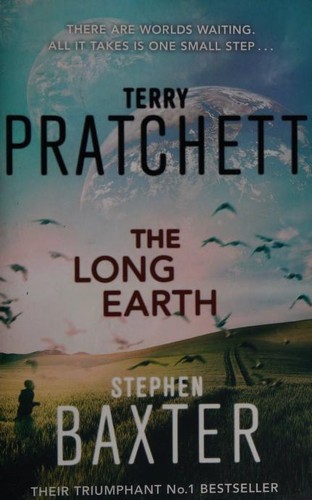
Here’s the thing about The Long Earth: it has one of the best ideas I’ve ever encountered in a science fiction novel, and it spends most of its 400 pages ambling past that idea like a man who’s already seen it and would rather talk about potatoes. I love it and I’m annoyed by it, sometimes on the same page. If you want a book that grabs you by the collar, keep walking. If you want a book that opens a door onto infinity and then makes you a cup of tea, pull up a chair.
| Author | Terry Pratchett (with Stephen Baxter) |
| Published | 2012 |
| Genre | Science fiction, parallel worlds, quiet adventure |
| Format | Book one of a five-book series (The Long Earth sequence) |
| Reception | Divisive: adored premise, frequently criticized for having almost no plot |
| Our rating | 3.5/5 |
| Read it if | You love ideas, wandering, and the sheer vertigo of “what’s over the next hill, forever” |
| Skip it if | You need tension, stakes, and characters who want something urgently |
A potato, a box, and the end of scarcity
The premise is deceptively simple, and it’s the whole reason this book exists. One day, plans for a device called a Stepper appear on the internet. Anyone can build one. It runs on a potato (yes, a potato, and yes, that’s a very Pratchett detail that made me grin). Flip the switch and you step sideways into a parallel Earth. Flip it again, another Earth. And another. Endlessly, in both directions, a chain of alternate Earths stretching out to what might as well be forever, all of them empty of humans. Untouched forests. Unmined gold. No other people. An infinite frontier that opened all at once, for free.
Think about what that does to a civilization. Land becomes worthless because there’s infinite land. Borders stop meaning anything. And a small percentage of people can’t step at all, which turns out to be its own quiet catastrophe.
Our guide is Joshua Valienté, a loner who can step without the nausea everyone else feels, and who’d frankly rather be alone in a silent world than deal with humans. He’s paired with Lobsang, an AI who claims to be the reincarnation of a Tibetan motorcycle repairman, which is exactly as ridiculous and charming as it sounds. Together they set off in an airship to travel out along the Long Earth, further than anyone has gone, to find out what’s out there.
The idea is a genius. The book is a slow walk.
Look, I read this on a delayed train out of a city I won’t name, the kind of delay where they stop announcing new times because they’ve given up. And there was something perfect about being stuck, motionless, reading a book about infinite motion into unlimited space. I got maybe eighty pages deep before I realized the plot hadn’t actually started, and I didn’t mind, because the ideas were doing all the work. That’s the trick of the first half. It’s not story, it’s tour. And the tour is glorious.
Where it works, it really works. The concept of the “Datum Earth” (our Earth, the original) becoming just one node in an unimaginable string. The eeriness of stepping into a world that is your city, your street, but with a forest where your house should be. There’s a genuinely unsettling early sequence involving people stepping away from the Datum and the ones left behind, and the way whole societies quietly fracture along the line of who can go and who can’t. Baxter’s fingerprints are all over this. He thinks in systems, in consequences, in the cold logic of what a technology actually does to people. That’s his strength and you feel it.
And then, because I question my own taste at least once per book, I have to admit the thing everyone complains about is true. Nothing much happens. For long stretches, Joshua and Lobsang float along, observe a strange world, discuss it thoughtfully, and float to the next one. There is a plot, technically, involving a growing sense that something is pushing the sentient creatures of the Long Earth ahead of it, a wrongness rippling back down the chain. But it arrives late, moves gently, and resolves in a way that feels more like a comma than a period. This is book one behaving very much like book one.
Here’s my tangent, bear with me. I think part of the disappointment people felt (and there was a lot of it) is a marketing problem more than a book problem. You put Terry Pratchett’s name on a cover and my brain expects Discworld: wit on every line, footnotes that are funnier than most people’s whole novels, a plot that’s secretly a scalpel. This is not that. The humor is present but muted, the warmth is there but the mischief is dialed way down. Reviewers at the time noted it read more like a Baxter novel wearing a Pratchett coat, and honestly, that’s fair. If you come in expecting Rincewind and get a contemplative airship documentary, of course you feel cheated. I felt a flicker of it too. Lobsang is the one place Pratchett’s voice really sings, the AI who’s simultaneously omniscient and a bit of a smart aleck, and every scene he’s in is better for it.
My other real memory: I finished the last chapter late at night, closed the book, and immediately felt that specific hollow of “wait, that’s where you’re stopping?” Not satisfied. Not angry. Just standing at the edge of something enormous with the story politely tapping me on the shoulder to say we’d continue another day. I bought book two within a week anyway. Make of that what you will.
An infinite frontier should feel like freedom. What The Long Earth quietly understands is that infinite room to run is also infinite room to be lonely, and most of us aren’t built for either.
About Terry Pratchett
Terry Pratchett was one of the funniest, kindest, sharpest writers Britain ever produced, and he built most of his legend on the Discworld books, a fantasy series that used a flat world on the back of a turtle to say true things about our round one. He wrote fast, he wrote a lot, and underneath the jokes he was almost always arguing for decency. In 2007 he was diagnosed with a rare early-onset form of Alzheimer’s, and he spent his final years writing openly about it and campaigning around it, right up until his death in 2015. The Long Earth was his big collaborative swing outside Discworld, teaming with hard-SF veteran Stephen Baxter. Knowing what he was living through while writing it gives the book’s themes of endings, thresholds, and things slipping away a weight I don’t think the authors necessarily planned. You feel it anyway.
Grab it here if you want to travel the Long Earth yourself: The Long Earth on Amazon.
If the itch to keep stepping got you, read these next
- The Long War (Pratchett & Baxter) — the direct sequel, and honestly it gives the payoff of tension book one keeps promising and delaying.
- Small Gods (Pratchett) — if you want to see the man at full power, funny and furious and humane, start here, it’s the Discworld standalone I’d hand anyone.
- The Time Ships (Baxter) — for the other half of this book’s DNA: cold, vast, idea-drunk science fiction that isn’t scared of deep time.
- The City & The City (China Miéville) — another novel obsessed with two worlds occupying the same space and the people caught in the seam.
For your book club
- If infinite empty Earths opened tomorrow and land became worthless, what actually happens to money, borders, and ambition? Would you step, or stay?
- The small percentage of people who can’t step at all become a kind of new underclass. What is the book saying about mobility, and who gets left behind when everyone else moves on?
- Joshua would rather be alone in a silent world than among people. Is that presented as a flaw, a gift, or just a fact of him?
- Lobsang claims to be a reincarnated motorcycle repairman. Does the book earn that absurdity, or is it a gimmick? Does it matter whether he’s telling the truth?
- Plenty of readers found this book slow and plotless. Is “a tour of wonders with almost no story” a failure, or a legitimate thing a novel can choose to be?
Where to wander next
If the vertigo of infinite worlds is your thing, you’ll find a lot more of it on our best sci-fi books list, where the big-idea novels live. Go get lost.
So. 3.5 out of 5, and I’ll defend that number: it’s a book with the ceiling of a masterpiece and the pacing of a Sunday stroll, and the gap between those two is exactly where it loses me and exactly where some people fall completely in love. I’m still thinking about that potato, months later, so…