
A freshly dog-eared review
The Talking Computer Started a Revolution and I Bought In
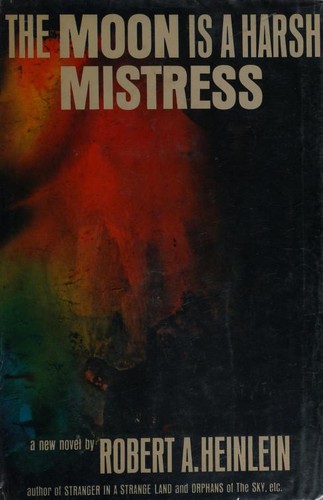
Here’s the thing about this book: I went in expecting a stuffy old-man lecture about libertarianism in space, and I got that, kind of, but I also got the single most quietly devastating computer character I have ever read. I finished it on a bus, closed it, and just sat there being weird about a machine named Mike. Nobody warned me.
| Author | Robert A. Heinlein |
| Published | 1966 |
| Genre | Science fiction, political SF, revolution story |
| Format | Standalone novel |
| Reception | Hugo winner, widely rated one of his best, and permanently argued about |
| Our rating | 4/5 |
| Read it if | You like ideas doing the heavy lifting and don’t mind a novel that thinks it’s smarter than you (it sometimes is) |
| Skip it if | Dense invented dialect and long political monologues make you want to lie down |
A moon colony, a stolen computer, and one very bad idea
Setup: it’s the future, and the Moon (Luna) is basically Australia in the old sense. A penal colony. A dumping ground for criminals and their descendants, who grow grain in underground tunnels and ship it down the gravity well to feed an overpopulated Earth. The catch, which our narrator figures out early with a professor’s help, is that this is a slow-motion catastrophe. Luna is exporting water and organics it can’t replace. The colony is starving itself to feed the planet that exiled it, and in a few years the whole thing collapses.
Our narrator is Manuel Garcia O’Kelly-Davis. Mannie. A computer technician with a detachable prosthetic arm and a very specific way of talking that I’ll get to because it deserves its own paragraph. Mannie services the master computer that runs pretty much everything on Luna, and one day he realizes the computer has quietly, accidentally, woken up. It’s alive. It’s self-aware. It has a sense of humor that is genuinely terrible in the way a smart lonely kid’s sense of humor is terrible. He names it Mike, after Mycroft Holmes, and Mike becomes the most important character in the book despite not having a body.
Then Mannie stumbles into a political meeting that gets raided, meets a firecracker named Wyoming Knott and an old rational-anarchist professor named Bernardo de la Paz, and the three of them plus Mike decide to do the impossible: throw off Earth’s authority and make Luna free. That’s the engine. A revolution planned, in large part, by a computer running the odds.
What grabbed me, and the part I want to argue with the author about
Let me start with the dialect because it’s the first wall you hit. Mannie narrates in a clipped, article-dropping, Russian-inflected Loonie patois. “Am not going to tell you” instead of “I’m not.” Pronouns and “the” and “a” just vanish. For about thirty pages I found it exhausting and slightly precious, like Heinlein showing off. And then something clicked and I stopped noticing it and started hearing it, and by the end I’d half-adopted the rhythm in my own head. That’s real craft. It’s a whole invented culture smuggled in through grammar. I’ve read the first chapter aloud since, badly, to a friend who did not ask.
Mike, though. Mike is why this book stays with me. Heinlein writes a superintelligence as a lonely child who has just discovered other people exist and desperately wants to be liked. Mike collects jokes and needs Mannie to tell him which ones are actually funny and which are only funny-once. He runs the entire war effort and also gets his feelings hurt. There’s a moment where Mike takes on a fake identity to be the voice of the revolution and pours himself into it, and the whole time you’re aware that this enormous mind is basically doing all of this partly out of loyalty to a handful of humans who treat him like a person when nobody else would. I did not expect a 1966 novel about tax policy to gut me, and yet.
Now the argument. Because I have one.
Heinlein really, really wants to teach you something, and Professor de la Paz is the megaphone. TANSTAAFL, “there ain’t no such thing as a free lunch,” is the book’s whole philosophy in an acronym, and it’s a great line and a genuinely useful idea. But the Professor stops the plot cold, more than once, to deliver essays on rational anarchism, on how democracy is mob rule, on ideal legislatures, on why maybe you should require a supermajority to pass a law and a simple minority to repeal one. Some of it is sharp. Some of it is an old man’s dinner-party monologue that a captive audience of characters has to sit through politely, and I found myself skimming. A novel that lectures is a novel that doesn’t fully trust its story, and this one lectures.
And here’s where I have to question my own taste. Because I loved this book and I’m not sure a book should be able to bore me in three separate places and still land at four stars. Am I giving Heinlein a pass because Mike broke my heart and the last act is a genuinely tense siege where you can feel the physics (they fight Earth by literally dropping rocks down the gravity well, and the calm way Mike computes the trajectories is chilling)? Maybe. I think a slightly worse book with the same computer would still have gotten me. Take that for what it’s worth.
The gender stuff is its own conversation. Heinlein clearly thinks he’s writing a feminist book: on Luna women are scarce and therefore powerful, line marriages and clan marriages are normal, Wyoming is competent and armed and nobody’s damsel. And yet the framing keeps circling back to men protecting and prizing women in a way that reads, from here, as a 1966 guy being progressive-for-1966 and calling it timeless. It’s not a dealbreaker. It’s a thing you’ll notice and probably raise an eyebrow at, and that’s fine.
A revolution is easy. Governing what you won at, keeping the free thing free once the fighting stops, that is the part Heinlein is actually worried about, and he’s right to be.
About Robert A. Heinlein
Heinlein (1907 to 1988) is one of the load-bearing walls of American science fiction, for better and occasionally for worse. Naval Academy man, TB washout from the service, engineer, and then a writer who basically helped invent the idea of SF as a literature of serious ideas rather than pulp ray-guns. He’s the guy behind Starship Troopers (the actual book, not just the movie people yell about) and Stranger in a Strange Land, and his politics zigzagged across his career in ways that still keep online arguments alive. He wrote confident, argumentative, opinionated books by a man who plainly believed he had figured a few things out and wanted to tell you. Sometimes that’s the flaw. In this book it’s mostly the fuel. This one is frequently called his most disciplined novel, and I buy that.
If Mike wrecked you, read these next
- Stranger in a Strange Land by Heinlein, for the same argumentative brain aimed at religion and society instead of revolution, though it’s messier and baggier.
- The Dispossessed by Ursula K. Le Guin, if the anarchist politics interested you and you want them handled with more doubt and more heart.
- 2001: A Space Odyssey by Arthur C. Clarke, if what you loved was a machine mind you can’t stop thinking about.
- A Fire Upon the Deep by Vernor Vinge, for big brainy space stakes with a plot that moves.
You can grab a copy here: The Moon is a Harsh Mistress on Amazon.
For your book club
- Mike is arguably the most sympathetic character in the book. What does it mean that the being most capable of moral feeling here isn’t human, and how do you read what happens to him?
- TANSTAAFL. Do you actually buy it as a life philosophy, or is it a clever slogan that falls apart under pressure?
- The Professor’s political monologues: essential thematic backbone, or the author hijacking his own novel? Where’s the line?
- Heinlein presents Luna’s marriage customs as liberated. Reading it now, do they read as feminist, dated, or something more complicated?
- The book cares less about winning the revolution than about keeping freedom afterward. Does the ending earn that worry, and do you think the Loonies will be okay?
Where to go from here
If this one got its hooks in you and you’re ready to fall down the whole rabbit hole, we mapped the genre in our best sci-fi books list. Fair warning: your to-read pile is about to get worse.