
A freshly dog-eared review
The Book That Made Me Ration My Own Food
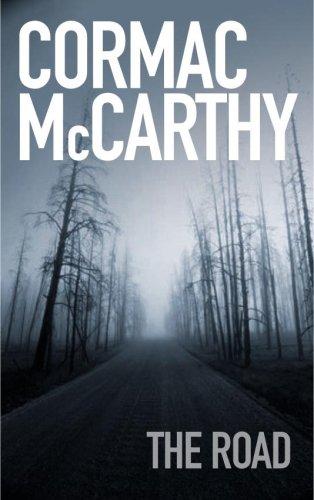
I read most of this book in a laundromat on a Tuesday night, which is possibly the worst place on earth to read a novel about starving to death in a gray, dead world, because every ten minutes a dryer buzzer went off and I jumped like it was the end of everything. I finished it at home with the lights on. All of them. Every lamp in the apartment. I am not exaggerating for effect. This is a book that makes you check the locks.
| Author | Cormac McCarthy |
| Published | 2006 |
| Genre | Post-apocalyptic literary fiction |
| Format | Standalone novel |
| Reception | Pulitzer Prize winner, widely called one of the best novels of the 2000s, though a vocal minority finds it punishing to the point of pointlessness |
| Our rating | 4.4/5 |
| Read it if | you want a book that rearranges something in your chest and you don’t mind grief without relief |
| Skip it if | you need plot momentum, quotation marks, or a reason to hope that arrives before the last page |
A man, a boy, a shopping cart, and the end of the world
Here’s the setup, stripped down because that’s how McCarthy wrote the whole book: a father and his young son are walking south, pushing a shopping cart full of scavenged junk, trying to reach the coast before winter kills them. Something happened to the world. We never find out what. Could be nuclear, could be something else, doesn’t matter, and that not-mattering is the whole point. The sky is the color of ash. Nothing grows. Most of the other people left alive are either starving like our guys or have made peace with eating other people to avoid it.
That’s the plot. Walk south. Find food. Avoid being eaten. Keep the fire, as the boy keeps saying, like a prayer he doesn’t fully understand yet.
I want to be upfront that if you need a plot with turns and reveals, this is not that book. It’s a road, literally and structurally. You either surrender to the rhythm of it or you fight it the whole way, and fighting it is exhausting.
Why it worked on me (and where I think it cheats a little)
The prose is the reason people who don’t even like McCarthy’s other stuff end up loving this one. No quotation marks, minimal punctuation, sentences that sometimes run a full page and sometimes stop at two words. It sounds like a gimmick when you describe it. It doesn’t read like one. It reads like someone stripped the language down to match the burned-out world, like even grammar is a luxury nobody can afford anymore. There’s a passage early on where the father is trying to remember the taste of an orange, and it’s maybe four lines long, and I had to put the book down and just sit there for a second. That’s not a plot beat. That’s just McCarthy doing something with sentence rhythm that shouldn’t work as well as it does.
The father-son relationship is the actual engine of the book, not the apocalypse. Every scene is really about whether this man can keep his kid decent in a world that’s actively punishing decency. There’s a scene with a thief who steals their cart, and what the father does about it, and what the boy makes him do afterward, that tells you everything about who these two people are without a single line of backstory. No flashbacks explaining who they used to be. You just watch them be who they are now.
I’ll admit the flip side. The book can feel monotonous if you’re not locked in, because it kind of is monotonous, deliberately. Walk, scavenge, hide, walk. Some readers call it a slog and I understand exactly why, even if I don’t fully agree. There were stretches in the middle where I wanted an actual scene, a turn, something besides the gray. And the ambiguity that I love (what happened to the world, why doesn’t it matter) is the exact thing that leaves some readers cold, because there’s nothing to hold onto except mood. If you go in wanting answers, you will be furious by page 200.
Also, and I say this as someone who thinks this book is genuinely great: the wife’s storyline, told mostly in memory, is the weakest part. It’s necessary, it explains a lot, but it’s also the one place where the book leans into something closer to melodrama than anywhere else. It’s a small crack in an otherwise airtight thing.
Tangent, but stay with me: I read this maybe six months after becoming a parent, and I do not think that was an accident of timing, I think it changed the book completely. Before I had a kid I think I would have read this as a bleak survival story. After, I read it as basically the most accurate description of parental terror I’ve ever encountered, just relocated to a burned world so you can see it without flinching away from the ordinary version of it. I’m not sure I’d have rated it this high without that context, honestly, and that’s worth admitting rather than pretending my reaction is the objective one.
You can grab a copy here if you want to see for yourself: The Road on Amazon.
Carrying the fire isn’t about hope. It’s about refusing to become the thing the world is trying to turn you into.
About Cormac McCarthy
McCarthy spent decades writing brutal, biblical, unpunctuated novels that most people ignored until Oprah picked this one and the movie adaptations started rolling out. Before The Road he wrote Blood Meridian, a novel so violent that even people who love it describe it like it’s a fight they survived. He famously didn’t do the media circuit, didn’t do much of anything except write and, according to legend, occasionally hang out with actual scientists because he found them more interesting than writers. He died in 2023, having spent his whole career convinced that punctuation was mostly optional and mostly being right about it.
If this wrecked you, read these next
Station Eleven by Emily St. John Mandel, for apocalypse with more warmth and an actual ensemble to root for.
Blood Meridian, also by McCarthy, if you want to see where this stripped-down brutal style came from, minus any of the tenderness.
Never Let Me Go by Kazuo Ishiguro, for a different kind of quiet devastation that sneaks up on you the same way.
The Girl With All the Gifts by M.R. Carey, for post-apocalypse that still has plot and pace if The Road’s stillness frustrated you.
For your book club
- Why do you think McCarthy never explains what caused the apocalypse, and does that choice help or hurt the book for you?
- What does “carrying the fire” mean to you by the end, and does the father actually manage to do it?
- The father makes several morally grey choices to protect his son. Which one, if any, crossed a line for you?
- How did the absence of quotation marks and traditional punctuation change how you experienced the dialogue?
- Do you read the ending as hopeful, ambiguous, or something else entirely, and what in the text supports your read?
Still thinking about it
I don’t know that I’d call this a comfortable recommendation, exactly, more like something I need other people to have read so I have someone to talk to about that orange. If you want more books that will do something to you, check out more of our book reviews, though fair warning, most of them are a lot less likely to make you sleep with the lights on.