
A freshly dog-eared review
I Read 400,000 Years of Physics Trauma So You Don’t Have To
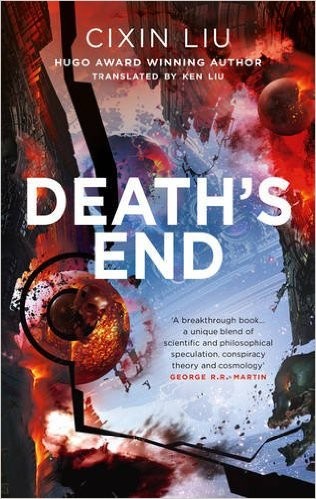
Here’s the thing about The Three-Body Problem: it made me feel stupid in a way I actually enjoyed. Not stupid like a bad textbook makes you feel. Stupid like standing at the edge of something enormous and cold and realizing the author is not going to hold your hand across it. I put it down twice. I picked it back up both times. That should tell you something.
| Author | Liu Cixin |
| Published | 2008 in China, 2014 in English (trans. Ken Liu) |
| Genre | Hard science fiction, first-contact |
| Format | Book one of the Remembrance of Earth’s Past trilogy (three books) |
| Reception | Won the Hugo, adored by physicists and Obama, and quietly resented by people who find it emotionally frozen |
| Our rating | 4/5 |
| Read it if | you want ideas so big they reorganize your brain and you don’t need to like the characters |
| Skip it if | you read for people, warmth, or prose that sings |
It opens in the Cultural Revolution, and that’s not a warmup
I went in expecting spaceships. What I got, in the first pages, was a physics professor being beaten to death by teenage Red Guards in front of a crowd, and his daughter Ye Wenjie watching it happen. That’s the ignition point of the whole thing. Not a rocket. A woman who watches the worst of humanity up close and quietly decides humanity might not be worth saving.
Look, I’ll keep the plot light because the fun of this book is watching it detonate slowly. But the frame is this: decades later, scientists around the world are dying, killing themselves, and a few of them mutter the same thing before they go, that physics itself has stopped making sense. A nanomaterials researcher named Wang Miao gets pulled into investigating, and the trail runs through a bizarre, hyper-realistic video game called Three Body, where players live on a planet with three suns and never know if the next dawn will freeze them solid or cook them alive.
That game is the best idea in the book. I mean it. The players are trying to solve the actual three-body problem (an unsolvable orbital-mechanics nightmare) by rebuilding civilization over and over, watching it get incinerated, dehydrating themselves to survive the chaotic eras. It sounds dry. It is not dry. It’s the part I read on my phone at 1am in bed telling myself one more level, one more.
What’s genuinely great, and the part where I got bored
When this book is good it is unlike anything else. Liu Cixin thinks at a scale most writers won’t touch. There’s a sequence involving a plan to read a message off a piece of computing hardware, except the “hardware” is thirty million soldiers arranged on a plain, each holding a flag, each one a single bit, forming a human motherboard that a general on horseback boots up like a machine. I read that scene and actually set the book down and went for a walk. It’s absurd and it’s completely rigorous at the same time. That’s the trick he keeps pulling.
And the central menace, once it lands, is one of the coldest, most patient threats in science fiction. I won’t say what it is. I’ll just say the villains are not evil in a cackling way. They’re evil in a physics way, which is worse.
Now the criticism, because this is not a flawless book and anyone who tells you it is has a poster of it on their wall. The characters are cardboard. Wang Miao, our supposed protagonist, is basically a camera with a job. He has no interior life I could find. He reacts, he investigates, he goes home. The one truly alive character is Ye Wenjie, and she works because her rage is real and earned. Everybody else is a delivery mechanism for the next idea. The lone exception is a foul-mouthed detective named Da Shi, who I loved precisely because he refuses to be impressed by any of it, and honestly the book breathes every time he walks in.
There’s also a stretch in the middle, the long info-dumps about the Trisolaran civilization and the radio project at the base, where the prose flattens into something closer to a briefing document than a novel. I skimmed. I’ll admit it. Some of that is translation flavor (Chinese SF has a different relationship to exposition than the Western stuff I grew up on), and Ken Liu, to his enormous credit, keeps it readable and even footnotes the history so I didn’t drown. But some of it is just Liu Cixin caring more about the concept than the sentence.
Here’s where I question my own taste. I gave the trilogy’s second book, The Dark Forest, a higher place in my heart than this one, and I’ve met people who think the reverse, that book one is the pure hit and the sequels bloat. And I’ve met a physicist who thinks the whole trilogy is juvenile philosophy dressed up in equations. He might be right. I don’t fully trust my four stars here. Some days I think it’s a five for ambition alone. Some days I remember how little I felt about anyone in it and I want to knock it to a three. The four is me splitting the difference honestly.
This is a book about the moment a civilization stops assuming the universe is on its side, and starts doing the math on what happens when it isn’t.
About Liu Cixin
Liu Cixin spent years as a computer engineer at a power plant in Shanxi Province, writing science fiction on the side, which explains a lot. He writes like an engineer who wandered into literature and decided the load-bearing walls matter more than the paint. He’s the biggest name in Chinese SF by a mile, and this trilogy is the thing that broke the genre out of China and onto every English-language shelf and, eventually, a big-budget Netflix adaptation. He’s said he cares about the ideas more than the people, and reader, it shows. Take that as warning or invitation depending on your wiring.
If this rearranged your brain, read these next
- The Dark Forest by Liu Cixin, the sequel, where the “dark forest” theory of the cosmos will genuinely ruin your ability to look at the night sky the same way.
- Blindsight by Peter Watts, if you want cold, brilliant, human-consciousness-questioning hard SF that’s even more merciless.
- Roadside Picnic by the Strugatsky brothers, for another translated masterpiece about contact with something we can’t comprehend and don’t survive intact.
- Project Hail Mary by Andy Weir, if you loved the physics puzzles but want a book that actually likes its main character.
You can grab a copy over on Amazon here if you want to see whether your brain bends the way mine did.
For your book club
- Ye Wenjie makes a choice that dooms (or saves) everyone based on what she witnessed in the Cultural Revolution. Did the book earn her decision, or is it too neat a line from trauma to betrayal?
- The characters are famously thin. Did that hurt the book for you, or did the ideas carry it anyway? Is “the concept is the character” a fair defense?
- The human-motherboard scene and the video game are pure spectacle-of-ideas. Which set piece stuck with you, and why that one?
- How much did knowing this was translated change how you read it? Did the different rhythm of exposition bother you or intrigue you?
- The book argues, more or less, that a threatened universe is a hostile one. Do you buy the pessimism, or is it edgelord physics dressed up as wisdom?
Keep going
If cold, enormous, brain-bending science fiction is your drug now, I put the whole spread together in our best sci-fi books list. Fair warning, you’re going to lose a weekend.
I still think about those thirty million soldiers on the plain. I probably always will. That’s the thing nobody warns you about with this book. You don’t love it exactly. It just moves in and rearranges the furniture and never leaves…