← I'm Loving BooksAll book toolsReading Atlas
The Reading Atlas

Private preview · draft one

An atlas of American popular reading, 1894 to now

TheReading Atlas

From the Gilded Age to the Fanfic Slop

This is a record of what Americans actually bought, borrowed and binged for 131 years, from the first national bestseller list to fan archives with millions of stories. It starts in 1894 with a Paris artist's model whose bare feet set off a national craze. It ends on Wattpad, with a werewolf rejection story that shows sixteen million reads.

1,310US bestseller slots, 1895–2025
131No. 1 bestsellers, one per year
3,312,362AO3 works tagged Fluff
16,428,118Reads on one Wattpad story
Begin at the bookcase ↓

Plate I · 1895–2025

Every No. 1 Novel, on One Bookcase

Each spine is the year’s No. 1 book on the annual US bestseller list, from the annual Bookman and Publishers Weekly lists. The bindings change with the decades, from stamped cloth to paperback slab type. Hover or tap a spine to read it.

1895 · Beside the Bonnie Brier Bush · Ian Maclaren

Plate II · 1,310 rows

What was America reading the year your grandmother was born?

Drag through 131 years of the annual top ten. Every list here comes from the same record the rest of this atlas is built on.

1925

    Prologue · Before the lists

    Before Anyone Kept Score

    America had runaway books long before anyone printed a bestseller list. They sold by the hundred thousand, were read aloud in parlors and argued over in pulpits.

    How America read

    Before the first American bestseller list appeared in February 1895, there was no regular national tally of what sold; the term "best seller" itself is first known in print in 1889, in the Kansas City newspaper The Kansas Times & Star.[1]
    In 1860 Erastus and Irwin Beadle launched Beadle's Dime Novels, cheap paperbacks priced at ten cents that were immediately popular among young, working-class readers.[2]
    Weekly story papers, eight-page newspaper-like publications usually costing five or six cents, carried serial fiction to mass audiences and have been called the television of their day.[2]
    A flood of cheap paperbacks ran from the 1870s into the early 1890s, uniformly priced at a quarter or less while new clothbound books sold for $1.50.[3]
    Subscription publishers bypassed the bookstore entirely, sending agents door to door to take orders before a book was even printed.[3]
    Until 1891 American publishers could legally reprint British books without permission or payment, which made foreign novels far cheaper to publish than American ones.[4]
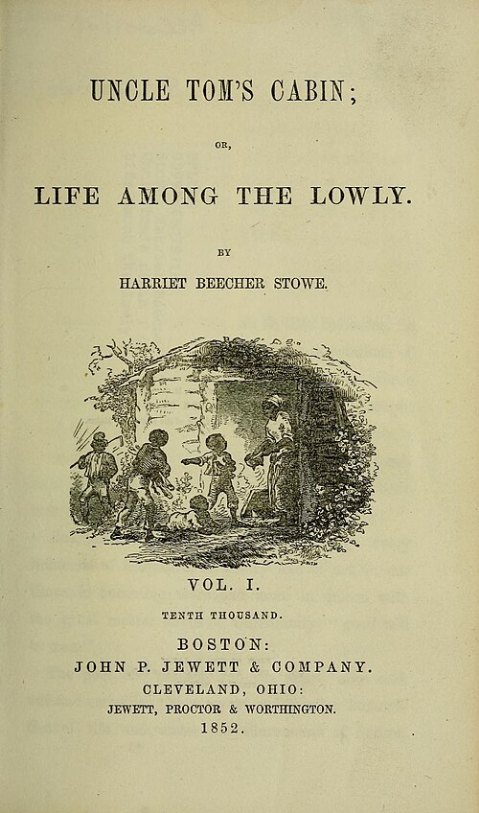
    Title page of Uncle Tom's Cabin, volume one, 1852, with an engraving of the cabin
    Title page, first edition, John P. Jewett, Boston, 1852. Illustration by Hammatt Billings. Wikimedia Commons, public domain.

    Before bestseller lists: 300,000 U.S. copies in its first year

    Uncle Tom's Cabin

    Harriet Beecher Stowe, 1852

    The second best-selling book of the nineteenth century after the Bible, it showed that a novel could move a nation's politics.

    Late in the afternoon of a chilly day in February, two gentlemen were sitting alone over their wine, in a well-furnished dining parlor, in the town of P——, in Kentucky. There were no servants present, and the gentlemen, with chairs closely approaching, seemed to be discussing some subject with great earnestness.

    Chapter I, "In Which the Reader Is Introduced to a Man of Humanity" (John P. Jewett illustrated edition, 1853) [5]

    • The novel first ran as a 40-week serial in the antislavery paper The National Era, starting with the June 5, 1851, issue.[6]
    • It sold 3,000 copies on its first day, March 20, 1852, and 300,000 copies in the United States in its first year.[6]
    • The first London edition appeared in May 1852 and sold 200,000 copies, and by 1857 the novel had been translated into 20 languages.[6]
    • Seven anti-Tom novels answering Stowe appeared in 1852 and six more in 1853.[6]
    • Stowe had no control over the 'Tom shows' that adapted her story, and George Aiken's stage version was the most popular play in the U.S. and Britain for 75 years.[6]

    The story

    White Southerners were outraged by the book, and Stowe received threatening letters, including a package containing a slave's severed ear. A famous story has Abraham Lincoln greeting her with "So this is the little lady who started this great war," though historians are undecided whether he ever said it.[6]

    “it is the most valuable addition that America has made to English literature.”Thomas Babington Macaulay [6]

    “I have read your book with the deepest interest and sympathy”Charles Dickens, letter to Stowe [6]
    Jacket drawn for the atlas

    Before bestseller lists: best-selling American novel of the 19th century by 1900

    Ben-Hur: A Tale of the Christ

    Lew Wallace, 1880

    A slow starter that became the century's best-selling American novel, a Broadway spectacle and a film franchise.

    The Jebel es Zubleh is a mountain fifty miles and more in length, and so narrow that its tracery on the map gives it a likeness to a caterpillar crawling from the south to the north. Standing on its red-and-white cliffs, and looking off under the path of the rising sun, one sees only the Desert of Arabia, where the east winds, so hateful to the vine-growers of Jericho, have kept their playgrounds since the beginning.

    Book First, Chapter I (Harper & Brothers "Player's Edition," 1904) [7]

    • Ben-Hur sold slowly at first and drew mixed reviews, but by 1889 Harper and Brothers had sold 400,000 copies.[8]
    • By 1886 the book was earning Wallace about $11,000 a year in royalties.[8]
    • In 1913 Sears Roebuck ordered another one million copies, and a 1946 Grosset and Dunlap edition boasted that 26 million copies were in print.[8]
    • The stage version recreated the chariot race with live horses and real chariots running on treadmills.[8]
    • It was the first novel ever blessed by a pope, Leo XIII.[8]

    The story

    On a train journey, the famous agnostic Robert Ingersoll invited Wallace into his railroad compartment, and the two men argued about religion. Wallace came away realizing how little he knew about Christianity, and the novel grew out of that realization.[8]

    Jacket drawn for the atlas

    Before bestseller lists: first printing of 2,000 sold out quickly

    Little Women

    Louisa May Alcott, 1868

    A book its author did not want to write became the template for the American girls' novel and is still read and filmed today.

    "Christmas won't be Christmas without any presents," grumbled Jo, lying on the rug. "It's so dreadful to be poor!" sighed Meg, looking down at her old dress. "I don't think it's fair for some girls to have plenty of pretty things, and other girls nothing at all," added little Amy, with an injured sniff. "We've got father and mother and each other," said Beth contentedly, from her corner.

    Chapter I, "Playing Pilgrims" (Little, Brown edition, 1916) [9]

    • Alcott wrote the first volume within 10 weeks, in record time, for money.[10]
    • The first printing of 2,000 copies sold out quickly, and the book was an immediate commercial and critical success.[10]
    • The novel first appeared in two volumes in 1868 and 1869, which were issued together as a single novel titled Little Women in 1880.[10]
    • Many girls wrote to Alcott asking who the little women would marry, yet she did not let Jo accept Laurie's proposal.[10]
    • Maxine Hong Kingston, Margaret Atwood and J. K. Rowling have all credited Jo March with shaping their artistic development.[10]

    The story

    Thomas Niles of the Boston publisher Roberts Brothers asked Alcott for a girls' book, and she noted in her journal, "I said I'd try." She told a friend she could not write a girls' story because she knew little about any girls but her sisters and had always preferred boys, so she wrote about her sisters.[10]

    “The great literary hit of the season is undoubtedly Miss Alcott's Little Women”publisher's announcement, 1868-69 [10]

    Jacket drawn for the atlas

    Before bestseller lists: about 200,000 copies within a year

    Looking Backward, 2000–1887

    Edward Bellamy, 1888

    A science-fiction utopia that sold like a thriller and launched a political movement of reading clubs.

    I first saw the light in the city of Boston in the year 1857. "What!" you say, "eighteen fifty-seven? That is an odd slip. He means nineteen fifty-seven, of course." I beg pardon, but there is no mistake. It was about four in the afternoon of December the 26th, one day after Christmas, in the year 1857, not 1957, that I first breathed the east wind of Boston, which, I assure the reader, was at that remote period marked by the same penetrating quality characterizing it in the present year of grace, 2000.

    Chapter I [11]

    • Julian West falls into a hypnosis-induced sleep in 1887 and wakes 113 years later, in the year 2000, to find the United States transformed into a socialist utopia.[12]
    • Bellamy's publisher could scarcely keep up with demand, and some 200,000 copies sold within a year.[13]
    • By the end of the century only Uncle Tom's Cabin and Ben-Hur had outsold it among books published in America.[13]
    • Readers founded Nationalist Clubs to spread its ideas, starting in Boston in late 1888, and by 1891 at least 161 of them existed.[13]
    • Bellamy, a former newspaperman, died of tuberculosis in Chicopee Falls, Massachusetts, at the age of 48.[13]

    The story

    The book set off a "battle of the books": rival authors answered it with utopias and anti-utopias of their own, and the argument lasted into the twentieth century. Bellamy avoided the word "socialism," so the movement his readers built came to be called Nationalism.[12]

    “It is one of the few books ever published that created almost immediately on its appearance a political mass movement.”Erich Fromm, 1960 (later assessment) [12]

    Jacket drawn for the atlas

    Before bestseller lists: more than 65,000 copies in its first few months as a dime novel

    Malaeska, the Indian Wife of the White Hunter (and the dime novel)

    Ann S. Stephens, 1860

    The very first Beadle's Dime Novel, it stands for the cheap paper-covered fiction that millions of working Americans actually read.

    The traveler who has stopped at Catskill, on his way up the Hudson, will remember that a creek of no insignificant breadth washes one side of the village,

    Chapter I, opening prose after the verse epigraph (Irwin P. Beadle and Company, June 1860) [14]

    • Malaeska was a reprint of a serial Stephens had published in the Ladies' Companion magazine in 1839.[15]
    • It was the first book in the Beadle's Dime Novels series and sold more than 65,000 copies in its first few months.[2]
    • The term "dime novel" originated with Malaeska, and the Grolier Club later listed it as the most influential book of 1860.[15]
    • Highbrow critics derided dime-novel fiction, and the term became a pejorative for sensational but superficial writing.[2]
    • The detective Nick Carter first appeared in 1886 in the New York Weekly, and dime-novel weeklies eventually turned into the pulp magazines of the twentieth century.[2]

    The story

    Ann Stephens was already a busy New York magazine editor who wrote more than twenty-five serial novels, and she had once edited the Ladies' Companion herself. When the Beadles needed a first title for their new ten-cent series in 1860, they reprinted her twenty-year-old frontier romance, and it became the book that gave the dime novel its name.[15]

    Sources for this chapter
    1. https://en.wikipedia.org/wiki/Bestseller
    2. https://en.wikipedia.org/wiki/Dime_novel
    3. https://www.encyclopedia.com/history/culture-magazines/literary-marketplace
    4. https://en.wikipedia.org/wiki/International_Copyright_Act_of_1891
    5. https://archive.org/stream/uncletomscabinor00stow/uncletomscabinor00stow_djvu.txt
    6. https://en.wikipedia.org/wiki/Uncle_Tom%27s_Cabin
    7. https://archive.org/stream/benhurtaleofchri00wall/benhurtaleofchri00wall_djvu.txt
    8. https://en.wikipedia.org/wiki/Ben-Hur:_A_Tale_of_the_Christ
    9. https://archive.org/stream/littlewomen00alcoiala/littlewomen00alcoiala_djvu.txt
    10. https://en.wikipedia.org/wiki/Little_Women
    11. https://archive.org/stream/lookingbackward200bell/lookingbackward200bell_djvu.txt
    12. https://en.wikipedia.org/wiki/Looking_Backward
    13. https://en.wikipedia.org/wiki/Edward_Bellamy
    14. https://archive.org/stream/malaeskaindianwi00step/malaeskaindianwi00step_djvu.txt
    15. https://en.wikipedia.org/wiki/Ann_S._Stephens

    Chapter 1 · 1895–1899

    The Gilded Age Learns to Binge

    The Bookman printed its first national list in 1895, and the first craze it caught was a novel about an artist’s model with famous feet.

    50top-ten slots in our record
    35different authors
    28%of slots held by the top five
    Ian Maclarenmost listed, 4 times

    How America read

    With its first issue in February 1895, The Bookman's editor Harry Thurston Peck created America's first bestseller list, borrowing the idea from an English magazine of the same name.[1]
    The Bookman's lists ran from 1895 until 1918, and Publishers Weekly later combined its monthly lists into the annual rankings used for 1895 to 1912.[2]
    The first several bestseller lists were dominated by European novels, a legacy of copyright law that before 1891 had made European books far cheaper to publish than American ones.[3]
    The International Copyright Act took effect on 1 July 1891, and from then on a book had to be manufactured in the United States to get American copyright.[4]
    In 1893 Munsey's Magazine cut its price to ten cents; within a year its circulation passed a quarter of a million, and historians date a revolution in magazine publishing from the move.[5]
    A successful novel of the 1890s sold about 5,000 copies, and a new novel by a well-known author might sell 10,000, which makes the six-figure hits of the decade stand out.[6]
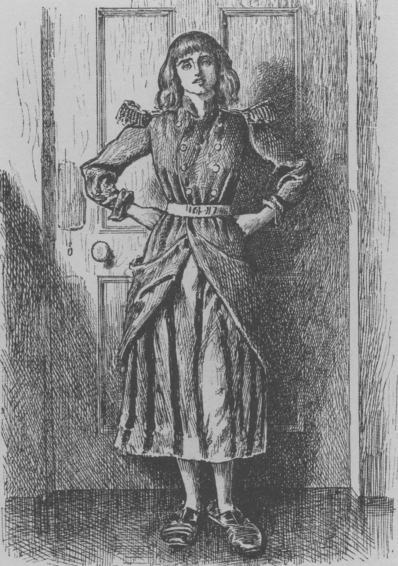
    George du Maurier's drawing of Trilby in a military greatcoat over her dress.
    “Wistful and Sweet.” George du Maurier's own drawing of Trilby, 1895. NYPL General Research Division, via Wikimedia Commons. Public domain.

    Chapter 1 · The 1890s · No. 2 of 1895

    The Feet That Sold a Hundred Thousand Books

    George du Maurier's Trilby was America's first great book craze. Thirty years later, an anthologist had to explain the plot, because nobody read it anymore.

    Harper's New Monthly Magazine ran Trilby as a serial from January to August 1894, and the book came out on September 8 that year. Almost 100,000 copies sold in its first two months, and American sales passed 200,000. Du Maurier drew the illustrations himself.

    Trilby O'Ferrall is an artist's model in the Latin Quarter of Paris, and readers fixed on her feet. “A perfect Trilby foot” became a compliment. Shops sold Trilby shoes, Trilby shoe polish, a Trilby sausage and ice cream shaped like a foot. Before “trilby” meant a hat it was slang for a foot, and foot-reading became a fad.

    “It's the only song I know. My father used to sing it just like that, when he felt jolly after hot rum and water. It used to make people cry; he used to cry over it himself. I never do.”

    Trilby, after singing “Ben Bolt” badly to three English art students. From Trilby (1894), as quoted in Burton E. Stevenson, Famous Single Poems (1924).

    The hat came from the stage. When Paul Potter's stage version opened at New York's Garden Theater in 1895, people were turned away at the door. A short-brimmed hat worn in a stage production became the trilby. The villain, Svengali, gave English a word of its own.

    Not everyone loved it. James McNeill Whistler saw himself in Joe Sibley, an idle art student, and took legal action, so Harper's removed the references before the book came out. The quarrel helped the early sales.

    Then it stopped. In 1924 Burton Stevenson wrote that “the vogue of the book ceased with a suddenness which still remains one of the puzzles of the publishing business.” He retold the story for his readers “because nobody reads Trilby nowadays, more's the pity!”

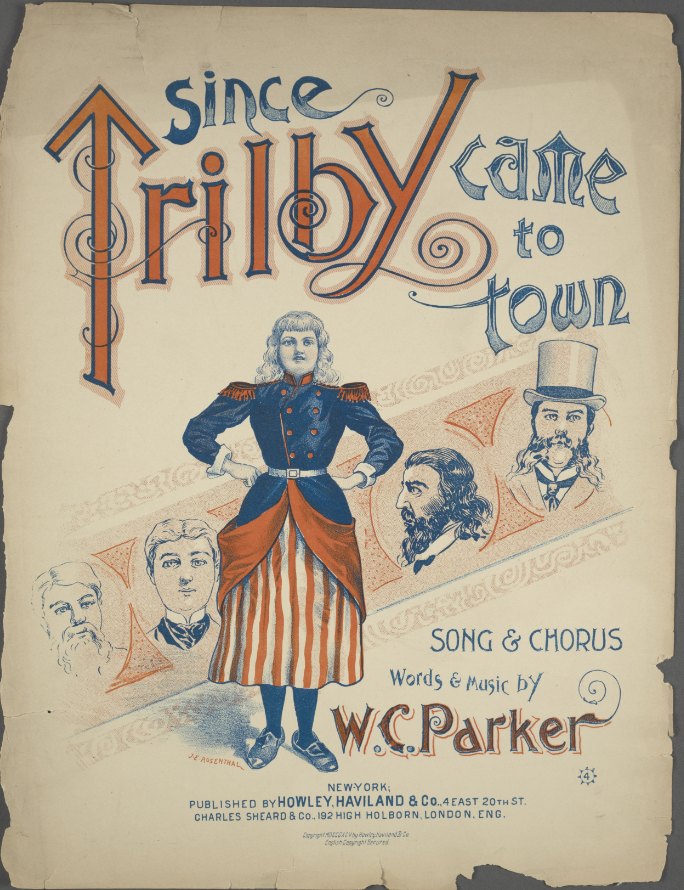
    Red, white and blue 1895 sheet music cover titled Since Trilby Came to Town, showing Trilby in a military coat and a striped skirt, with four men's faces on a banner behind her.
    “Since Trilby Came to Town,” words and music by W. C. Parker, cover by J. E. Rosenthal. New York: Howley, Haviland & Co., 1895. The chorus opens: “‘Trilby’ dinners and ‘Trilby’ plays, ‘Trilby’ wagons and ‘Trilby’ sleighs.” NYPL Music Division, via Wikimedia Commons. Public domain.

    What else America read in 1895

    The Bookman's top ten for the year

      A craze leaves things behind. Trilby left a hat, a word and the plot of The Phantom of the Opera.

      Gaston Leroux's novel drew partly on it. Women copied Trilby's military coat over their dresses, which is why both pictures on this page show it. The book itself fell out of print memory within a generation, which is the pattern this atlas keeps finding.

      Jacket drawn for the atlas

      No. 1 in 1895 (and No. 10 in 1896)

      Beside the Bonnie Brier Bush

      Ian Maclaren (John Watson), 1894

      The top seller on America's very first bestseller list is now almost forgotten, a sentimental giant that vanished.

      The Revolution reached our parish years ago, and Drumtochty has a School Board, with a chairman and a clerk, besides a treasurer and an officer. Young Hillocks, who had two years in a lawyer's office, is clerk, and summons meetings by post, although he sees every member at the market or the kirk.

      "Domsie," Chapter I, "A Lad o' Pairts" [7]

      • Publishers Weekly reported it as the bestselling novel in the U.S. during 1895 and the 10th bestselling novel during 1896.[8]
      • The book of linked stories sold more than 700,000 copies.[9]
      • The stories draw on Maclaren's experiences as a Free Church minister in rural Perthshire, and the book belongs to Scotland's sentimental 'Kailyard' (kitchen-garden) school.[8]
      • Its reputation collapsed so far that it is now called one of the most notorious works of Scottish literature.[8]
      • Donald Crisp directed a film version in 1921, and that film is now lost.[8]

      The story

      John Watson was a Liverpool minister who told stories so well that the editor William Robertson Nicoll asked him to write them down for the British Weekly. The result made him a popular and highly paid lecturer in America, where he made three tours, and on the last of them he fell ill and died on May 6, 1907, in Mount Pleasant, Iowa.[10]

      Jacket drawn for the atlas

      No. 8 in 1895

      The Prisoner of Zenda

      Anthony Hope, 1894

      It invented Ruritania and a whole genre of imaginary-kingdom romance that Americans devoured and imitated.

      "I wonder when in the world you're going to do anything, Rudolf?" said my brother's wife. "My dear Rose," I answered, laying down my egg-spoon, "why in the world should I do anything? My position is a comfortable one. I have an income nearly sufficient for my wants (no one's income is ever quite sufficient, you know), I enjoy an enviable social position: I am brother to Lord Burlesdon, and brother-in-law to that most charming lady, his countess. Behold, it is enough!"

      Chapter I, "The Rassendylls—With a Word on the Elphbergs" [11]

      • The idea came to Hope at the close of 1893 while he was walking in London; he finished the first draft in a month and the book was in print by April 1894.[12]
      • Zenda's instant success led Hope, a barrister who had trained under H. H. Asquith, to give up the law for writing.[12]
      • The stage version opened in New York on 4 September 1895 and toured the country for years.[13]
      • George McCutcheon's Graustark became the most widely read of the American imitations, and by 1906 a critic counted probably a hundred such novels.[13]
      • The novel has been adapted many times for film, and the 1937 Hollywood version is considered by many the definitive one.[14]

      The story

      The craze reached American parlors in 1896, when Parker Brothers sold a Prisoner of Zenda board game in which players fought for military advantage across a map of Ruritania. In London, the St. James's Theatre made so much from the play that its telegraphic address later became "Ruritania."[13]

      “no tale of adventure in far-off, mysterious countries surpasses the strange excitements”The Times (London), 21 May 1894 [13]

      Jacket drawn for the atlas

      No. 8 in 1896

      The Red Badge of Courage

      Stephen Crane, 1895

      A war novel by a 24-year-old who had never seen a battle, it is the one 1890s bestseller every American student still reads.

      The cold passed reluctantly from the earth, and the retiring fogs revealed an army stretched out on the hills, resting. As the landscape changed from brown to green, the army awakened, and began to tremble with eagerness at the noise of rumors. It cast its eyes upon the roads, which were growing from long troughs of liquid mud to proper thoroughfares. A river, amber-tinted in the shadow of its banks, purled at the army's feet; and at night, when the stream had become of a sorrowful blackness, …

      Chapter I (D. Appleton and Company, 1895 first edition) [15]

      • An abbreviated version first ran in The Philadelphia Press in December 1894 through the Bacheller newspaper syndicate.[16]
      • D. Appleton published the book in October 1895, and it went through ten editions in its first year.[16]
      • It sold faster in England than in the United States, and British praise helped make Crane an instant celebrity at twenty-four.[16]
      • Brigadier General Alexander C. McClurg attacked it as a vicious satire on American soldiers.[16]
      • Crane died of tuberculosis at 28, and John Huston filmed the novel in 1951 with Medal of Honor recipient Audie Murphy as Henry Fleming.[16]

      The story

      Crane was born six years after the Civil War ended, yet his battle scenes were so convincing that readers assumed he was a veteran. Asked about it, he said, "Of course, I have never been in a battle, but I believe that I got my sense of the rage of conflict on the football field."[16]

      “This is war from a new point of view.”The New York Press, 1895 [16]

      “a vicious satire upon American soldiers and American armies.”Brig. Gen. Alexander C. McClurg, 1896 [16]

      Jacket drawn for the atlas

      No. 1 in 1897, No. 5 in 1898

      Quo Vadis

      Henryk Sienkiewicz, 1896

      A Polish novel of Nero's Rome became an American mass phenomenon and later one of cinema's first blockbusters.

      It was well-nigh midday when Petronius awoke, exceedingly wearied, as usual. He said himself that he felt benumbed in the morning, and had no power to collect his thoughts. But the morning bath and a careful kneading of the body done by the hands of skilful slaves gradually hastened the sluggish course of his blood, refreshed him, enlivened him, and restored his strength.

      Chapter I, in William E. Smith's translation (J. S. Ogilvie's cheap Sunnyside Series, No. 101, April 1898) [17]

      • The novel first ran in instalments in the Warsaw paper Gazeta Polska from 26 March 1895 to 29 February 1896.[18]
      • In the United States, Quo Vadis sold 800,000 copies in eighteen months.[19]
      • Because Russian-ruled Poland was outside the Berne Convention, Sienkiewicz rarely received royalties from translations.[19]
      • The novel has been translated into more than 50 languages and contributed to Sienkiewicz's 1905 Nobel Prize in Literature.[18]
      • Mervyn LeRoy's 1951 American film version was nominated for eight Academy Awards.[18]

      The story

      The 1913 Italian film, with 5,000 extras and a two-hour running time, was one of cinema's first blockbusters. It was the first film shown at the Astor Theatre on Broadway, where it ran for nine months, from April to December 1913.[20]

      Jacket drawn for the atlas

      No. 1 in 1899

      David Harum: A Story of American Life

      Edward Noyes Westcott, 1898

      A dead banker's first novel about a horse-trading country banker became the top seller of 1899 and then disappeared from memory.

      David poured half of his second cup of tea into his saucer to lower its temperature to the drinking point, and helped himself to a second cut of ham and a third egg. Whatever was on his mind to have kept him unusually silent during the evening meal, and to cause certain wrinkles in his forehead suggestive of perplexity or misgiving, had not impaired his appetite. David was what he called "a good feeder."

      Chapter I [21]

      • Westcott was a Syracuse, New York, banker who wrote the novel while on leave from his bank with chronic tuberculosis.[22]
      • Six publishers rejected the manuscript before D. Appleton & Company accepted it.[23]
      • The book came out in the fall of 1898, about six months after the author's death, and sold 400,000 copies in the following year.[23]
      • Harum's version of the Golden Rule, "Do unto the other feller the way he'd like to do unto you, an' do it fust," was widely quoted.[23]
      • Will Rogers starred in a 1934 film version that did well at the box office, though the Jim Crow Museum cites it as one of the most blatant examples of racist caricature in film.[23]

      The story

      Edward Westcott never saw his book in print. He died in Syracuse on March 31, 1898, after several rejections, and when the novel appeared that September it became an immediate best-seller.[22]

      Sources for this chapter
      1. https://live-legacy-admin.nypl.org/blog/2020/12/28/what-were-we-reading-125-years-ago-1895
      2. https://en.wikipedia.org/wiki/The_Bookman_(New_York_City)
      3. https://www.encyclopedia.com/media/encyclopedias-almanacs-transcripts-and-maps/bestsellers
      4. https://en.wikipedia.org/wiki/International_Copyright_Act_of_1891
      5. https://en.wikipedia.org/wiki/Munsey%27s_Magazine
      6. https://www.encyclopedia.com/history/culture-magazines/literary-marketplace
      7. https://archive.org/stream/besidethebonnieb00macl/besidethebonnieb00macl_djvu.txt
      8. https://en.wikipedia.org/wiki/Beside_the_Bonnie_Brier_Bush
      9. https://en.wikipedia.org/wiki/Ian_Maclaren
      10. https://ebsco.com/research-starters/history/john-watson
      11. https://archive.org/stream/prisonerofzendab00hope/prisonerofzendab00hope_djvu.txt
      12. https://en.wikipedia.org/wiki/Anthony_Hope
      13. https://branchcollective.org/?p=3185
      14. https://en.wikipedia.org/wiki/The_Prisoner_of_Zenda
      15. https://archive.org/stream/redbadgeofcourag00cranrich/redbadgeofcourag00cranrich_djvu.txt
      16. https://en.wikipedia.org/wiki/The_Red_Badge_of_Courage
      17. https://archive.org/stream/quovadisstoryoft00sien/quovadisstoryoft00sien_djvu.txt
      18. https://en.wikipedia.org/wiki/Quo_Vadis_(novel)
      19. https://en.wikipedia.org/wiki/Henryk_Sienkiewicz
      20. https://en.wikipedia.org/wiki/Quo_Vadis_(1913_film)
      21. https://archive.org/stream/davidharumstoryo00westuoft/davidharumstoryo00westuoft_djvu.txt
      22. https://en.wikipedia.org/wiki/Edward_Noyes_Westcott
      23. https://en.wikipedia.org/wiki/David_Harum

      Chapter 2 · 1900–1909

      Costume Dramas and Cowboys

      The new century read about the old one, from colonial Virginia to the cattle range. Then it read about the slaughterhouse, and Congress changed the food laws.

      100top-ten slots in our record
      55different authors
      24%of slots held by the top five
      George Barr McCutcheonmost listed, 7 times

      How America read

      The Ladies' Home Journal passed one million subscribers by 1903, the first American magazine to do so.[1]
      Andrew Carnegie's grants built 1,689 public libraries in the United States, and his open-shelf policy let readers browse the stacks themselves instead of asking a clerk to fetch books.[2]
      Carnegie gave the buildings only on condition that towns stocked and maintained them with public money.[2]
      Grosset & Dunlap, founded in 1898, built its business on cheap hardcover reprints at 50 cents, competing with other reprinters such as A. L. Burt.[3]
      Historical and imaginary-kingdom romance dominated the lists, and by 1906 a critic counted probably a hundred Ruritanian novels alone.[4]
      Publishers already sold books at a discount through dry-goods and department stores such as Wanamaker's and Macy's.[5]

      Jacket drawn for the atlas

      No. 1 in 1900

      To Have and to Hold

      Mary Johnston, 1900

      The top novel of 1900 captured the historical-romance craze and shaped how a generation pictured colonial Virginia.

      The work of the day being over, I sat down upon my doorstep, pipe in hand, to rest awhile in the cool of the evening. Death is not more still than is this Virginian land in the hour when the sun has sunk away, and it is black beneath the trees, and the stars brighten slowly and softly, one by one.

      Chapter I, "In Which I Throw Ambs-ace" (Houghton, Mifflin and Company, 1900) [6]

      • The Atlantic Monthly serialized the adventures of Ralph Percy and Lady Jocelyn from June 1899 until March 1900.[7]
      • The book sold more than 135,000 copies in its first week.[7]
      • By September 15, 1900, advertisements claimed 250,000 copies sold, and Publishers Weekly named it the No. 1 bestseller in April and June of that year.[8]
      • Ralph Percy, an English soldier turned Jamestown settler, buys a wife from a shipload of brides, and Jocelyn seems to abhor him.[8]
      • Silent films followed in 1916 and 1922, and both are now lost.[9]
      • A 1942 biographical sketch claimed that a whole generation formed its picture of early Virginia from the novel.[7]

      The story

      The young poet Wallace Stevens picked up the novel and stayed up reading it until half-past three in the morning. Johnston herself was cooler about her creations and privately called her characters "puppets."[7]

      “There is a wonderful pirate episode in the middle of the story, with its glowing description of the tropic sea and shore.”The New York Times, February 10, 1900 [10]

      “has little humor and she has not yet learned the novelist's power”Chicago Tribune, 1900 [7]

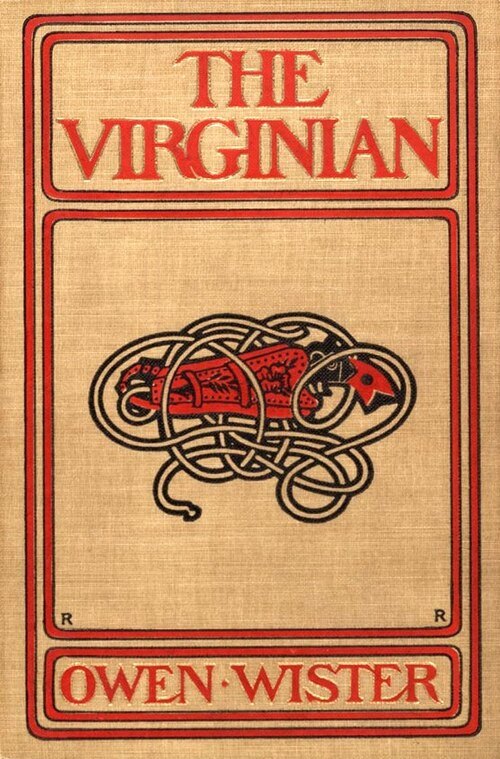
      Tan cloth cover of The Virginian with a coiled lasso and holster in red and black
      First edition cover, Macmillan, 1902. Wikimedia Commons, public domain.

      No. 1 in 1902, No. 5 in 1903

      The Virginian: A Horseman of the Plains

      Owen Wister, 1902

      The novel that turned the cowboy into an American icon and gave the Western its showdown.

      Therefore Trampas spoke. "Your bet, you son-of-a —." The Virginian's pistol came out, and his hand lay on the table, holding it unaimed. And with a voice as gentle as ever, the voice that sounded almost like a caress, but drawling a very little more than usual, so that there was almost a space between each word, he issued his orders to the man Trampas:— "When you call me that, smile!"

      Chapter II, "When You Call Me That, Smile!" (The Macmillan Company, 1902) [11]

      • The Virginian sold over 200,000 copies in its first year and has sold over 1.5 million copies without ever going out of print.[12]
      • At the height of its success, booksellers were ordering one thousand copies a day, and the book created a market for Western novels.[13]
      • Its climactic gun duel is the first showdown in fiction, and it is the first known use of the line "When you call me that, smile!"[14]
      • A stage version opened at the Manhattan Theatre on January 5, 1904, and films followed in 1914, 1923, 1929 and 1946, with an NBC television series from 1962 to 1971.[14]
      • Wister, a Philadelphian, became friends with Theodore Roosevelt through Harvard's Porcellian Club.[12]

      The story

      In 1885 the Philadelphia-born Wister visited the VR Ranch near Douglas, Wyoming, and fell for the West. He went back almost every summer for the next fifteen years to gather material, and those trips became The Virginian.[12]

      Jacket drawn for the atlas

      No. 2 in 1902, No. 6 in 1903

      Mrs. Wiggs of the Cabbage Patch

      Alice Hegan Rice, 1901

      A cheerful slum widow from Louisville became a national favorite on page, stage and screen, and her real neighborhood got a settlement house.

      Mrs. Wiggs made the statement as cheerfully as if her elbows were not sticking out through the boy's coat that she wore, or her teeth chattering in her head like a pair of castanets. But, then, Mrs. Wiggs was a philosopher, and the sum and substance of her philosophy lay in keeping the dust off her rose-colored spectacles. When Mr. Wiggs traveled to eternity by the alcohol route, she buried his faults with him, and for want of better virtues to extol she always laid stress on the fine hand he wrote.

      Chapter I, "Mrs. Wiggs's Philosophy" (The Century Co., 1903 printing) [15]

      • The book sold 650,000 copies in its first two years and has been reprinted more than 50 times.[16]
      • Mrs. Wiggs was based on Mrs. Mary A. Bass, a resident of Louisville's Cabbage Patch neighborhood.[17]
      • The stage version opened on Broadway at the Savoy Theatre in September 1904, toured widely and brought Liebler & Company some $800,000, its most successful play.[17]
      • The novel became a play and four films, including a 1934 Paramount version starring Pauline Lord.[18]
      • Rice helped found the Cabbage Patch Settlement House in Louisville in 1910 and sat on its founding board.[19]

      The story

      At sixteen, Alice Hegan began teaching at a Presbyterian mission Sunday school in the Cabbage Patch, a poor Louisville neighborhood. There she met the cheerful, hard-pressed Mary Bass, and years later she turned her into Mrs. Wiggs, whose book sold half a million copies before the play even opened.[16]

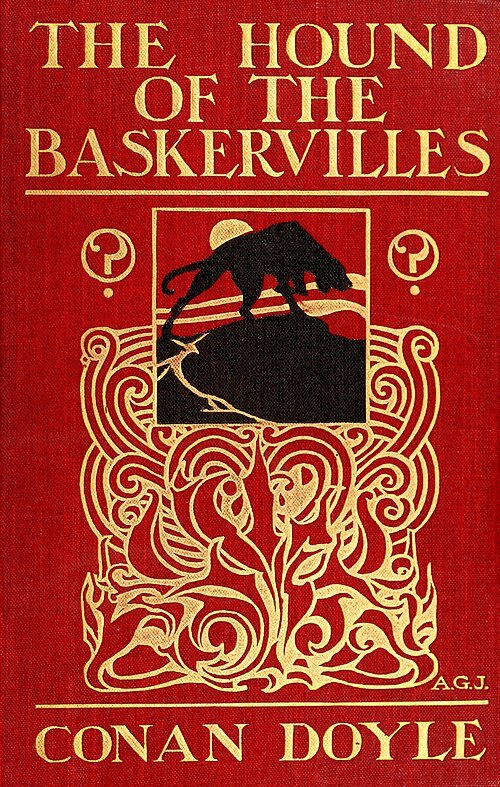
      Red cloth cover of The Hound of the Baskervilles with a gold Art Nouveau frame and a black hound on a moor
      First edition cover by Alfred Garth Jones, George Newnes, London, 1902. Wikimedia Commons, public domain.

      No. 7 in 1902

      The Hound of the Baskervilles

      Arthur Conan Doyle, 1902

      Readers had mourned Sherlock Holmes for eight years, and this story brought him back to the top of the lists, where he has never really left.

      "But one false statement was made by Barrymore at the inquest. He said that there were no traces upon the ground round the body. He did not observe any. But I did—some little distance off, but fresh and clear." "Footprints?" "Footprints." "A man's or a woman's?" Dr. Mortimer looked strangely at us for an instant, and his voice sank almost to a whisper as he answered:— "Mr. Holmes, they were the footprints of a gigantic hound!"

      Chapter II/III, end of Dr. Mortimer's account (George Newnes, London, 1902) [20]

      • Doyle killed off Holmes in 1893, and The Strand Magazine barely survived the rush of cancelled subscriptions.[21]
      • The Hound was serialised in The Strand from August 1901 to April 1902, with chapters ending on cliffhangers.[22]
      • McClure, Phillips & Co. published it in the United States in 1902, the same year as the British edition.[22]
      • Doyle explored Dartmoor with his friend Bertram Fletcher Robinson in June 1901, and Robinson received a one-third royalty that came to over 500 pounds by the end of the year.[22]
      • More than 20 film and television versions have been made, and a 1999 poll of Sherlockians ranked it the best of the four Holmes novels.[22]

      The story

      When Holmes went over the Reichenbach Falls in 1893, young men in London were said to wear black mourning crêpe for a month, though Doyle's son may have exaggerated the story. When the Hound began in The Strand, readers lined up outside the magazine's offices waiting for the next instalment, and sales reached their peak.[23]

      Jacket drawn for the atlas

      No. 4 in 1905

      The Clansman: A Historical Romance of the Ku Klux Klan

      Thomas Dixon Jr., 1905

      A racist bestseller whose stage and screen versions did real harm, it shows how popular fiction fed the revival of the Klan.

      • The novel sold over 100,000 copies, but its 1905 stage adaptation reached a far larger audience.[24]
      • The play was banned in Montgomery, Alabama, and Macon, Georgia, while it was extremely popular elsewhere in the South.[24]
      • After a performance in Bainbridge, Georgia, in October 1905, a Black man was lynched, and a newspaper linked the killing to the play.[24]
      • D. W. Griffith's film The Birth of a Nation (1915) finally gave Dixon's story an audience large enough to help revive the Ku Klux Klan.[24]
      • Historian Thomas D. Clark wrote that the novel opened a vein of racial hatred which was to poison further an age.[24]

      The story

      Philadelphia's mayor banned the play, and when it opened there anyway, audience members threw rotten eggs at the actors. Dixon, offered membership in the Klan he had glorified, reportedly turned it down, saying he disagreed with its methods.[24]

      “The play does not possess even the merit of historic truth.”The Washington Post, on the stage version, 1905-06 [24]

      Jacket drawn for the atlas

      No. 6 in 1906

      The Jungle

      Upton Sinclair, 1906

      A socialist novel about immigrant meatpackers that changed federal food law, it is the decade's clearest case of a bestseller with consequences.

      It was four o'clock when the ceremony was over and the carriages began to arrive. There had been a crowd following all the way, owing to the exuberance of Marija Berczynskas. The occasion rested heavily upon Marija's broad shoulders — it was her task to see that all things went in due form, and after the best home traditions; …

      Chapter I (Grosset & Dunlap reprint of the 1906 edition) [25]

      • Sinclair spent seven weeks in 1904 gathering material in the meatpacking district around Chicago's Union Stock Yards.[26]
      • The novel ran as a serial in the socialist paper Appeal to Reason from February 25 to November 4, 1905.[26]
      • Five publishers rejected it as too shocking before Doubleday published it on February 28, 1906, and it sold 25,000 copies in six weeks.[26]
      • Federal investigators sent to Chicago confirmed much of what Sinclair described, and public pressure led to the Meat Inspection Act and the Pure Food and Drug Act.[26]
      • Jack London called it "the Uncle Tom's Cabin of wage slavery."[26]

      The story

      President Theodore Roosevelt read an advance copy and sent investigators to Chicago, yet he publicly called Sinclair a "crackpot" and privately wrote, "I have an utter contempt for him." Sinclair was just as unhappy, because readers cared about tainted beef rather than the workers: "I aimed at the public's heart, and by accident I hit it in the stomach."[26]

      “the Uncle Tom's Cabin of wage slavery.”Jack London, 1906 [26]

      “He is hysterical, unbalanced, and untruthful.”Theodore Roosevelt, private letter to William Allen White [26]

      Sources for this chapter
      1. https://en.wikipedia.org/wiki/Ladies%27_Home_Journal
      2. https://en.wikipedia.org/wiki/Carnegie_library
      3. https://sdrc.lib.uiowa.edu/lucile/publishers/grosset/GROSSET.HTM
      4. https://branchcollective.org/?p=3185
      5. https://www.encyclopedia.com/history/culture-magazines/literary-marketplace
      6. https://archive.org/stream/tohavetohold00john/tohavetohold00john_djvu.txt
      7. https://encyclopediavirginia.org/entries/hold-to-have-and-to-1900/
      8. https://en.wikipedia.org/wiki/To_Have_and_to_Hold_(Johnston_novel)
      9. https://en.wikipedia.org/wiki/To_Have_and_to_Hold
      10. https://encyclopediavirginia.org/entries/miss-johnstons-to-have-and-to-hold-february-10-1900/
      11. https://archive.org/stream/virginianhorsema00wistuoft/virginianhorsema00wistuoft_djvu.txt
      12. https://en.wikipedia.org/wiki/Owen_Wister
      13. https://www.encyclopedia.com/media/encyclopedias-almanacs-transcripts-and-maps/bestsellers
      14. https://en.wikipedia.org/wiki/The_Virginian_(novel)
      15. https://archive.org/stream/mrswiggsofcabbag00rice/mrswiggsofcabbag00rice_djvu.txt
      16. https://carnegiecenterlex.org/hall-of-fame/alice-hegan-rice/
      17. https://en.wikipedia.org/wiki/Mrs._Wiggs_of_the_Cabbage_Patch_(play)
      18. https://en.wikipedia.org/wiki/Alice_Hegan_Rice
      19. https://history.ky.gov/markers/cabbage-patch-settlement
      20. https://archive.org/stream/houndofbaskervil00doyluoft/houndofbaskervil00doyluoft_djvu.txt
      21. https://en.wikipedia.org/wiki/The_Adventure_of_the_Final_Problem
      22. https://en.wikipedia.org/wiki/The_Hound_of_the_Baskervilles
      23. https://en.wikipedia.org/wiki/The_Strand_Magazine
      24. https://en.wikipedia.org/wiki/The_Clansman:_A_Historical_Romance_of_the_Ku_Klux_Klan
      25. https://archive.org/stream/thejungle00sincuoft/thejungle00sincuoft_djvu.txt
      26. https://en.wikipedia.org/wiki/The_Jungle

      Chapter 3 · 1910–1919

      Gladness, Then War

      Eleanor H. Porter put seven books in the top ten this decade, more than anyone else. By its end the list was full of the war.

      100top-ten slots in our record
      55different authors
      27%of slots held by the top five
      Eleanor H. Portermost listed, 7 times

      How America read

      Andrew Carnegie's money built 1,689 public libraries in the United States, and his grants paid for 1,670 library buildings in 1,412 American communities.[1]
      Carnegie libraries pioneered an open-shelf, self-service policy that let patrons browse the stacks themselves instead of asking a clerk to fetch each book.[1]
      During the First World War the American Library Association's Library War Service raised $5 million from the public, built 36 camp libraries and distributed 7 to 10 million books and magazines to soldiers.[2]
      Publishers printed special editions for the troops: Harper sold Zane Grey's The U.P. Trail in a thin-paper 'Khaki edition for the soldiers and sailors' bound in flexible leatherette at $1.50.[3]
      Cheap pulp magazines, printed on wood-pulp paper, competed with books for readers; Frank Munsey's Argosy, the first pulp, grew from a few thousand copies a month to over half a million.[4]
      The Modern Library, a reprint series of classic and modern titles, was founded in 1917 by Albert Boni and Horace Liveright.[5]

      Jacket drawn for the atlas

      No. 1 in 1910; No. 9 in 1911

      The Rosary

      Florence L. Barclay, 1909

      A love story by a clergyman's wife who had taken up writing while bedridden became the No. 1 novel in America and sold close to a million copies within a decade.

      The peaceful stillness of an English summer afternoon brooded over the park and gardens at Overdene. A hush of moving sunlight and lengthening shadows lay upon the lawn, and a promise of refreshing coolness made the shade of the great cedar tree a place to be desired. The old stone house, solid, substantial and unadorned, suggested unlimited spaciousness and comfort within; and was redeemed from positive ugliness without, by the fine ivy, magnolia trees, and wistaria, of many years' growth, climbing its plain face, and now covering it with a mantle of soft green, large white blooms, and a cascade of purple blossom.

      Chapter I, "Enter—The Duchess" (opening), Putnam edition scanned at the Internet Archive [6]

      • G.P. Putnam's Sons published The Rosary in November 1909, and Publishers Weekly counted more than 250,000 copies sold by 1910.[7]
      • Frank Luther Mott's Golden Multitudes counted 500,000 copies by 1913, 900,000 by 1919 and more than a million by 1947.[7]
      • The novel was the No. 1 bestselling novel of 1910 in the United States, was translated into eight languages and was made into five films.[8]
      • Barclay was the wife of an Anglican clergyman and the mother of eight children, and she began writing fiction when health problems left her bedridden in her early forties.[8]
      • Barclay died in 1921, aged fifty-eight, while undergoing surgery; the New York Times headline read 'Author of The Rosary Dies.'[7]

      The story

      Barclay's daughter suggested the title because 'The Rosary' was a favorite American song of her mother's. Readers believed the story so completely that they wrote to Barclay asking for the real name and address of Dr. Brand, a character who existed only in her imagination.[7]

      “Barclay has struck out in a new path in her treatment of the ancient love theme...”New York Times, "A Song Novelized," January 15, 1910 [7]

      “A delightful love story of English Life”Publishers' Weekly, October 23, 1909 [7]

      Jacket drawn for the atlas

      No. 5 in 1911; No. 1 in 1912

      The Harvester

      Gene Stratton-Porter, 1911

      The nature-writing novelist from Indiana's Limberlost swamp was one of the biggest-selling authors of her age, and The Harvester, about a man who gathers medicinal herbs, topped the 1912 list.

      "Bel, dost remember the day?" inquired the Harvester. The eager attitude and anxious eyes of the dog betrayed that he did not, but was waiting with every sense alert for a familiar word that would tell him what was expected. "Surely you heard the killdeers crying in the night," prompted the man. "I called your attention when the first bluebird waked the dawn. All day you have seen the gold-yellow and blood-red osiers, the sap-wet maples and spring tracing announcements of her arrival on the sunny side of the levee.

      Chapter I, 1911 edition scanned at the Internet Archive [9]

      • The Harvester centers on David Langston, who harvests and sells medicinal herbs, and it reached number one on the bestseller list in 1912.[10]
      • At her peak in the early 1910s, Stratton-Porter's readership was estimated at 50 million, and her novels were translated into twenty-three languages.[10]
      • Stratton-Porter was also a wildlife photographer known for close-up pictures of birds taken in the Limberlost Swamp and along the Wabash River.[10]
      • In 1924 she formed her own movie studio, and Gene Stratton-Porter Productions filmed The Harvester (1927) at her Wildflower Woods estate in Indiana.[10]
      • She died on December 6, 1924, in Los Angeles, when the car her chauffeur was driving collided with a streetcar.[10]

      The story

      As a girl she rescued a red-tailed hawk her father had shot and nursed it back to health, and her family nicknamed her 'Little Bird Woman.' Late in life she said, 'Time, the hearts of my readers, and the files of my publisher will find me my ultimate place.'[10]

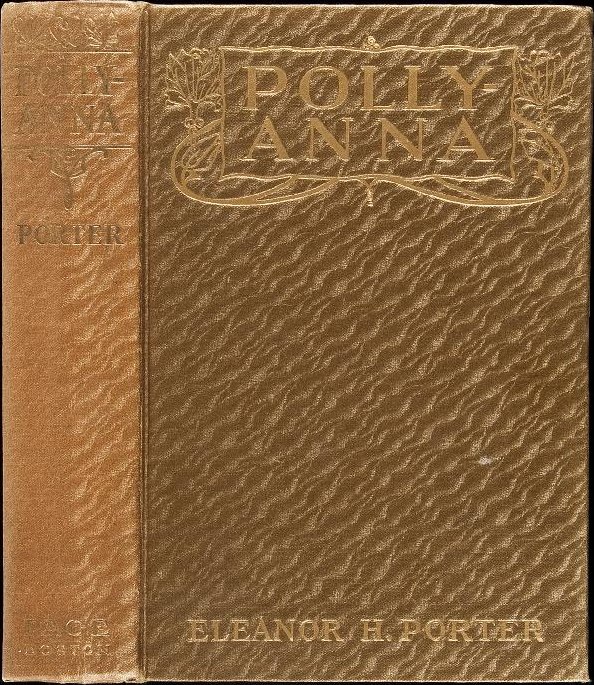
      First edition of Pollyanna, gold-stamped cloth binding with the title in an Art Nouveau frame
      First edition, L. C. Page, Boston, 1913. Wikimedia Commons, public domain.

      No. 8 in 1913; No. 2 in 1914

      Pollyanna

      Eleanor H. Porter, 1913

      A girl who plays 'the glad game' sold about a million copies, launched Glad Clubs, and put a new word for relentless optimism into the dictionary.

      "Oh, yes; the game was to just find something about everything to be glad about—no matter what 'twas," rejoined Pollyanna, earnestly. "And we began right then—on the crutches." "Well, goodness me! I can't see anythin' ter be glad about—gettin' a pair of crutches when you wanted a doll!" Pollyanna clapped her hands. "There is—there is," she crowed. "But I couldn't see it, either, Nancy," she added, with quick honesty. "Father had to tell it to me." "Well, then, suppose you tell me," almost snapped Nancy. "Goosey! Why, just be glad because you don't—need—'em!" exulted Pollyanna, triumphantly.

      Chapter V, "The Game" (1913 L.C. Page edition scanned at the Internet Archive; OCR dropped the apostrophe in 'twas) [11]

      • L.C. Page and Company of Boston published Pollyanna in February 1913, and it was also serialized in The Christian Herald.[12]
      • Mott's Golden Multitudes counted 900,000 copies sold between 1910 and 1919, and new printings were needed every week in the first month.[12]
      • Glad Clubs spread around the country after publication, and a 1914 Christian Herald advertisement said 'people everywhere began to play "the Glad Game".'[12]
      • Webster's Third International Dictionary defines a pollyanna as one having 'irrepressible optimism and a tendency to find good in everything.'[12]
      • Mary Pickford starred in a 1920 silent film that grossed $1.1 million, and Walt Disney's 1960 film starred Hayley Mills.[13]

      The story

      The heroine's name ended up on 'White Mountain Cabins, Colorado Teahouses, Texan babies, Indiana appartment houses and a brand of milk,' according to Grant Overton in 1928. Porter herself grew tired of the craze and told an interviewer, 'You know I have been made to suffer from the Pollyanna books,' because people thought the girl chirped that she was glad about everything.[12]

      “Although the story is sentimental to a degree, it will be enjoyed by a large number of adult and juvenile readers.”Booklist, 1913–1914 [12]

      “There is little artistry in the Pollyanna books, but great sincerity.”Grace Isabel Colbron, The Bookman, May 1915 [12]

      Jacket drawn for the atlas

      No. 4 in 1916; No. 1 in 1917

      Mr. Britling Sees It Through

      H. G. Wells, 1916

      A novel about the First World War written while the war was still raging, it topped the American list and gave grieving readers a mirror.

      It was the sixth day of Mr. Direck's first visit to England, and he was at his acutest perception of differences. He found England in every way gratifying and satisfactory, and more of a contrast with things American than he had ever dared to hope.

      Book I, Chapter the First, "Mr. Direck Visits Mr. Britling" (opening), Project Gutenberg eBook 14060 [14]

      • Macmillan published the novel in September 1916, and 350,000 copies were sold in its first fifteen months at $1.50 a copy.[15]
      • Macmillan reprinted it 19 times by February 1917.[15]
      • Wells's American publisher paid £20,000 for the book.[16]
      • In the novel Mr. Britling's son Hugh is killed at the front, and the book was taken up by military officers and religious leaders and used as a text at a chaplains' school.[16]
      • Macmillan advertised that Wells 'fore-saw the Great War and wrote about its air battles over seven years ago!'[15]

      The story

      Maxim Gorky praised it as 'the finest, most courageous, truthful, and humane book written in Europe in the course of this accursed war.'[16]

      “This is the most thoughtfully and carefully worked out book the Mr. Wells has given us for many a year.”New York Times, September 24, 1916 [15]

      “a pyramid of sand, and the reader must watch every little grain hoisted into place.”Gordon Ray Young, Los Angeles Times, October 15, 1916 [15]

      Jacket drawn for the atlas

      No. 1 in 1918

      The U.P. Trail

      Zane Grey, 1918

      The king of the Western topped the list in the last year of the war with an epic of the Union Pacific railroad, sold to soldiers in a special khaki edition.

      In the early sixties a trail led from the broad Missouri, swirling yellow and turgid between its green-groved borders, for miles and miles out upon the grassy Nebraska plains, turning westward over the undulating prairie, with its swales and billows and long, winding lines of cottonwoods, to a slow, vast heave of rising ground—Wyoming—where the herds of buffalo grazed and the wolf was lord and the camp-fire of the trapper sent up its curling blue smoke from beside some lonely stream; on and on over the barren lands of eternal monotony, all so gray and wide and solemn and silent under the endless sky...

      Chapter I (the chapter is a single sentence; this is its first half), 1918 Harper edition scanned at the Internet Archive [17]

      • Harper & Brothers published The U.P. Trail in January 1918, after it ran as 'The Roaring U.P. Trail' in Blue Book magazine in June 1917.[3]
      • The novel sold 751,926 hardcover copies between 1918 and 1975, according to Hackett and Burke's 80 Years of Best Sellers.[3]
      • Grey sold nearly twenty million copies of his novels in his lifetime, and readers bought at least another twenty million after his death in 1939.[3]
      • A seven-reel film version directed by Jack Conway came out in 1920.[3]
      • Grey was christened Pearl Zane Gray and later changed the spelling of his surname.[3]

      The story

      Harper printed a 'Khaki edition for the soldiers and sailors' on thin paper, bound in flexible leatherette, at the same $1.50 as the cloth edition. The Library of Congress holds Grey's pencil draft of the manuscript, given by his widow.[3]

      “So epic was the tale he has to tell that he needed and has used a big canvas.”New York Times Review of Books, January 20, 1918 [3]

      “The book must be judged an attempt rather than an achievement.”The Nation, April 11, 1918 [3]

      Jacket drawn for the atlas

      No. 1 in 1919

      The Four Horsemen of the Apocalypse

      Vicente Blasco Ibáñez, 1918

      A Spanish war novel in translation became America's top seller at a record price, and its film made Rudolph Valentino a star.

      The change of the seasons was at this time greatly confused in his mind, and evidently demanded some readjustment. Five months had passed since their last interview in this square had afforded the wandering lovers the refuge of a damp, depressing calmness near a boulevard of continual movement close to a great railroad station. The hour of the appointment was always five and Julio was accustomed to see his beloved approaching by the reflection of the recently lit street lamps, her figure enveloped in furs, and holding her muff before her face as if it were a half-mask.

      Part I, Chapter I, "The Tryst" (Dutton, 1919 printing, Jordan translation) [18]

      • E.P. Dutton published Charlotte Brewster Jordan's authorized English translation in 1918, and it was the best-selling novel in the US in 1919 according to Publishers Weekly.[19]
      • It sold 500,000 copies in its first year at $1.90, a price Alice Payne Hackett called 'a new high for a book destined for wide sales.'[20]
      • Publishers Weekly reported in July 1919 that it was the best-selling book in the United States for March, April, May and June.[20]
      • The 1921 Metro film directed by Rex Ingram starred Rudolph Valentino and helped sales of the book, which rose to $2.15.[20]
      • Dutton claimed the novel's sales were not topped until Anthony Adverse in the 1930s.[20]

      The story

      Blasco Ibáñez was born in a room above a corner grocery in Valencia and ran away to Madrid at sixteen. Valencians were so devoted to him that after his death in 1928 he was ceremoniously reinterred in his home city.[20]

      “takes the world for its canvas and glistens with all the varieties of mood and color that one would expect.”New York Times, August 25, 1918 [20]

      “a superbly human story told by a genius.”Publishers Weekly, quoting Dutton [19]

      Sources for this chapter
      1. https://en.wikipedia.org/wiki/Carnegie_library
      2. https://en.wikipedia.org/wiki/Library_War_Service
      3. https://bestsellers.lib.virginia.edu/submissions/15.html
      4. https://en.wikipedia.org/wiki/Pulp_magazine
      5. https://en.wikipedia.org/wiki/Modern_Library
      6. https://archive.org/stream/rosar00barc/rosar00barc_djvu.txt
      7. https://bestsellers.lib.virginia.edu/submissions/250.html
      8. https://en.wikipedia.org/wiki/Florence_L._Barclay
      9. https://archive.org/stream/harvester00stra/harvester00stra_djvu.txt
      10. https://en.wikipedia.org/wiki/Gene_Stratton-Porter
      11. https://archive.org/stream/pollyanna00port_2/pollyanna00port_2_djvu.txt
      12. https://bestsellers.lib.virginia.edu/submissions/111.html
      13. https://en.wikipedia.org/wiki/Pollyanna
      14. https://gutenberg.org/files/14060/14060-h/14060-h.htm
      15. https://bestsellers.lib.virginia.edu/submissions/380.html
      16. https://en.wikipedia.org/wiki/Mr._Britling_Sees_It_Through
      17. https://archive.org/stream/theuptrail00greyrich/theuptrail00greyrich_djvu.txt
      18. https://distantreader.org/stacks/trust/uc2/uc2_ark+=13960=t3hx17x99.txt
      19. https://en.wikipedia.org/wiki/The_Four_Horsemen_of_the_Apocalypse_(novel)
      20. https://bestsellers.lib.virginia.edu/submissions/303.html

      Chapter 4 · 1920–1929

      Main Street and the Jazz Age

      Sinclair Lewis and Zane Grey shared the decade’s top spot with five list years each. The book this decade is remembered for never made its top ten at all.

      100top-ten slots in our record
      56different authors
      23%of slots held by the top five
      Zane Greymost listed, 5 times

      How America read

      The Book-of-the-Month Club was founded in 1926; a panel of judges picked the books, and it grew from 4,000 subscribers to more than 550,000 within twenty years.[1]
      E. Haldeman-Julius's Little Blue Books, launched in 1919 and sold mostly by mail order, cost 5 cents a copy for many years, and an estimated 300 to 500 million were sold.[2]
      Retitling sold books: a Maupassant story sold 15,000 copies a year as 'The Tallow Ball' and 54,700 the next year under a new name.[2]
      Boston's Watch and Ward Society helped get books banned, including Elmer Gantry and Theodore Dreiser's An American Tragedy in 1927, and H. L. Mencken was arrested in Boston in 1926 for selling a banned issue of his magazine.[3]
      Publishers were often pleased to be 'banned in Boston,' because a ban gave a book more appeal everywhere else.[3]
      Pulp magazines reached their peak of popularity from the 1920s, and the most successful sold up to one million copies an issue.[4]

      Jacket drawn for the atlas

      No. 1 in 1921

      Main Street

      Sinclair Lewis, 1920

      Lewis's satire of a Minnesota small town was the sensation of 1921 and helped carry him to the 1930 Nobel Prize.

      On a hill by the Mississippi where Chippewas camped two generations ago, a girl stood in relief against the cornflower blue of Northern sky. She saw no Indians now; she saw flour-mills and the blinking windows of skyscrapers in Minneapolis and St. Paul. Nor was she thinking of squaws and portages, and the Yankee fur-traders whose shadows were all about her. She was meditating upon walnut fudge, the plays of Brieux, the reasons why heels run over, and the fact that the chemistry instructor had stared at the new coiffure which concealed her ears.

      Chapter 1 (opening) [5]

      • Harcourt, Brace and Howe published Main Street in October 1920 at $2.00, and it sold 295,000 copies in 1921.[6]
      • The novel sold 930,929 copies through 1975, according to Hackett.[6]
      • Warner Brothers bought the film rights for $40,000 and released the film in 1923, and the studio reported a loss on it.[6]
      • Lewis dedicated the book 'To Gracie, who is all the good part of Carol,' and told a friend that 'Carol is "Red" Lewis.'[6]
      • Demand caught the publisher by surprise, and when the printer reported broken type Harcourt said 'don't stop the press until it collapses,' so the defects were never fixed.[6]

      The story

      Families fought over the one copy in the house. The writer Philip Curtiss reported of his own household, 'We slip away from the table early so as to get it before anyone else.'[6]

      “It is, in brief, good stuff.”H. L. Mencken, The Smart Set, January 1921 [6]

      “the best novel written in these United States in a decade, I'll eat my hat.”John Peter Toohey, in a Harcourt advertisement, November 13, 1920 [6]

      Jacket drawn for the atlas

      No. 6 in 1921; No. 2 in 1922

      The Sheik

      E. M. Hull, 1919

      A desert romance by an English country wife scandalized critics, sold over a million copies, and turned Rudolph Valentino into one of the screen's first male sex symbols.

      "Are you coming in to watch the dancing, Lady Conway?" "I most decidedly am not. I thoroughly disapprove of the expedition of which this dance is the inauguration. I consider that even by contemplating such a tour alone into the desert with no chaperon or attendant of her own sex, with only native camel drivers and servants, Diana Mayo is behaving with a recklessness and impropriety that is calculated to cast a slur not only on her own reputation, but also on the prestige of her country. I blush to think of it.

      Chapter I (opening), Small, Maynard & Company, Boston, 1921 [7]

      • Hull's novel quickly sold more than 1.2 million copies worldwide.[8]
      • When it was published it was considered an erotic novel and was described in the press as 'shocking' and 'poisonously salacious.'[9]
      • The 1921 Paramount film with Rudolph Valentino was made for under $200,000 and passed $1 million in ticket sales in its first year.[10]
      • The film made 'sheik' slang for a young man on the prowl, and the object of his desire became 'a Sheba.'[10]
      • The Sheik set off a major and influential revival of the desert romance, though it has been strongly criticized for its idea that rape leads to love.[9]

      The story

      Hull lived quietly on her husband's family estate in Derbyshire, where he later became a prize-winning pig farmer, and the book's success surprised her. She avoided publicity and later regretted that she had sold the film rights to her novels for too little money.[8]

      “embodying the typist's day-dream”Q. D. Leavis [9]

      Jacket drawn for the atlas

      No. 2 in 1926

      Gentlemen Prefer Blondes

      Anita Loos, 1925

      Lorelei Lee's misspelled diary was a surprise smash that made James Joyce and Edith Wharton laugh and became a Marilyn Monroe film.

      A gentleman friend and I were dining at the Ritz last evening and he said that if I took a pencil and a paper and put down all of my thoughts it would make a book. This almost made me smile as what it would really make would be a whole row of encyclopediacs. I mean I seem to be thinking practically all of the time. I mean it is my favorite recreation and sometimes I sit for hours and do not seem to do anything else but think.

      Chapter One, "Gentlemen Prefer Blondes" (the diary entry of March 16th), Boni & Liveright, 1925 [11]

      • The whole novel first ran in installments in Harper's Bazaar in 1925, and by the final episode in August it had become a huge success.[12]
      • Boni & Liveright's small first printing sold out overnight, a second printing of 20,000 followed two weeks later, and by May 1926 the book had sold over 115,000 copies.[12]
      • A 1926 advertisement priced it at $1.75.[12]
      • A stage version opened September 28, 1926; a 1949 musical starred Carol Channing; and the 1953 film starred Marilyn Monroe and Jane Russell.[12]

      The story

      Loos never meant the sketches for publication, but H. L. Mencken read them and told her, 'you're making fun of sex and that's never been done before in the USA,' and suggested she send them to Harper's Bazaar. Edith Wharton later wrote to a friend that she was 'now reading the great American novel (at last!)'[12]

      “Miss Loos's book is civilized, human, ironic, and never crude in its effects.”H. J. Mankiewicz, New York Times [12]

      “it is the kind of sly, sophisticated spontaneity that will make any man and most women roar with laughter.”Boston Transcript [12]

      Jacket drawn for the atlas

      No. 1 in 1927

      Elmer Gantry

      Sinclair Lewis, 1927

      Lewis's portrait of a hypocritical preacher was the top novel of 1927 and one of the decade's great censorship fights.

      Elmer Gantry was drunk. He was eloquently drunk, lovingly and pugnaciously drunk. He leaned against the bar of the Old Home Sample Room, the most gilded and urbane saloon in Cato, Missouri, and requested the bartender to join him in “The Good Old Summer Time,” the waltz of the day.

      Chapter I (opening); text of the 1927 Harcourt, Brace novel as reprinted by Signet, scanned at the Internet Archive [13]

      • Elmer Gantry was the best-selling work of fiction in the United States in 1927.[14]
      • It was banned in Boston and in other cities.[14]
      • Lewis dedicated the novel to his friend H. L. Mencken.[14]
      • Richard Brooks's 1960 film starred Burt Lancaster and won Brooks the Academy Award for Best Adapted Screenplay.[14]

      The story

      To research the book Lewis gathered about fifteen ministers from different denominations in Kansas City for weekly meetings, a group later called 'Sinclair Lewis's Sunday School Class.' After publication one cleric suggested Lewis be imprisoned for five years.[14]

      Jacket drawn for the atlas

      No. 1 in 1928

      The Bridge of San Luis Rey

      Thornton Wilder, 1927

      A short, philosophical novel by an unknown schoolteacher became the top seller of 1928, won the Pulitzer, and is still read today.

      On Friday noon, July the twentieth, 1714, the finest bridge in all Peru broke and precipitated five travellers into the gulf below. This bridge was on the highroad between Lima and Cuzco and hundreds of persons passed over it every day. It had been woven of osier by the Incas more than a century before and visitors to the city were always led out to see it. It was a mere ladder of thin slats swung out over the gorge, with handrails of dried vine.

      Part One, "Perhaps an Accident" (opening), Project Gutenberg eBook 69768 [15]

      • Albert & Charles Boni published the novel in 1927, and it sold 240,000 copies in its first year, becoming the No. 1 fiction bestseller of 1928.[16]
      • It cost $2.50, and by March 1958 more than two million copies had been sold.[16]
      • It won the Pulitzer Prize, and MGM filmed it in 1929 and again in 1944.[16]
      • Pocket Books' paperback sales alone had reached 1,189,764 copies by 1981.[16]

      The story

      Wilder said the idea came to him on the winding walk from the golf club to the Graduate College at Princeton. The book's success meant, as Yankee magazine put it in 1978, that an 'overnight and unknown school teacher became a celebrity.'[16]

      “A work of genius. I regard the author as already attained to the front rank of living novelists.”William Lyon Phelps, New York Times Book Review ad, January 8, 1928 [16]

      “One hundred thousand individuals have been paying $2.50 apiece for an unusually brief novel”Harry Salpeter, Outlook, 1928 [16]

      Jacket drawn for the atlas

      No. 1 in 1929

      All Quiet on the Western Front

      Erich Maria Remarque, 1929

      A German soldier's war novel sold over a million copies in a year, topped the American list, and was later burned by the Nazis.

      We are at rest five miles behind the front. Yesterday we were relieved, and now our bellies are full of beef and haricot beans. We are satisfied and at peace. Each man has another mess-tin full for the evening; and, what is more, there is a double ration of sausage and bread. That puts a man in fine trim. We have not had such luck as this for a long time.

      Chapter One (opening), A. W. Wheen translation, 1929, Project Gutenberg eBook 75011 [17]

      • Little, Brown published A. W. Wheen's translation in 1929 at $2.50, and it went through 17 printings in its first seven months.[18]
      • It sold over a million copies in a single year.[18]
      • The Book-of-the-Month Club News predicted in May 1929 that it would become what The Red Badge of Courage had become to the Civil War.[18]
      • Universal's 1930 film, directed by Lewis Milestone, followed within a year.[18]
      • The Nazis rejected the novel, Remarque fled Germany for Switzerland, and he later had his German citizenship revoked.[18]

      The story

      Remarque wrote the novel in less than six weeks, and it was first serialized in the Berlin newspaper Vossische Zeitung in late 1928. He had changed his name, taking his mother's name Maria and his great-grandfather's spelling of Remarque.[18]

      “It is an objective book, an ironic book, but it is never callous”New York Times, June 2, 1929 [18]

      “It is written with simplicity and candor”New Republic, June 19, 1929 [18]

      Sources for this chapter
      1. https://en.wikipedia.org/wiki/Book_of_the_Month_Club
      2. https://en.wikipedia.org/wiki/Little_Blue_Books
      3. https://en.wikipedia.org/wiki/Banned_in_Boston
      4. https://en.wikipedia.org/wiki/Pulp_magazine
      5. https://etc.usf.edu/lit2go/38/main-street/482/chapter-1/
      6. https://bestsellers.lib.virginia.edu/submissions/261.html
      7. https://archive.org/stream/sheiknovel00hull/sheiknovel00hull_djvu.txt
      8. https://en.wikipedia.org/wiki/E._M._Hull
      9. https://en.wikipedia.org/wiki/The_Sheik_(novel)
      10. https://en.wikipedia.org/wiki/The_Sheik_(film)
      11. https://archive.org/stream/gentlemenpreferb00loos/gentlemenpreferb00loos_djvu.txt
      12. https://bestsellers.lib.virginia.edu/submissions/175.html
      13. https://archive.org/stream/elmergantry0000sinc_b9l8/elmergantry0000sinc_b9l8_djvu.txt
      14. https://en.wikipedia.org/wiki/Elmer_Gantry
      15. https://m.gutenberg.org/ebooks/69768.txt.utf-8
      16. https://bestsellers.lib.virginia.edu/submissions/125.html
      17. https://gutenberg.org/ebooks/75011.txt.utf-8
      18. https://bestsellers.lib.virginia.edu/submissions/26.html

      Plate III · 1895–1930 against today

      326 bestsellers. Three still get read.

      Each dot is a different novel that made the US top ten between 1895 and 1930. The lit ones are the only three that appear among Project Gutenberg's 192 most-downloaded books in a recent 30-day count: The Hound of the Baskervilles, The Enchanted April and The Woman of Andros. Every one of them is now old enough to be in the US public domain, free for anyone to read. Almost nobody does.

      Hover or tap a dot.

      This is what the internet downloads instead. The Great Gatsby sits at No. 23 below, and it never made the annual top ten in 1925. It reached the list in 2013.

      Sources: annual US bestseller lists as compiled on Wikipedia; Project Gutenberg top downloads over 30 days, captured for this project. Titles matched by name; an edition under a different title may be missed.

      Chapter 5 · 1930–1939

      Escape, Priced for Hard Times

      The Depression bought long books. The Good Earth, Anthony Adverse and Gone with the Wind each held No. 1 for two straight years.

      100top-ten slots in our record
      60different authors
      20%of slots held by the top five
      Lloyd C. Douglasmost listed, 6 times

      How America read

      The New York Times first published a best-seller list on October 12, 1931; it covered five fiction and four nonfiction books for New York City only.[1]
      Within a month the Times list expanded to eight cities, each with its own list, and a national list arrived on April 9, 1942.[1]
      Pocket Books produced the first mass-market pocket-sized paperbacks in the United States in 1939, priced at 25 cents with Gertrude the kangaroo as their logo.[2]
      The first ten Pocket Books, published in May 1939, included James Hilton's Lost Horizon and Felix Salten's Bambi, and the company sold more than 1.5 million copies by year's end.[2]
      Pulp magazines still crowded the newsstands: in 1934 the writer Frank Gruber counted some 150 pulp titles.[3]
      Attempts to suppress and censor The Grapes of Wrath directly inspired the American Library Association's Library Bill of Rights.[4]

      Jacket drawn for the atlas

      No. 1 in 1930

      Cimarron

      Edna Ferber, 1930

      Ferber's saga of the Oklahoma Land Rush was the best-selling novel of 1930 and its 1931 film won the Oscar for Best Picture.

      • Cimarron was published in April 1930, follows Yancey and Sabra Cravat in Oklahoma after the Land Rush, and was the best-selling novel of 1930.[5]
      • Ferber originally intended the novel as a satirical criticism of American womanhood and American sentimentality.[5]
      • RKO's 1931 film won the Academy Award for Best Picture but did not earn back its budget during the Depression.[6]
      • The book was not a hit in Oklahoma, where readers objected to its critical view of the treatment of Native Americans.[6]

      The story

      Ferber, a tough businesswoman even as she claimed not to be, sold the film rights to RKO for roughly $100,000 to $125,000.[6]

      “there is still a hollow sound about it, as of someone drumming in a well.”Cincinnati Enquirer, March 29, 1930 [6]

      Jacket drawn for the atlas

      No. 1 in 1931 and 1932

      The Good Earth

      Pearl S. Buck, 1931

      A missionary's daughter's novel of a Chinese farmer gave Depression-era Americans a story of drought and survival, won the Pulitzer and led to a Nobel Prize.

      It was Wang Lung's marriage day.

      Chapter One (opening line) [7]

      • The John Day Company published The Good Earth on March 2, 1931, with a first printing of 55,000.[8]
      • It was the best-selling novel in the United States in both 1931 and 1932 and won the Pulitzer Prize for Fiction in 1932.[9]
      • Buck learned to speak Chinese before English and wrote the book in three months.[8]
      • MGM paid Buck $50,000 for the film rights, and Luise Rainer won an Oscar as O-lan in the 1937 film.[8]
      • In 1938 Buck became the first American woman to win the Nobel Prize in Literature.[8]

      The story

      Demand was so high that the publisher, Richard Walsh, had to borrow copies from the Book-of-the-Month Club to stock bookstores. Buck had found her literary agent by picking his name at random from a writer's guide in an English-language bookstore in Shanghai.[8]

      “A beautiful, beautiful book. At last we read, in the pages of a novel, of the real people of China.”Saturday Review of Literature, 1931 [8]

      “Mrs. Buck does not understand the meaning of the Confucian separation of man's kingdom from that of woman”Younghill Kang, New Republic, July 1, 1931 [8]

      Jacket drawn for the atlas

      No. 1 in 1933 and 1934

      Anthony Adverse

      Hervey Allen, 1933

      A half-million-word historical romance that weighed nearly three pounds was the top novel two years running, proof that Depression readers wanted long escapes.

      • Farrar & Rinehart published the 1,224-page novel at $3 in 1933, and Time noted that it weighed 2¾ pounds.[10]
      • It was the July 1933 choice of the Book-of-the-Month Club.[10]
      • Anthony Adverse was the Publishers Weekly best-selling novel in the United States in both 1933 and 1934.[11]
      • The 1936 Warner Bros. film won four Academy Awards and was the studio's most popular release of the year.[12]

      The story

      Allen spent five years in Bermuda writing and farming, and wrote most of the book's 500,000 words in an old house in Somerset Parish that he believed had been built by a retired pirate.[10]

      “Not a great book, except in size, Anthony Adverse is a solid, worthy addition to U. S. Letters.”Time, June 26, 1933 [10]

      “It is a thriller de luxe, but it is more than a melodrama of the most intricate happenings.”Fanny Butcher [11]

      Jacket drawn for the atlas

      No. 1 in 1936 and 1937

      Gone with the Wind

      Margaret Mitchell, 1936

      The best-selling American novel of the century sold a million copies in six months at a then-startling $3 and became the most famous film of its era.

      • Macmillan published the novel on May 31, 1936, with a first printing of 60,000 copies at $3.[13]
      • Six months after its release, in December 1936, it had sold one million copies, and by fall 1941 it had sold 2,868,200.[13]
      • Less than a month after publication David O. Selznick bought the film rights for $50,000, and the 1939 film won the Academy Award.[13]
      • Mitchell began writing in 1926 while recovering from an injury, wrote the final scene first, and won the Pulitzer Prize in 1937.[14]
      • Its working title was Tomorrow Is Another Day, taken from its last line.[14]

      The story

      Macmillan editor Harold Latham traveled to Atlanta on a scouting tour, heard about Mitchell and obtained her manuscript. Fame did not suit her: at 36 she was a national celebrity, and she spent the next twelve years answering fan mail and lawsuits, while merchandise down to 'The Scarlett O'Hara' underwear carried her heroine's name.[13]

      “best Civil War novel ever written”J. D. Adams, New York Times, July 5, 1936 [13]

      “It is a good novel rather than a great one.”Stephen Vincent Benét, Saturday Review of Literature, July 1936 [13]

      Jacket drawn for the atlas

      No. 4 in 1938; No. 3 in 1939

      Rebecca

      Daphne du Maurier, 1938

      A gothic romance with a nameless narrator and one of the most famous opening lines in English has never gone out of print.

      Last night I dreamt I went to Manderley again.

      Chapter 1 (opening line), as quoted on Wikipedia [15]

      • Doubleday, Doran published the American first edition in September 1938 at $2.75, and Doubleday sold 205,706 copies in 1938 including book club editions.[16]
      • Rebecca has never gone out of print and sold 2.8 million copies between 1938 and 1965.[15]
      • Neither the narrator's first name nor her maiden name is ever revealed.[15]
      • Alfred Hitchcock's 1940 film won the Academy Award for Best Picture.[16]
      • Du Maurier based Manderley on Menabilly, a house in Cornwall.[16]

      The story

      Du Maurier disliked public appearances. After attending a Foyle's Literary Lunch as a favor to her publisher Victor Gollancz, she vowed never to go to another, believing 'authors never should be seen or heard,' yet she answered every fan letter that came with a stamped, self-addressed envelope.[16]

      “Rebecca is a spellbinder: give the book 60 pages, and you're caught”Atlantic Monthly, December 1938 [16]

      “Miss du Maurier writes well, but not well enough. Her plot is good, but not good enough”Canadian Forum, October 1938 [16]

      Jacket drawn for the atlas

      No. 1 in 1939

      The Grapes of Wrath

      John Steinbeck, 1939

      Steinbeck's Dust Bowl epic was the best-selling book of 1939, was banned and burned, and won the Pulitzer.

      For the quality of owning freezes you forever into "I", and cuts you off forever from the "we".

      Chapter 14 [4]

      • Viking published the novel in April 1939 at $2.75.[17]
      • It was the best-selling book of 1939, and 430,000 copies had been printed by February 1940.[4]
      • It was publicly banned and burned by citizens, and the Associated Farmers of California denounced it as a 'pack of lies' and 'communist propaganda.'[17]
      • It won the Pulitzer Prize for Fiction, and John Ford's 1940 film starred Henry Fonda.[17]
      • The Nobel committee later cited The Grapes of Wrath as a 'great work.'[4]

      The story

      Before the novel, Steinbeck wrote seven articles for the San Francisco News about migrant workers, later collected as the pamphlet 'Their Blood is Strong.' Once the book was out, he refused to promote it, believing it should sell on its own merit.[17]

      “To me, The Grapes of Wrath is the summation of eighteen years of realism.”Edward Weeks, The Atlantic, 1939 [17]

      “mess of silly propaganda, superficial observation”Burton Rascoe, Newsweek, 1939 [17]

      Sources for this chapter
      1. https://en.wikipedia.org/wiki/The_New_York_Times_Best_Seller_list
      2. https://en.wikipedia.org/wiki/Pocket_Books
      3. https://en.wikipedia.org/wiki/Pulp_magazine
      4. https://en.wikipedia.org/wiki/The_Grapes_of_Wrath
      5. https://en.wikipedia.org/wiki/Cimarron_(novel)
      6. https://www.literaryladiesguide.com/?p=20046
      7. https://www.powells.com/book/good-earth-9780743272933/1759324
      8. https://bestsellers.lib.virginia.edu/submissions/55.html
      9. https://en.wikipedia.org/wiki/The_Good_Earth
      10. https://time.com/archive/6819450/books-big-book/
      11. https://en.wikipedia.org/wiki/Anthony_Adverse_(novel)
      12. https://en.wikipedia.org/wiki/Anthony_Adverse
      13. https://bestsellers.lib.virginia.edu/submissions/19.html
      14. https://en.wikipedia.org/wiki/Gone_with_the_Wind_(novel)
      15. https://en.wikipedia.org/wiki/Rebecca_(novel)
      16. https://bestsellers.lib.virginia.edu/submissions/45.html
      17. https://bestsellers.lib.virginia.edu/submissions/29.html

      Chapter 6 · 1940–1949

      Books Go to War

      A country at war read about faith and scandal at once. The Robe and Forever Amber both topped the list in the same decade.

      100top-ten slots in our record
      57different authors
      22%of slots held by the top five
      Lloyd C. Douglasmost listed, 6 times

      How America read

      Pocket Books launched the first mass-market, pocket-sized American paperbacks in 1939 at 25 cents each, and sold more than 1.5 million copies by the end of that year; its Wuthering Heights sold out a 100,000-copy run in its first week.[1]
      Pocket and its imitators thrived during World War II because material shortages worked to their advantage.[1]
      From 1943 to 1947 the Council on Books in Wartime, whose slogan was "Books are weapons in the war of ideas," printed more than 122 million Armed Services Editions of over 1,300 titles, at about 6 cents a copy, for free distribution to American troops.[2]
      Soldiers wrote that the Armed Services Editions were "as popular as pin-up girls," newspapers described them being "read to tatters," and before the Normandy invasion each man boarding a transport in southern England was handed a book.[2]
      On April 9, 1942, The New York Times began printing a national bestseller list in its Sunday Book Review, ranking books by how often they appeared on its city lists.[3]
      The Book-of-the-Month Club, founded in 1926 with 4,000 subscribers, had more than 550,000 members within twenty years; members who did not return a reply card were mailed the month's Main Selection automatically.[4]

      Jacket drawn for the atlas

      No. 7 in 1942, No. 1 in 1943, No. 2 in 1944 and 1945, No. 1 again in 1953

      The Robe

      Lloyd C. Douglas, 1942

      A former minister's novel about the soldier who won Christ's robe at the crucifixion became the defining religious blockbuster of the war years and returned to No. 1 a decade later with the first CinemaScope film.

      • The Robe entered the New York Times bestseller list in October 1942, reached No. 1 four weeks later and held that spot for nearly a year.[5]
      • Douglas left the ministry and did not begin his literary career until he was in his fifties; at the height of his fame he received about 100 fan letters a week.[5]
      • The novel sold 3,724,391 copies by Hackett's 1967 count, and it sold for $2.75 through most of the 1940s.[6]
      • Producer Frank Ross bought the film rights in 1942 for $100,000, before the novel was finished, and later sold them to Twentieth Century-Fox for $300,000 plus $650,000 from future profits.[7]
      • The 1953 film was the first movie released in CinemaScope; it premiered at New York's Roxy Theatre on September 16, 1953, took a record $36,000 there in one day, and ran No. 1 at the US box office for nine straight weeks.[7]

      The story

      The idea came in a letter from Hazel McCann, a department store clerk in Ohio, who asked Douglas what he thought had happened to Christ's garments after the crucifixion. He started the novel at once and mailed her each chapter as he finished it. The two finally met in 1941, and he dedicated the book to her.[5]

      “Dr. Douglas has woven, in THE ROBE, an almost unrivalled fabric of old cliches”Edmund Wilson, The New Yorker, 1944 [6]

      “one of the great literary successes of all time”Edmund Wilson, The New Yorker, 1944 (on its sales) [6]

      Jacket drawn for the atlas

      No. 4 in 1943, No. 3 in 1944

      A Tree Grows in Brooklyn

      Betty Smith, 1943

      Betty Smith's semi-autobiographical novel of a poor Williamsburg girl became the book American soldiers carried in their pockets, and it is still read today.

      • The novel began as a nonfiction manuscript called They Lived in Brooklyn that publishers kept rejecting; in 1942 Smith entered it in a Harper & Brothers contest, and the editors had her expand it into a novel and change the title.[8]
      • Twentieth Century-Fox bought the film rights two months before publication for $55,000, and the novel sold about 300,000 copies in its first six weeks.[9]
      • Wartime paper shortages slowed production, and in August 1944 Harper handed the reprint to Doubleday, which had bought another publisher partly for its paper supply.[9]
      • The pocket-sized Armed Services Edition was one of the most popular books sent free to US troops; it was first printed as series D-117 (about 50,000 copies) and quickly reprinted as K-28.[8]
      • Elia Kazan's 1945 film won James Dunn the Oscar for Best Supporting Actor and Peggy Ann Garner a special award as outstanding child actress.[8]

      The story

      Smith said she received ten times more fan mail from soldiers than from civilians. One Marine wrote to her: "I can't explain the emotional reaction that took place in this dead heart of mine..."[8]

      “a remarkably good first novel”New York Times, 1943 [9]

      “A welcome relief from the latter-day fashion of writing about slum folk as if they were all brutalized morons.”New York Times, 1943 [9]

      Jacket drawn for the atlas

      No. 1 in 1944

      Strange Fruit

      Lillian Smith, 1944

      Lillian Smith's novel of an interracial love affair and a lynching topped the list, was banned in Boston, and was briefly barred from the US mails until Eleanor Roosevelt stepped in.

      • Published on February 29, 1944, Strange Fruit topped the New York Times Book Review list within a few months and sold about a million hardcover copies.[10]
      • Smith took the title from Billie Holiday's song about lynching; her working title had been Jordan Is So Chilly.[11]
      • On March 20, 1944, the book was banned in Boston and Detroit; it was the first No. 1 bestseller banned in Boston, and the Detroit ban was overturned after the United Auto Workers and the Detroit Public Library appealed.[10]
      • The complaint objected that a four-letter word was printed twice; Smith said she "wanted no other word in that place and she intends it to stay there," and her publisher refused to change it.[11]
      • Selling at $2.75, the novel had 350,000 copies in print by July 1944 and was selling 19,000 copies a week.[11]

      The story

      To test the Boston ban, the critic Bernard DeVoto publicly bought a copy at the Harvard Law Book Exchange; the store's owner was charged, found guilty and fined $200. When the Post Office then stopped interstate shipments in May 1944, publisher Curtice Hitchcock appealed to Eleanor Roosevelt, who urged the President to lift the ban, and it ended after three days.[10]

      “the tragedy of the South is explicit in every line”New York Times Book Review, March 5, 1944 [11]

      “she sins against good taste so grossly as to make her story quite unfit for general circulation”Catholic World, May 1944 [11]

      Jacket drawn for the atlas

      No. 4 in 1944, No. 1 in 1945

      Forever Amber

      Kathleen Winsor, 1944

      A 972-page Restoration romp by a first novelist was banned in fourteen states and still became the best-selling American novel of the decade.

      • Forever Amber sold over 100,000 copies in its first week and eventually more than three million; it was the best-selling American novel of the 1940s.[12]
      • Winsor's manuscript ran to about two and a half million words, the publishers cut it to about a fifth, and she claimed to have read 356 books on the Restoration period while writing it.[13]
      • Fourteen states banned it as pornography, Massachusetts first; the state's attorney general counted 70 references to sexual intercourse, 39 illegitimate pregnancies, 7 abortions and "10 descriptions of women undressing in front of men."[12]
      • Macmillan priced it at $3.00, and in its second year (1945) it sold 868,630 copies.[14]
      • Twentieth Century Fox bought the film rights within a month of publication and released Otto Preminger's toned-down version in 1947.[13]

      The story

      Winsor always denied the book was daring: "I wrote only two sexy passages. My publishers took both of them out. They put in ellipses instead." She added, "In those days, you know, you could solve everything with an ellipsis." Bandleader Artie Shaw had scolded his then-wife Ava Gardner for reading the "trashy novel" two years before he married Winsor herself.[12]

      “seethes with life. Its action never flags.”Arthur D. Howden Smith, Saturday Review [12]

      “quite simply, it entertains you in the most preposterous, flamboyant, unaesthetic way.”Frances Woodward [14]

      Jacket drawn for the atlas

      No. 3 in 1947

      Gentleman's Agreement

      Laura Z. Hobson, 1947

      A magazine writer who poses as Jewish to report on genteel antisemitism turned a book its author expected nobody to buy into a No. 1 bestseller and a Best Picture winner.

      • Cosmopolitan serialized the novel in four parts from November 1946 to February 1947; the first printing of 30,000 copies, priced at $2.75, sold out three days after publication.[15]
      • The book reached No. 1 on the New York Times list on April 27, 1947, and had sold 1,221,986 copies by Hackett's 1976 count.[15]
      • Hobson pitched the idea as a book that "the magazines will never look at, the movies won't touch, and the public won't buy."[15]
      • Elia Kazan's 1947 film, starring Gregory Peck, won three Academy Awards including Best Picture.[15]

      The story

      Advisers warned producer Darryl F. Zanuck against filming the novel, asking "Why rock the boat?" He made it anyway, telling his writers: "if you have something worthwhile to say, dress it in the glittering robes of entertainment."[15]

      “required reading for every thoughtful citizen in this perilous century”New York Times Book Review [16]

      “Unfortunately the story is not as good as the sermon.”E.R. Embree, Chicago Sun Book Week, March 2, 1947 [15]

      Jacket drawn for the atlas

      No. 2 in 1948

      The Naked and the Dead

      Norman Mailer, 1948

      A 25-year-old veteran's brutal Pacific war novel made Mailer famous overnight and gave the language the euphemism "fug."

      • Rinehart published the novel in 1948, when Mailer was 25; he drew on his service as a cook with the 112th Cavalry Regiment in the Philippines.[17]
      • The book sold 200,000 copies in its first three months and stayed on the New York Times bestseller list for 62 weeks.[17]
      • The publishers would not let Mailer print "fuck," so he wrote "fug" instead, and the band the Fugs later took its name from the euphemism.[17]
      • The book cost $4.00 when most novels were $2.95, and it was banned in Canada and Australia.[18]
      • In 1998 the Modern Library ranked it 51st among the 100 best English-language novels of the 20th century.[17]

      The story

      Mailer later recalled that Tallulah Bankhead's press agent planted a story in the papers in which the actress greeted him: "Oh, hello, you're Norman Mailer," and called him the young man who didn't know how to spell the word he had replaced with "fug." The papers printed the word as asterisks.[17]

      “by far the most impressive piece of fiction to date about Americans in the Second World War.”C.J. Rolo, Atlantic, June 1948 [18]

      “virtually a Kinsey Report on the sexual behavior of the GI.”David Dempsey, New York Times, 1948 [18]

      Sources for this chapter
      1. https://en.wikipedia.org/wiki/Pocket_Books
      2. https://en.wikipedia.org/wiki/Armed_Services_Editions
      3. https://en.wikipedia.org/wiki/The_New_York_Times_Best_Seller_list
      4. https://en.wikipedia.org/wiki/Book_of_the_Month_Club
      5. https://en.wikipedia.org/wiki/The_Robe
      6. https://bestsellers.lib.virginia.edu/submissions/249.html
      7. https://en.wikipedia.org/wiki/The_Robe_(film)
      8. https://en.wikipedia.org/wiki/A_Tree_Grows_in_Brooklyn_(novel)
      9. https://bestsellers.lib.virginia.edu/submissions/144.html
      10. https://en.wikipedia.org/wiki/Strange_Fruit_(novel)
      11. https://bestsellers.lib.virginia.edu/submissions/206.html
      12. https://en.wikipedia.org/wiki/Forever_Amber_(novel)
      13. https://en.wikipedia.org/wiki/Kathleen_Winsor
      14. https://bestsellers.lib.virginia.edu/submissions/231.html
      15. https://bestsellers.lib.virginia.edu/submissions/171.html
      16. https://en.wikipedia.org/wiki/Gentleman%27s_Agreement_(novel)
      17. https://en.wikipedia.org/wiki/The_Naked_and_the_Dead
      18. https://bestsellers.lib.virginia.edu/submissions/40.html

      Chapter 7 · 1950–1959

      The Paperback Decade

      Sixty-two different authors shared the decade’s one hundred top-ten slots, tied with the 1960s for the most of any decade. It was the paperback’s first full decade.

      100top-ten slots in our record
      62different authors
      20%of slots held by the top five
      Frances Parkinson Keyesmost listed, 5 times

      How America read

      Fawcett launched Gold Medal Books in 1950 as a line of paperback originals, paying a $2,000 advance on a first printing of 200,000 copies; titles like Bruno Fischer's House of Flesh sold 1.8 million copies.[1]
      Mickey Spillane's I, the Jury sold 6.5 million copies in hardcover and 25-cent Signet paperback, and a 1956 survey found his six novels among the ten best-selling American fiction titles of all time.[2]
      Fredric Wertham's Seduction of the Innocent (1954) blamed comics for juvenile delinquency; after televised Senate hearings that April, 15 comic publishers went out of business and the industry created the self-censoring Comics Code Authority.[3]
      In Roth v. United States (1957) the Supreme Court defined obscenity as material whose "dominant theme taken as a whole appeals to the prurient interest" of the average person, replacing the old rule that let isolated passages justify a ban.[4]
      In 1959 Grove Press published an unexpurgated Lady Chatterley's Lover; when the Post Office seized copies, publisher Barney Rosset sued and won in New York and on federal appeal.[5]
      By the 1950s the New York Times list and Publishers Weekly's list were the lists the book trade watched, and in 1956 Jean Shepherd's fans pushed requests for a nonexistent novel, I, Libertine, to show how demand could be faked.[6]

      Jacket drawn for the atlas

      No. 1 in 1951, No. 5 in 1953

      From Here to Eternity

      James Jones, 1951

      Jones's profane novel of peacetime army life at Schofield Barracks before Pearl Harbor won the National Book Award and became an eight-Oscar film.

      Gentlemen-rankers, out on a spree, damned from here to eternity. God ha' mercy on such as we.

      The novel's epigraph, from Rudyard Kipling's poem "Gentleman-Rankers" (as quoted by NPR) [7]

      • The novel sold 240,000 copies in 1951, making it the year's No. 1 bestseller, and 3,351,400 copies by 1975.[8]
      • It won the National Book Award in 1952.[9]
      • Before the 1953 film the book sold about 500 copies a month; after the film it sold about 4,000 a week, and Variety suggested readers wanted to find out what words Jones had used.[9]
      • Scribner's made Jones cut expletives and gay sex scenes before publication; his daughter Kaylie Jones revealed this in 2009, and a restored edition appeared in 2011.[9]
      • Life magazine ran an article on the book titled "From Here to Obscenity."[8]

      The story

      Robert Lee Stewart, the soldier who was the model for Private Prewitt, disliked the book and said "it was an invasion of my privacy," but chose not to sue because he and Jones were friends. Another company member, Joseph A. Maggio, did sue Jones, the publishers and Columbia Pictures after seeing the film, claiming his character had been defamed.[9]

      “For the non-squeamish adult this is the best picture of Army life ever written by an American”Ned Calmer, Saturday Review of Literature [8]

      “a slovenly, ferocious book.”John Lardner, The New Yorker [8]

      Jacket drawn for the atlas

      No. 3 in 1956, No. 2 in 1957

      Peyton Place

      Grace Metalious, 1956

      A New Hampshire housewife's novel of small-town secrets became one of the best-selling novels ever, a film, a TV soap and a byword.

      • Peyton Place sold 60,000 copies in its first ten days and stayed on the New York Times bestseller list for 59 weeks.[10]
      • Freelance reader Leona Nevler thought the manuscript too steamy for a big house and passed it to Kitty Messner of the small firm Julian Messner, who bought it at once; it came out on September 24, 1956.[11]
      • The hardcover sold for $3.95, and Hackett counted 10,670,302 copies sold in hardcover and paperback.[12]
      • Gilmanton residents took the book personally, and George Metalious lost his job as a school principal soon after it appeared.[12]
      • Metalious died in 1964 at 39 of cirrhosis, with bank accounts of $41,174 and debts of over $200,000; the ABC series Peyton Place started later that year.[11]

      The story

      Grace and George Metalious found "Payton, Texas" in an atlas, and she cried, "Wonderful—that's it, George. Peyton Place." After the book came out, a reader wrote to her: "I'm sure you're writing about my town. I live in Peyton Place." Metalious told Cosmopolitan, "I don't know what all the screaming is about. To me, Peyton Place isn't sexy at all."[12]

      “the book reads like a tabloid version of life in a small town”New York Herald Tribune [12]

      “she captures a real sense of the tempo, texture and tensions in the social anatomy of a small town.”Time [12]

      Jacket drawn for the atlas

      No. 10 in 1957

      Atlas Shrugged

      Ayn Rand, 1957

      Rand's 1,168-page novel of industrialists on strike was savaged by critics, yet it has kept selling for decades and surged again after the 2008 crash.

      Who is John Galt?

      Opening line [13]

      • Random House published the novel on October 10, 1957, with a first print run of 100,000 copies; it peaked at No. 3 on the New York Times list and stayed on it for 22 weeks.[14]
      • Rand worked on the book for about ten years, and John Galt's radio speech alone took her more than two years to write.[14]
      • The novel sold over 500,000 copies in 2009 after the financial crisis, and 10 million copies in all by 2022.[14]
      • A 1991 Library of Congress and Book-of-the-Month Club survey reportedly ranked it second only to the Bible among books that had influenced readers' lives.[15]

      The story

      When Bennett Cerf of Random House asked Rand to cut a manuscript of more than 600,000 words, she compared the idea to cutting the Bible, and he backed off. The title came from her husband, Frank O'Connor; the working title had been The Strike.[14]

      “Not in any literary sense a serious novel, it is an earnest one, belligerent, and unrelenting in its earnestness.”Granville Hicks, New York Times Book Review, 1957 [15]

      “Is it a novel? Is it a nightmare?”Time, 1957 [14]

      Jacket drawn for the atlas

      No. 3 in 1958, No. 8 in 1959

      Lolita

      Vladimir Nabokov, 1958

      Rejected by five American publishers and first printed by a Paris press known for pornography, Nabokov's novel became a sensation and freed him to quit teaching.

      Lolita, light of my life, fire of my loins. My sin, my soul.

      Opening sentence (as quoted by NPR) [16]

      • Viking, Simon & Schuster, New Directions, Farrar, Straus and Doubleday turned the manuscript down, and Olympia Press in Paris published it in September 1955 as two green paperbacks.[17]
      • Graham Greene named it one of the year's three best books in the Sunday Times, and the Sunday Express editor John Gordon replied that it was "the filthiest book I have ever read."[17]
      • Putnam's US edition appeared in August 1958, went into a third printing within days and sold 100,000 copies in three weeks.[17]
      • A Cincinnati library banned it a month after the US release, and France banned it for two years from December 1956.[17]
      • The book's earnings let Nabokov leave Cornell within a year and write full time; sales eventually reached about 50 million copies.[16]

      The story

      Researching American life for the novel, Nabokov rode the buses in Ithaca and wrote down phrases from schoolgirls' conversations in a notebook, according to his biographer Brian Boyd. Some Cornell parents were upset that the author of Lolita was teaching their daughters, while students called him a lecturer not to be missed.[16]

      “dull, dull, dull in a pretentious, florid and archly fatuous fashion”Orville Prescott, New York Times, 1958 [17]

      “one of the funniest serious novels I have ever read”Charles Rolo, Atlantic Monthly, September 1958 [18]

      Jacket drawn for the atlas

      No. 1 in 1958, No. 2 in 1959

      Doctor Zhivago

      Boris Pasternak, 1958

      A Russian novel smuggled out of the Soviet Union became America's best-selling novel of 1958 just as its author was forced to refuse the Nobel Prize.

      I don't know a movement more self-centered and further removed from the facts than Marxism.

      Yuri Zhivago (as quoted in the UVA Bestsellers database entry) [19]

      • Italian publisher Giangiacomo Feltrinelli had the manuscript smuggled out of the Soviet Union and published it in Italian in November 1957.[20]
      • The CIA had 1,000 Russian-language copies printed in The Hague and handed out 365 of them at the Vatican pavilion of the 1958 Brussels world's fair.[20]
      • Pantheon's $5.00 edition reached No. 1 on the Publishers Weekly list in November 1958 and held it for 25 weeks; 625,206 copies had sold by June 1959.[19]
      • Pasternak won the Nobel Prize on October 23, 1958, and under state pressure sent a telegram on October 29 renouncing "this undeserved distinction."[20]
      • David Lean's 1965 film starring Omar Sharif and Julie Christie won five Oscars.[20]

      The story

      Handing over the manuscript, Pasternak reportedly joked, "You are hereby invited to watch me face the firing squad." After the Nobel affair, cartoonist Bill Mauldin drew Pasternak splitting logs in the snow with the caption "I won the Nobel Prize for literature. What was your crime?", a cartoon that won the 1959 Pulitzer Prize.[20]

      “one of the very great books of our time.”Edmund Wilson, The New Yorker, November 1958 [19]

      “Absolutely a must for the literati.”Kirkus, August 15, 1958 [19]

      Jacket drawn for the atlas

      No. 1 in 1959

      Exodus

      Leon Uris, 1958

      Uris's epic of the founding of Israel was the biggest American bestseller since Gone with the Wind and later circulated in secret copies among Soviet Jews.

      • Exodus was the biggest US bestseller since Gone with the Wind and topped the New York Times list for 19 weeks.[21]
      • Uris reportedly traveled 12,000 miles in Israel and conducted about 1,200 interviews for the book.[22]
      • Bantam's 75-cent paperback of October 1959 had its first print order raised from 1.5 million to 2.9 million copies; total sales reached 5,474,949 by 1975.[22]
      • Otto Preminger filmed it in 1960 with Paul Newman as Ari Ben Canaan, from a screenplay by Dalton Trumbo.[22]

      The story

      In the Soviet Union, translator Leah Pliner made about 300 copies of a Russian version on a mimeograph machine, and tens of thousands of samizdat copies eventually circulated. David Ben-Gurion's verdict on the book was blunt: "As a literary work, it isn't much. But as a piece of propaganda, it's the greatest thing ever written about Israel."[21]

      “has all the two-dimensional sublety of a sheriff in a TV western”Time, December 8, 1958, on the hero [22]

      “probably the most eloquent and powerful novel about the Jews written in our time”Times Literary Supplement, July 24, 1959 [22]

      Sources for this chapter
      1. https://en.wikipedia.org/wiki/Gold_Medal_Books
      2. https://en.wikipedia.org/wiki/Mickey_Spillane
      3. https://en.wikipedia.org/wiki/Seduction_of_the_Innocent
      4. https://en.wikipedia.org/wiki/Roth_v._United_States
      5. https://en.wikipedia.org/wiki/Grove_Press
      6. https://en.wikipedia.org/wiki/The_New_York_Times_Best_Seller_list
      7. https://www.npr.org/2009/11/23/112212197/damned-from-here-to-eternity
      8. https://bestsellers.lib.virginia.edu/submissions/100.html
      9. https://en.wikipedia.org/wiki/From_Here_to_Eternity_(novel)
      10. https://en.wikipedia.org/wiki/Peyton_Place_(novel)
      11. https://en.wikipedia.org/wiki/Grace_Metalious
      12. https://bestsellers.lib.virginia.edu/submissions/117.html
      13. https://en.wikipedia.org/wiki/John_Galt
      14. https://en.wikipedia.org/wiki/Atlas_Shrugged
      15. https://bestsellers.lib.virginia.edu/submissions/170.html
      16. https://www.wlrn.org/npr-breaking-news/2005-09-15/50-years-later-lolita-still-seduces-readers
      17. https://en.wikipedia.org/wiki/Lolita
      18. https://bestsellers.lib.virginia.edu/submissions/14.html
      19. https://bestsellers.lib.virginia.edu/submissions/64.html
      20. https://en.wikipedia.org/wiki/Doctor_Zhivago_(novel)
      21. https://en.wikipedia.org/wiki/Exodus_(Uris_novel)
      22. https://bestsellers.lib.virginia.edu/submissions/245.html

      Chapter 8 · 1960–1969

      Spies, Dolls and Scandal

      The list swung from Washington politics to Cold War spies to pills and Hollywood. The decade ended with Portnoy’s Complaint at No. 1.

      100top-ten slots in our record
      62different authors
      19%of slots held by the top five
      Irving Wallacemost listed, 5 times

      How America read

      Grove Press published Henry Miller's Tropic of Cancer in 1961, 27 years after its Paris debut; about 60 obscenity cases followed in more than 21 states before the Supreme Court cleared it in Grove Press v. Gerstein on June 22, 1964.[1]
      In Memoirs v. Massachusetts (March 21, 1966) the Supreme Court ruled that Fanny Hill could not be banned, holding that a book could be suppressed only if it was "utterly without redeeming social value."[2]
      The 1965 fight over Naked Lunch in Boston is described as the last major literary censorship battle in the United States.[3]
      In 1965 Ace Books issued an unauthorized paperback of The Lord of the Rings, believing the US copyright had lapsed; Tolkien then approved an authorized Ballantine paperback whose covers urged readers not to buy the Ace edition.[4]
      Jacqueline Susann and her husband Irving Mansfield are widely credited with inventing the modern book tour, with talk-show appearances, bookstore visits and coffee and doughnuts for the drivers delivering her books.[5]
      B. Dalton opened its first bookstores in 1966 and grew from 12 stores in 1968 to 125 in 1973, mostly in shopping malls, where it sold hardcovers and paperbacks side by side.[6]

      Jacket drawn for the atlas

      No. 3 in 1961

      To Kill a Mockingbird

      Harper Lee, 1960

      A first novel whose publisher expected only a few thousand sales won the Pulitzer, became a classroom staple and is still one of the most read American novels.

      Shoot all the bluejays you want, if you can hit ‘em, but remember it’s a sin to kill a mockingbird.

      Chapter 10, Atticus Finch [7]

      • Lippincott published the novel on July 11, 1960; its editors warned Lee she would "probably sell only several thousand copies," and it has sold more than 30 million.[8]
      • Donations from friends let Lee write for a year without interruption, and editor Tay Hohoff then led her through drafts for two and a half years.[8]
      • The novel won the 1961 Pulitzer Prize during its 41st week on the bestseller list, and Reader's Digest Condensed Books and the Book of the Month Club both carried it to a wider readership.[8]
      • The first edition sold for $3.95, and the third printing was needed before the publication date.[9]
      • Gregory Peck won the Best Actor Oscar as Atticus Finch in the 1962 film.[8]

      The story

      In 1966 a parent in Hanover, Virginia, protested that the novel's use of rape as a plot device was immoral. Lee sent $10 to The Richmond News Leader, suggesting it go toward enrolling "the Hanover County School Board in any first grade of its choice."[8]

      “a skilled, unpretentious, and totally ingenious writer”The New Yorker, 1960 [8]

      “melodramatic and contrived”Granville Hicks [8]

      Jacket drawn for the atlas

      No. 6 in 1961

      Tropic of Cancer

      Henry Miller, 1961

      Banned for 27 years and smuggled home by GIs, Miller's Paris novel became a bestseller the moment it was legal and set off the decade's great obscenity fight.

      Boris has just given me a summary of his views. He is a weather prophet.

      Opening page (quoted on Wikipedia as the source of the band name The Weather Prophets) [1]

      • Obelisk Press published the novel in Paris in 1934 with money Anaïs Nin borrowed from Otto Rank, and US Customs banned it from import.[1]
      • American troops smuggled copies home from France after the war, building demand before the book could be sold legally.[10]
      • Grove Press's 1961 edition sold 68,000 copies in its first week; the hardcover cost $7.50 and the Black Cat paperback 95 cents.[10]
      • Doubleday, Scribner Book Store and Macy's refused to sell it, and the Post Office refused to deliver shipments.[10]

      The story

      Long before the book was legal, Frances Steloff sold smuggled copies at her Gotham Book Mart in New York, and in 1940 Jacob Brussel printed a pirated edition with a false Mexico imprint and was sentenced to three years in jail. When the 1961 edition reached the courts, Justice Michael Musmanno wrote in dissent that it was "not a book" but "a cesspool, an open sewer."[1]

      “a remarkable book”George Orwell, 1935 [1]

      “For me, Tropic of Cancer stands beside Moby Dick.”Lawrence Durrell [10]

      Jacket drawn for the atlas

      No. 1 in 1966

      Valley of the Dolls

      Jacqueline Susann, 1966

      Susann's pill-popping showbiz saga was mocked by critics and sold like nothing before it, and she sold it in person, store by store and talk show by talk show.

      • Bernard Geis Associates published the novel on February 10, 1966; it reached No. 1 on the New York Times list on May 8 and stayed there 28 straight weeks, 65 weeks on the list in all.[11]
      • By Susann's death in 1974 the Guinness Book of World Records listed it as the best-selling novel in publishing history, with more than 17 million copies; sales passed 31 million by 2016.[11]
      • The book cost $5.95, and the publisher claimed more than 25,000 copies sold before publication.[12]
      • Susann dedicated the novel to her poodle, Josephine, and her husband, Irving Mansfield.[11]
      • The 1967 film was savaged by critics, grossed $44 million and became a camp classic; Susann had a cameo and hated it.[11]

      The story

      In July 1969 Truman Capote told The Tonight Show that Susann looked "like a truck driver in drag." On her next visit Johnny Carson asked what she thought of Capote, and she said: "I think history will prove he's one of the best presidents we've had."[5]

      “big, brilliant and sensational”Publishers Weekly advance review, 1966 [11]

      “Dirty Book of the Month”Time, 1966 [11]

      Jacket drawn for the atlas

      No. 2 in 1969

      The Godfather

      Mario Puzo, 1969

      A broke novelist wrote a Mafia saga for money and produced one of the best-selling novels of the century and the source of a landmark film.

      • Puzo wrote the book mainly for money after two unprofitable novels, and Putnam gave him a $5,000 cash advance on a ten-page outline.[13]
      • Putnam sold the paperback rights to Fawcett for $410,000 before the hardcover came out, the highest price in the company's history.[13]
      • The novel stayed on the New York Times list for 67 weeks and sold over nine million copies in two years.[14]
      • Francis Ford Coppola's 1972 film, which Puzo co-wrote, grossed about $269 million worldwide and won three Oscars.[14]

      The story

      Paramount's Robert Evans recalled that when he met Puzo in early 1968, the writer said he urgently needed $10,000 to pay gambling debts. Puzo's agent told him to turn down Paramount's $12,500 option on the unfinished manuscript, but Puzo was desperate and took it.[15]

      “a voyeur's dream, a skillful fantasy of violent personal power without consequences.”Roger Jellinek, New York Times, 1969 [13]

      “a big, turbulent, highly entertaining novel.”Pete Axthelm [13]

      Jacket drawn for the atlas

      No. 1 in 1969

      Portnoy's Complaint

      Philip Roth, 1969

      Roth's comic monologue of a guilt-ridden son scandalized readers, made him a celebrity, and topped the list in the year sex novels ruled it.

      • Random House paid Roth a $250,000 advance and he sold the movie rights for $350,000, so he had $600,000 before the book sold a copy.[16]
      • Random House said 275,000 copies sold within two days of publication; the book sold 418,000 copies in 1969 at $6.95.[16]
      • Australia declared it a prohibited import in 1969, so Penguin Australia printed copies secretly in Sydney and hid them in moving trucks.[17]
      • Gershom Scholem called it "the book for which all anti-Semites have been praying."[18]

      The story

      On The Tonight Show Jacqueline Susann told Johnny Carson she'd like to meet Roth, "But I wouldn't want to shake his hand." In Clayton, Missouri, a bookseller reported a customer asking for "Pornography's Complaint", and Roth said readers who told him they no longer ate liver were "funny the first 7,000 times I heard it."[18]

      “the sickest book of the year or perhaps the decade”Robert Kirsch, Los Angeles Times, 1969 [16]

      “This is more than a book about Jews.”Geoffrey Wolff, Washington Post, 1969 [16]

      Jacket drawn for the atlas

      No. 7 in 1969

      Naked Came the Stranger

      "Penelope Ashe" (Mike McGrady and Newsday colleagues), 1969

      A deliberately terrible sex novel written by two dozen Newsday journalists proved the decade's point about what sold, and kept selling after the hoax was exposed.

      • Newsday columnist Mike McGrady recruited colleagues in 1966 to write a deliberately bad, sexually explicit novel to test whether any book could sell with enough sex in it; each chapter had a different author.[19]
      • McGrady's memo promised "an unremitting emphasis on sex" and warned that "true excellence in writing will be quickly blue-penciled into oblivion."[20]
      • McGrady's sister-in-law, Billie Young, posed as the "demure suburban housewife" Penelope Ashe for photos and publisher meetings.[20]
      • The book cost $5.95, sold 20,000 copies before the hoax was revealed in August 1969 and about 90,000 by mid-October, and spent 13 weeks on the New York Times list.[19]

      The story

      The male authors revealed the hoax on The David Frost Show, walking out single file when "Penelope Ashe" was introduced. Sales rose after the reveal, and when the 1975 film version was shown, someone shouted "Author, Author!" and, as co-editor Harvey Aronson recalled, "Seventeen of us stood up."[19]

      “No library needs this book.”Joan M. Hoagland, Library Journal [20]

      “In the category of erotic fantasy, this one rates about a C.”New York Times review [19]

      Sources for this chapter
      1. https://en.wikipedia.org/wiki/Tropic_of_Cancer_(novel)
      2. https://en.wikipedia.org/wiki/Memoirs_v._Massachusetts
      3. https://en.wikipedia.org/wiki/Banned_in_Boston
      4. https://en.wikipedia.org/wiki/Ace_Books
      5. https://en.wikipedia.org/wiki/Jacqueline_Susann
      6. https://en.wikipedia.org/wiki/B._Dalton_Bookseller
      7. https://americanliterature.com/story-so-far/to-kill-a-mockingbird/chapter-10/
      8. https://en.wikipedia.org/wiki/To_Kill_a_Mockingbird
      9. https://bestsellers.lib.virginia.edu/submissions/30.html
      10. https://bestsellers.lib.virginia.edu/submissions/47.html
      11. https://en.wikipedia.org/wiki/Valley_of_the_Dolls_(novel)
      12. https://bestsellers.lib.virginia.edu/submissions/102.html
      13. https://bestsellers.lib.virginia.edu/submissions/86.html
      14. https://en.wikipedia.org/wiki/The_Godfather_(novel)
      15. https://en.wikipedia.org/wiki/Mario_Puzo
      16. https://bestsellers.lib.virginia.edu/submissions/334.html
      17. https://en.wikipedia.org/wiki/Portnoy%27s_Complaint
      18. https://www.dawn.com/news/1410314
      19. https://en.wikipedia.org/wiki/Naked_Came_the_Stranger
      20. https://bestsellers.lib.virginia.edu/submissions/226.html

      Chapter 9 · 1970–1979

      The Birth of the Blockbuster

      A short novel about a seagull held No. 1 for two years. Doorstop sagas of whole states and centuries followed it.

      100top-ten slots in our record
      58different authors
      21%of slots held by the top five
      Frederick Forsythmost listed, 5 times

      How America read

      Paperback reprint rights became a high-stakes auction game: in June 1978 a 15-hour sale at G. P. Putnam's Sons fetched $2.2 million for Mario Puzo's Fools Die plus $350,000 for The Godfather, months before the hardcover even reached stores.[1]
      The record Fools Die broke was the $1.9 million paid for Colleen McCullough's The Thorn Birds, and Time described paperback publishing as an arena as risky and profitable as the stock market or a casino.[1]
      A winning paperback bid let a publisher saturate the wire racks in drugstores, airports and supermarkets, and use a hot title as leverage to get stores to stock the rest of its list.[1]
      Bookselling moved to the shopping mall: B. Dalton Bookseller, founded in 1966 and later owned by Dayton Hudson, sat mainly in indoor malls, competed head to head with Waldenbooks, and became the largest retailer of hardcover books in the United States.[2]
      Harlequin sold its romances "where the women are," in supermarkets and drugstores, released six Harlequin Romance novels every month around 1971, and by 1975 drew 70 percent of its sales from the United States.[3]
      When the paperback of Love Story appeared on November 18, 1970, its first printing was 4,350,000 copies, and 600,000 more were ordered the next day; a 1971 Gallup poll found that one in five Americans had read the book.[4]

      Jacket drawn for the atlas

      No. 1 in 1970

      Love Story

      Erich Segal, 1970

      A short tearjerker by a Yale classics professor became the top-selling novel of 1970 and set the template for the book-and-movie blockbuster.

      What can you say about a twenty-five-year-old girl who died? That she was beautiful. And brilliant.

      Chapter 1, opening lines [5]

      • Segal first wrote Love Story as a screenplay, and Paramount asked him to turn it into a novel as part of the film's marketing campaign.[6]
      • The novel came out on Valentine's Day 1970, stayed on the New York Times best-seller list for 41 weeks, and was the top-selling work of fiction in the United States that year.[6]
      • Its first printing was 57,000 copies, there were 430,000 in print by the end of 1970, and by 1988 it had sold 21 million copies.[4]
      • The book was nominated for a National Book Award but was withdrawn when the judges threatened to resign.[6]
      • Before Love Story, Segal had co-written the screenplay for the Beatles' Yellow Submarine; he was later denied tenure at Yale.[7]

      The story

      The romance writer Susan Elizabeth Phillips remembered reading Love Story aloud to her boyfriend in 1970, sobbing through the whole thing. Fifty years later she noted that the two of them had been married ever since, while critics of the day dismissed the book as phony and contrived.[8]

      “The banality of 'Love Story' makes 'Peyton Place' look like 'Swann's Way'”S. K. Oberbeck, Newsweek, 1970 [4]

      “a lump forms in the throat and starts growing until it feels like a football coming up sideways.”Christopher Lehmann-Haupt, New York Times [4]

      Jacket drawn for the atlas

      No. 2 in 1971

      The Exorcist

      William Peter Blatty, 1971

      A comic screenwriter's possession novel was rescued by a lucky TV booking and became one of the decade's biggest sellers.

      • The novel was inspired by a 1949 case of supposed demonic possession and exorcism.[9]
      • Blatty had been a comic novelist and wrote comedy scripts such as A Shot in the Dark; he bankrolled his full-time writing with $10,000 won on Groucho Marx's quiz show You Bet Your Life.[10]
      • The Exorcist topped the New York Times list for 17 weeks, stayed on it for 57 consecutive weeks, and sold more than 13 million copies in the United States alone.[10]
      • Blatty's own screenplay for the 1973 film won him the Academy Award for Best Adapted Screenplay, and the film was the first horror movie nominated for Best Picture.[10]
      • Blatty said the published novel was essentially his first draft, and he revised it for a 40th-anniversary edition in 2011.[11]

      The story

      Early sales were so poor that Blatty's publisher took him to a farewell lunch. In the middle of it The Dick Cavett Show called because a guest had dropped out, and Cavett opened by admitting he hadn't read the book, so Blatty talked about it for 41 minutes. The next week Blatty picked up Time at the airport and found The Exorcist at No. 4 on the best-seller list.[11]

      “a page-turner par excellence”Webster Schott, Life [12]

      “I suspect [Blatty] wants his book to be interesting in an intellectual way, but it is not,”Peter S. Prescott, Newsweek, May 1971 [12]

      Jacket drawn for the atlas

      No. 1 in 1972 and 1973

      Jonathan Livingston Seagull

      Richard Bach, 1972

      A slim parable about a gull who loves to fly sold by word of mouth into the decade's self-help mood and topped the list two years running.

      It was morning, and the new sun sparkled gold across the ripples of a gentle sea.

      Part One, opening line [13]

      • Bach first published the story in pieces in Private Pilot magazine in the late 1960s, and several publishers rejected the book before Eleanor Friede bought it for Macmillan with a $2,000 advance.[14]
      • The 1970 first edition was only 3,000 copies; it sold out, 140,000 more were printed in 1971, and by July 1972 it had 440,000 copies in print.[14]
      • Mostly through word of mouth, it entered the New York Times list on April 20, 1972, two years after publication, and stayed for 37 weeks.[14]
      • Bach sued Paramount over the 1973 film and had his name removed from the screenplay credits, while Neil Diamond's soundtrack won a Grammy and sold two million copies, more money than the film made.[14]
      • In 2014 Bach published a Complete Edition with a 17-page fourth part he had revisited after a near-fatal plane crash in 2012.[14]

      The story

      Booksellers could not decide where to shelve the book, filing it under nature, religion, photography or children's books. Eleanor Friede, the editor who championed it, had simple advice for them: put it next to the cash register.[14]

      “so banal that it had to be sold to adults; kids would have seen through it.”Roger Ebert [14]

      Jacket drawn for the atlas

      No. 3 in 1974

      Jaws

      Peter Benchley, 1974

      A freelance journalist's shark novel became the model of the packaged blockbuster, with a $575,000 paperback deal and a film that carried it to tens of millions.

      • Doubleday editor Tom Congdon passed on Benchley's nonfiction ideas but liked his pitch about a shark terrorizing a beach resort, paying $1,000 for the first 100 pages and a $7,500 advance in all.[15]
      • The book had no title until twenty minutes before production, and the first cover image was vetoed for its sexual overtones before artist Paul Bacon was brought in to make a new one.[15]
      • Bantam bought the paperback rights for $575,000, and the paperback had 9 million copies in print by the time the film opened in June 1975.[16]
      • The hardcover stayed on the New York Times list for 44 weeks, helped by the Book of the Month Club making it a main selection.[15]
      • In a 2000 National Geographic article Benchley wrote that he couldn't possibly write Jaws today, not in good conscience.[15]

      The story

      Doubleday promoted the novel by mailing reviewers a real shark tooth with their copies. Benchley himself expected little: "Nobody thought Jaws would be a success," he recalled, since it was a novel about a fish and nobody cared about fish.[16]

      “cliché and crude literary calculation.”John Skow, Time [15]

      “Jaws has rubber teeth for a plot.”Donald Newlove, The Village Voice [15]

      Jacket drawn for the atlas

      No. 1 in 1975

      Ragtime

      E. L. Doctorow, 1975

      A literary novel that mixed Houdini, J. P. Morgan and Henry Ford with invented families became the year's top seller and still ranks among the century's best novels.

      In 1902 Father built a house at the crest of the Broadview Avenue hill in New Rochelle, New York.

      Part I, chapter 1, opening line [17]

      • Ragtime was the top-selling novel of 1975.[18]
      • It won the National Book Critics Circle Award for fiction and ranks No. 86 on the Modern Library's list of the 100 best novels.[19]
      • Doctorow had spent nine years as a book editor and had worked as a script reader for a film company before writing Ragtime at his home in New Rochelle, New York.[20]
      • Milos Forman filmed it in 1981, and the 1998 Broadway musical won four Tony Awards.[19]
      • Some readers objected to the liberties Doctorow took with real historical figures, even as critics acclaimed the book.[19]

      The story

      Random House ran just one advertisement for Ragtime, in July 1975, quoting Doris Grumbach's prediction that it would be the most read novel of the year. When the film was made, James Cagney announced it would be his one return to the screen after a twenty-year retirement.[18]

      “insistent, declarative pulse that beats on every page - subject, verb, object”Raymond Sokolov, Washington Post Book World [18]

      “It flares up on the page, and quickly dies,”Jonathan Raban, Encounter [18]

      Jacket drawn for the atlas

      No. 2 in 1977

      The Thorn Birds

      Colleen McCullough, 1977

      An Australian outback saga written at night by a Yale neuroscientist set a paperback-auction record and became a TV event.

      There is a legend about a bird which sings just once in its life, more sweetly than any other creature on the face of the earth.

      Epigraph [21]

      • McCullough wrote The Thorn Birds while working as a neuroscientist at Yale Medical School in New Haven.[22]
      • Avon bought the paperback rights for a record $1.9 million.[23]
      • It held the No. 1 spot on national lists through the summer of 1977 and sold 590,287 copies that year.[23]
      • McCullough's husband made her watch the hugely popular 1983 TV adaptation, and she hated it.[24]
      • The 1983 miniseries starring Richard Chamberlain became the second-highest-rated miniseries in US history, behind Roots.[21]

      The story

      McCullough began the novel in June 1975 after an unhappy love affair, determined to succeed after her first novel failed. She typed at least 15,000 words a night, working so hard that her legs swelled.[23]

      “It is in fact a good bad book, and it deserves a suspension of the critical faculties.”Anita Brookner [23]

      “The Thorn Birds offers big, simplified emotions, startling coincidences and thumping hammer blows of fate.”Walter Clemons, Newsweek [23]

      Sources for this chapter
      1. https://content.time.com/time/subscriber/article/0,33009,916359-1,00.html
      2. https://en.wikipedia.org/wiki/B._Dalton
      3. https://en.wikipedia.org/wiki/Harlequin_Enterprises
      4. https://bestsellers.lib.virginia.edu/submissions/23.html
      5. https://lovereading.co.uk/extract/3560/Love-Story-by-Erich-Segal.html
      6. https://en.wikipedia.org/wiki/Love_Story_(novel)
      7. https://en.wikipedia.org/wiki/Erich_Segal
      8. https://www.tpr.org/2020-12-22/successful-sentimental-and-satirized-love-story-celebrates-50th-anniversary
      9. https://en.wikipedia.org/wiki/The_Exorcist_(book)
      10. https://en.wikipedia.org/wiki/William_Peter_Blatty
      11. https://www.kpbs.org/news/national/2011/10/29/after-40-years-grisly-exorcist-book-gets-a-rewrite
      12. https://bestsellers.lib.virginia.edu/submissions/106.html
      13. https://valsec.barnesandnoble.com/w/jonathan-livingston-seagull/richard-bach/1100181525
      14. https://en.wikipedia.org/wiki/Jonathan_Livingston_Seagull
      15. https://en.wikipedia.org/wiki/Jaws_(book)
      16. https://www.mentalfloss.com/posts/jaws-peter-benchley-book-facts
      17. https://brilliantdisguises.blogspot.com/2022/09/the-opening-bars-of-el-doctorows-ragtime.html
      18. https://bestsellers.lib.virginia.edu/submissions/81.html
      19. https://en.wikipedia.org/wiki/Ragtime_(novel)
      20. https://en.wikipedia.org/wiki/E._L._Doctorow
      21. https://en.wikipedia.org/wiki/Thorn_Birds
      22. https://www.irishtimes.com/life-and-style/people/australian-novelist-whose-huge-success-saw-her-give-up-a-career-in-science-1.2085878
      23. https://bestsellers.lib.virginia.edu/submissions/41.html
      24. https://www.npr.org/2015/01/29/382475666/remembering-thorn-birds-author-colleen-mccullough

      Plate IV · The annual top ten, 1895–2025

      The Same Names, Year After Year

      Twenty authors who kept coming back to the list. Each dot is one year that author had a novel in the US top ten. No author who first charted before 1960 logged more than 15 years. Three who arrived after 1975 logged more than 30.

      33years for Stephen King, 1979–2019
      32years for Danielle Steel, 1983–2001
      32years for John Grisham, 1991–2019

      A year counts once per author even with two books on the list.

      The top five took half the list

      For seventy years, the five busiest authors of any decade held about a fifth of its top-ten slots. Then the blockbuster arrived. In the 1990s Danielle Steel alone held 20 of 100 slots, and in the 2020s so far Colleen Hoover holds 12 of 60.

      Share of each decade's annual top-ten slots held by its five most-listed authors, with the most-listed author named under each bar. The 1890s start in 1895 and the 2020s run through 2025.

      Chapter 10 · 1980–1989

      Brand-Name Authors

      Stephen King and Danielle Steel took 21 of the decade’s 100 slots between them. The author’s name grew bigger than the title on the cover.

      100top-ten slots in our record
      48different authors
      37%of slots held by the top five
      Stephen Kingmost listed, 11 times

      How America read

      Paperback money peaked when Bantam paid a record $3.2 million for the reprint rights to Judith Krantz's Princess Daisy, settled after a 14-and-a-half-hour auction among eight of the nine leading paperback houses.[1]
      Mall chains ruled bookselling: B. Dalton grew to 779 stores, and when Barnes & Noble bought it in 1986 the deal made Barnes & Noble the biggest bookseller in the United States.[2]
      Publishers believed an author should release only one book a year, which is why Stephen King published extra novels as Richard Bachman until a bookstore clerk named Steve Brown found the proof in Library of Congress records in 1985.[3]
      Name recognition was everything: the Bachman novel Thinner sold 28,000 copies on its first run and ten times as many once readers learned King had written it.[3]
      Category romance went corporate: Simon & Schuster launched Silhouette Books in 1980 to compete with Harlequin, and Harlequin bought Silhouette in 1984.[4]
      When Iran's Ayatollah Khomeini called for Salman Rushdie's death in February 1989, chains including B. Dalton, Barnes & Noble and Waldenbooks pulled The Satanic Verses, leaving it unavailable in about a third of American bookstores.[5]

      Jacket drawn for the atlas

      No. 4 in 1980

      Princess Daisy

      Judith Krantz, 1980

      The glitz novel whose $3.2 million paperback sale made headlines before anyone had read it, and the purest case of a book sold as an event.

      • Rights to the paperback sold for $3.2 million, the highest price ever paid for a fiction reprint at that time.[6]
      • The book hit No. 1 on the New York Times list a week before its official publication.[6]
      • Crown backed it with a $210,000 initial promotion budget, a 20-city author tour, and DAISY window streamers and posters shipped with every order.[1]
      • Krantz was known for her work at Cosmopolitan magazine before she began writing novels.[1]
      • The novel became a miniseries in 1983.[6]

      The story

      Time's Paul Gray opened his review by asking why Bantam had paid a record $3.2 million for the paperback, noting the sum was enough to hand a dollar to every person in New Zealand. Bantam's president defended the price, saying the book would pull people into bookstores and pull the whole industry along.[7]

      “Princess Daisy certainly isn't literature. It's money: a record $3.2 million for paperback rights.”Charlotte Curtis, New York Times Book Review [1]

      “this novel [ Princess Daisy] is verbal popcorn- light, addictive, not exactly nourishing but not really bad for you either.”Newsweek [1]

      Jacket drawn for the atlas

      No. 6 in 1982

      The Valley of Horses

      Jean M. Auel, 1982

      The second Earth's Children novel turned Ice Age romance into a mass phenomenon and showed how a series could own the list for years.

      • Auel entered the market in 1980 with The Clan of the Cave Bear, and The Valley of Horses continued the story of Ayla.[8]
      • Its first printing was 100,000 copies; it sold 875,000 in hardcover, and 4.78 million paperbacks were in print by 1990.[8]
      • It spent 47 weeks on the New York Times best-seller list.[8]
      • Crown set aside $100,000 to promote the novel.[8]

      The story

      The book's launch turned into a civic celebration when the mayor of Portland declared September 8, 1982, Jean Auel Day.[8]

      “Jondalar is the ultimate civilized Cro-Magnon, a well-muscled, artistic, spear-throwing Cary Grant.”Susan Isaacs [8]

      “primordial-ooze soap opera”People Weekly, September 27, 1982 [8]

      Jacket drawn for the atlas

      No. 6 in 1984

      "...And Ladies of the Club"

      Helen Hooven Santmyer, 1984

      A university-press novel written over decades by an elderly Ohio woman was rescued by library gossip and became the best-selling paperback in history at the time.

      • Ohio State University Press first published the novel in 1982, printing 1,500 copies at $35 and selling a few hundred, mostly to libraries.[9]
      • Santmyer's manuscript was written in longhand in dozens of ledger books and arrived at the press in 11 boxes.[10]
      • The Book-of-the-Month Club chose it as a main selection before G. P. Putnam's Sons republished it.[9]
      • Berkley's 1985 paperback sold more than 2 million copies between June and September, the best-selling paperback in history at that point.[9]
      • Santmyer, nearly blind and living in a nursing home, became famous in her late 80s and died in February 1986 at age 90.[10]

      The story

      A local library patron returning the book told the librarian it was the greatest novel she had ever read. Another patron, Grace Sindell, overheard, checked it out, agreed, and called her son Gerald in Hollywood. He ordered a copy from the publisher, bought the rights with a friend, and took it to the William Morris Agency, which auctioned it to Putnam.[9]

      “Happy End for Novelist's 50-Year Effort”New York Times headline, 1984 [9]

      Jacket drawn for the atlas

      No. 1 in 1986

      It

      Stephen King, 1986

      King's 1,138-page monster book shows the horror king at the height of his commercial power, and its killer clown is still everywhere.

      Kids, fiction is the truth inside the lie, and the truth of this fiction is simple enough: the magic exists.

      Dedication [11]

      • The hardcover first edition had a printing of about 860,000 copies, and the book runs 1,138 pages.[11]
      • The hardcover sold more than 1,000,000 copies in its first year.[11]
      • Its sales catapulted it to the top of the best-seller list.[11]
      • King dedicated the novel to his children with the line that fiction is the truth inside the lie.[11]

      The story

      King traced the novel to an evening in Boulder, Colorado, when his car broke down and he had to walk. As he told Larry King, "I was walking over a wooden bridge and it was almost dark," and that walk became the seed of the book.[11]

      “proves once again that [King] is the indisputable King of horror, a demon fabulist who raises gooseflesh for fun and profit”Stefan Kanfer, Time [11]

      “Stephen King's apparent desire to be a literary heavy hitter weighs down his already elephantine new novel”David Gates, Newsweek [11]

      Jacket drawn for the atlas

      No. 2 in 1986

      Red Storm Rising

      Tom Clancy (with Larry Bond), 1986

      An insurance agent's techno-thrillers, launched by a naval press and a president's praise, made the Cold War a best-seller genre.

      • Clancy's first novel, The Hunt for Red October, was the first fiction ever published by the Naval Institute Press, which printed just 14,000 copies; Clancy was then selling insurance in his wife's family business.[12]
      • President Ronald Reagan called Red October "un-putdownable" and "the perfect yarn," and that endorsement drove much of its success.[12]
      • Clancy and Larry Bond plotted Red Storm Rising together and tested its battles with Bond's naval wargame Harpoon; Bond later said he wrote about 1 percent of the book.[13]
      • Red Storm Rising debuted at No. 1 on the New York Times best-seller list.[13]
      • Reagan recommended Red Storm Rising to Margaret Thatcher as a way to understand Soviet strategy.[13]

      The story

      To work out how a NATO-Soviet war might unfold, Clancy and Bond played out key battles with miniature rules from Bond's game Harpoon, with several players on each side and Clancy among them. The games did not decide the plot, but Bond said they showed what factors drove each side's thinking.[13]

      “an informative, readable, sometimes dazzling speculation on superpower war”Kirkus Reviews [13]

      “fascinating and totally credible story, told with authenticity and great suspense”Publishers Weekly [13]

      Jacket drawn for the atlas

      No. 6 in 1989

      The Satanic Verses

      Salman Rushdie, 1989

      A Booker finalist became a death sentence and a test of American bookselling nerve, and outsold everything else on the list.

      "To be born again," sang Gibreel Farishta tumbling from the heavens, "first you have to die."

      Chapter 1, "The Angel Gibreel", opening line [14]

      • Published in September 1988, the novel was a Booker Prize finalist and won the Whitbread novel award.[15]
      • On February 14, 1989, Ayatollah Khomeini issued a fatwa calling for the death of Rushdie and his publishers, and Iranian officials offered a bounty.[5]
      • B. Dalton received 30 threats in under three hours and briefly stopped stocking the book, then reversed course because it was flying off the shelves anyway.[5]
      • In America it sold five times as many copies as the No. 2 book, Danielle Steel's Star, passing 750,000 copies by May 1989 and becoming Viking's all-time best seller.[5]
      • Bookstores including Cody's and Waldenbooks in Berkeley, California, were firebombed on February 28, 1989.[5]

      The story

      Before dawn on a February morning in 1989, Cody's Books on Telegraph Avenue in Berkeley was firebombed, and cleanup crews then found an unexploded pipe bomb in the wreckage. A shaken owner, Andy Ross, gathered his staff and asked whether they should keep selling Rushdie's novel, warning that their lives could be in danger. They voted unanimously to keep it on the shelves.[16]

      “was selling so fast that even as we tried to stop it, it was flying off the shelves”B. Dalton, 1989 [5]

      Sources for this chapter
      1. https://bestsellers.lib.virginia.edu/submissions/158.html
      2. https://en.wikipedia.org/wiki/Leonard_Riggio
      3. https://en.wikipedia.org/wiki/Richard_Bachman
      4. https://en.wikipedia.org/wiki/Harlequin_Enterprises
      5. https://en.wikipedia.org/wiki/Rushdie_affair
      6. https://en.wikipedia.org/wiki/Princess_Daisy_(novel)
      7. https://time.com/archive/6855719/books-flower-child/
      8. https://bestsellers.lib.virginia.edu/submissions/116.html
      9. https://en.wikipedia.org/wiki/%22...And_Ladies_of_the_Club%22
      10. https://en.wikipedia.org/wiki/Helen_Hooven_Santmyer
      11. https://bestsellers.lib.virginia.edu/submissions/104.html
      12. https://bestsellers.lib.virginia.edu/submissions/283.html
      13. https://en.wikipedia.org/wiki/Red_Storm_Rising
      14. https://wikiwand.com/en/quotes/The_Satanic_Verses
      15. https://en.wikipedia.org/wiki/Saladin_Chamcha
      16. https://alumni.berkeley.edu/california-magazine/summer-2010-shelf-life/bound-sell

      Chapter 11 · 1990–1999

      Half the List, Five Names

      Only 35 different authors reached the top ten all decade. Danielle Steel alone held 20 of the 100 slots, and John Grisham held No. 1 six years running.

      100top-ten slots in our record
      35different authors
      51%of slots held by the top five
      Danielle Steelmost listed, 20 times

      How America read

      Oprah Winfrey launched her televised book club on September 17, 1996, and a single selection could raise a book's sales by several million copies, a power the industry called the Oprah Effect.[1]
      In October 1996 Oprah picked Toni Morrison's Song of Solomon, and she returned to Morrison with Paradise in January 1998.[1]
      Superstores remade the bookshop: Barnes & Noble's format added an in-store coffee shop and spacious reading alcoves, and by 1997 the company ran 483 superstores alongside 528 mall B. Daltons, with sales of $2.8 billion.[2]
      The mall era faded: Waldenbooks shrank from a peak of nearly 1,300 stores to 1,127 by early 1995.[3]
      Amazon began as an online bookstore run out of Jeff Bezos's garage in Bellevue, Washington, went live on the web in 1995, and went public two years later.[4]
      Christian fiction crossed into the mainstream with Tyndale House's Left Behind series, launched in 1995, which sold over 65 million copies and put its later volumes at No. 1.[5]

      Jacket drawn for the atlas

      No. 1 in 1991

      Scarlett

      Alexandra Ripley, 1991

      The authorized sequel to Gone With the Wind was the ultimate pre-sold blockbuster, a multimillion-dollar bet on a beloved name that critics savaged and readers bought anyway.

      • Margaret Mitchell's estate chose Ripley, and in 1988 Warner Books paid a $4.94 million advance for publication rights, of which Ripley received 15 percent.[6]
      • The first printing was 1.25 million copies in 18 languages and 40 countries.[6]
      • Scarlett was the top-selling book for 16 weeks and had sold 2.2 million hardcovers by 1996.[6]
      • CBS's eight-hour miniseries drew 26 million viewers but missed the ratings it had promised advertisers, costing the network an estimated $3 million to $5 million.[6]

      The story

      Ripley chafed at the estate's demands, recalling that they wanted her to send Scarlett and Rhett out to California and that she was murderously angry. Asked about the inevitable comparison, she was blunt: Margaret Mitchell wrote better than she did, "But she's dead."[6]

      “Ms. Ripley dares to turn the swashbuckling Rhett Butler into a mama's boy.”Janet Maslin, New York Times [6]

      “Tomorrow is here, and it's just plain awful.”A reader quoted in the Hartford Courant [6]

      Jacket drawn for the atlas

      No. 7 in 1991

      The Firm

      John Grisham, 1991

      A Mississippi lawyer-legislator's second novel turned the legal thriller into a mass-market franchise.

      The senior partner studied the résumé for the hundredth time and again found nothing he disliked about Mitchell Y. McDeere, at least not on paper.

      Chapter 1, opening line [7]

      • Grisham's first novel, A Time to Kill, sold only about 5,000 copies at first.[8]
      • He was serving in the Mississippi legislature and practicing law when he wrote The Firm, then left both to write full-time.[8]
      • He sold the film rights in 1990 for $600,000, before the book was published, and Paramount released the movie in 1993.[8]
      • The first printing was 50,000 copies; it sold 544,079 copies in 1991, spent 47 weeks on the New York Times list, and had more than 7 million copies in print by the time the film came out.[8]

      The story

      Hollywood bought The Firm before bookstores did: Grisham sold the movie rights for $600,000 in 1990, a year before publication, after a debut novel that had sold just 5,000 copies. By the time the film came out in 1993, more than 7 million copies were in print.[8]

      “If this money-grubbing worm is what passes for a hero in today's legal profession, we'll stick with Portia.”Marilyn Stasio, New York Times Book Review, March 24, 1991 [8]

      “Reading this book was much like living in the '80s - you're repulsed, mesmerized, and glad it's over.”Pagan Kennedy, Voice Literary Supplement, 1991 [8]

      Jacket drawn for the atlas

      No. 1 in 1993

      The Bridges of Madison County

      Robert James Waller, 1992

      A 1965 affair in rural Iowa, written in eleven days, became one of the best-selling books of the century and the decade's great middlebrow argument.

      • Waller completed the novel in eleven days.[9]
      • It debuted on the New York Times list in August 1992, climbed slowly to No. 1, and stayed on the list for 164 consecutive weeks, through October 8, 1995.[9]
      • It has sold 50 million copies worldwide.[9]
      • Clint Eastwood directed and starred in the 1995 film opposite Meryl Streep, and a Broadway musical opened in 2014.[9]

      The story

      Critics could not agree on what they were holding. Roger Ebert praised the story for elevating a common fantasy to a spiritual level, Peter Travers wrote that Waller's Whitman-style prose resembled a greeting card, and the New York Times Magazine compared it to Jonathan Livingston Seagull.[9]

      “Quietly powerful and thoroughly credible”Publishers Weekly [9]

      “its silly goose to lay a golden egg”Kirkus Reviews, on the publisher's hopes [10]

      Jacket drawn for the atlas

      No. 9 in 1992

      Waiting to Exhale

      Terry McMillan, 1992

      Four Black women in Phoenix talking about men reached an audience of Black women readers that McMillan courted herself, one bookstore and jazz club at a time.

      • Pocket Books paid $2.64 million for the paperback reprint rights.[11]
      • It made the New York Times list in its first week and stayed for 38 more weeks.[11]
      • It sold about 700,000 hardcovers, and the Pocket Books paperback had 2.5 million copies in print by 1995.[11]
      • The 1995 film adaptation opened at No. 1 at the box office.[11]

      The story

      McMillan promoted the novel with a 20-city, six-week tour in 1992. To reach readers the big chains overlooked, she went to jazz clubs, community centers and smaller ethnic bookstores.[11]

      “She writes from a black, female perspective that we don't get to hear.”Kim Hubbard, People Weekly [11]

      “McMillan's sparkling dialogue is raunchy and wild, half black street talk and half one-liners.”Charles Larson, Chicago Tribune [11]

      Jacket drawn for the atlas

      No. 3 in 1994

      The Celestine Prophecy

      James Redfield, 1994

      A self-published spiritual adventure sold out of small Southern shops became the world's best-selling book, a pre-internet word-of-mouth miracle.

      • Unable to find a publisher, Redfield and his wife Salle printed 3,000 copies and gave half to small bookshops in Alabama, Florida, North Carolina and Virginia.[12]
      • Within a few months, word of mouth had more than 100,000 readers excited about it, and Warner Books then took it on.[12]
      • By November 1997 it had spent 152 weeks on Publishers Weekly's fiction list, selling 4 million copies in the Warner edition and 8 million worldwide.[12]
      • Publishing Trends ranked it the No. 1 book in the world in 1995 and 1996.[12]

      The story

      James and Salle Redfield did the work of a publisher themselves, carrying the book to independent shops across four Southern states because no publisher would act soon enough. Word of mouth did the rest, and within a few months more than 100,000 readers were excited about it.[12]

      “The result is a tenth-rate melodrama joining gnostic hubris with flower-child theology.”Matthew Scully, National Review, December 19, 1994 [12]

      “Well-intended but poorly written, the plot is a cross between 'Indiana Jones' and a self-help book.”Yvonne Zipp, Christian Science Monitor, 1996 [12]

      Jacket drawn for the atlas

      No. 8 in 1996

      Primary Colors

      Anonymous (Joe Klein), 1996

      A thinly veiled Clinton campaign novel turned its author's anonymity into the year's great parlor game, and exposed a journalist's denials.

      • Primary Colors was No. 1 on the New York Times fiction list for nine weeks in 1996.[13]
      • Vassar professor Donald Foster identified the columnist Joe Klein as the author through a quantitative stylometric analysis of the text.[13]
      • Klein denied it, publicly condemned Foster, and denied it again in Newsweek.[13]
      • After The Washington Post published a handwriting analysis in July 1996, Klein admitted he wrote the book.[13]
      • It was adapted as a film of the same name in 1998.[13]

      The story

      When Washington Post Style editor David Von Drehle asked Joe Klein whether he would stake his journalistic credibility on his denial, Klein said yes. Months later, after the Post published a handwriting analysis in July 1996, Klein admitted that he was Anonymous.[13]

      “Anonymity makes truthfulness much easier”An early reviewer [13]

      Sources for this chapter
      1. https://en.wikipedia.org/wiki/Oprah_Book_Club
      2. https://en.wikipedia.org/wiki/Leonard_Riggio
      3. https://en.wikipedia.org/wiki/Waldenbooks
      4. https://www.history.com/this-day-in-history/july-5/amazon-is-founded-by-jeff-bezos
      5. https://en.wikipedia.org/wiki/Left_Behind
      6. https://mentalfloss.com/scarlett-gone-with-the-wind-sequel-controversy
      7. https://jgrisham.com/the-firm
      8. https://bestsellers.lib.virginia.edu/submissions/269.html
      9. https://en.wikipedia.org/wiki/The_Bridges_of_Madison_County
      10. https://kirkusreviews.com/book-reviews/robert-james-waller/the-bridges-of-madison-county/print
      11. https://bestsellers.lib.virginia.edu/submissions/50.html
      12. https://bestsellers.lib.virginia.edu/submissions/58.html
      13. https://en.wikipedia.org/wiki/Primary_Colors_(novel)

      Chapter 12 · 2000–2009

      Codes, Wizards and the Kindle

      The Da Vinci Code held No. 1 twice. By the end of the decade people were reading bestsellers on screens.

      100top-ten slots in our record
      34different authors
      46%of slots held by the top five
      John Grishammost listed, 13 times

      How America read

      The New York Times created a separate children's best-seller list in 2000 after the Harry Potter books kept occupying the top spots of its fiction list.[1]
      Oprah Winfrey's televised book club, started in 1996, could lift a pick's sales by several million copies; its 70 selections over 15 years sold an estimated 55 million copies.[2]
      In 2006 Winfrey confronted James Frey and his publisher Nan A. Talese on live television after his memoir A Million Little Pieces, a 2005 club pick, turned out to be largely fabricated.[2]
      Amazon released the first Kindle e-reader on November 19, 2007, at an introductory price of $399, with free wireless book downloads over its Whispernet service.[3]
      In 2008 and 2009 the four Twilight novels held the top four spots on USA Today's year-end best-seller list, making Stephenie Meyer the first author to do so.[4]

      Jacket drawn for the atlas

      No. 1 in 2003 and 2004; No. 2 in 2005

      The Da Vinci Code

      Dan Brown, 2003

      The decade's defining blockbuster: a puzzle thriller that turned art history and church conspiracy into a worldwide argument.

      Renowned curator Jacques Saunière staggered through the vaulted archway of the museum’s Grand Gallery.

      Prologue, first sentence (excerpt on the author's site) [5]

      • Doubleday published The Da Vinci Code in March 2003, and it had sold 80 million copies worldwide by 2016.[6]
      • Brown's first three novels had little success, with fewer than 10,000 copies in each of their first printings.[7]
      • In 2004 all four of Brown's novels were on the New York Times best-seller list in the same week.[7]
      • The book opens with a 'Fact' page declaring that all descriptions of artwork, architecture, documents and secret rituals in the novel are accurate, a claim scholars disputed.[5]
      • Many Christian denominations denounced the novel as an attack on the Catholic Church, and Ron Howard's 2006 film took an estimated $224 million worldwide in its opening weekend.[6]

      The story

      Before the book, Brown had moved to Hollywood in 1991 to try a career as a singer-songwriter, and had taught English at Phillips Exeter, his old school. When the novel became a phenomenon, it pushed sales of his earlier books, so that in 2004 all four of his novels sat on the Times list in the same week.[7]

      “That word is wow.”Janet Maslin, The New York Times [6]

      “Do not start me on The Da Vinci Code. A novel so bad that it gives bad novels a bad name.”Salman Rushdie [6]

      Jacket drawn for the atlas

      No. 1 in 2001; series titles also No. 2 and No. 4 in 2000, No. 3 in 2002, No. 5 in 2003, No. 4 in 2004

      Desecration (Left Behind, book 9)

      Tim LaHaye and Jerry B. Jenkins, 2001

      Evangelical end-times fiction, sold first through the Christian market, outsold every mainstream thriller at the start of the century.

      • The Left Behind series was published by Tyndale House from 1995 to 2007 and had sold over 65 million copies worldwide by 2016.[8]
      • The first novel, released on December 31, 1995, opens on an airliner piloted by Rayford Steele when several passengers suddenly vanish, leaving only their clothes behind.[9]
      • LaHaye conceived the books and Jerry B. Jenkins, a former sportswriter, wrote them from LaHaye's notes.[10]
      • The series dramatizes a dispensationalist reading of the Book of Revelation, a minority view among theologians.[8]
      • LaHaye had encouraged Jerry Falwell to found the Moral Majority and was one of its three directors.[10]

      The story

      Around 1994 LaHaye was sitting on an airplane watching a married pilot flirt with a flight attendant. He wondered what would happen to that pilot if the Rapture came at that very moment, and the opening scene of Left Behind was born.[10]

      “lip-licking anticipation of all the blood”Harvey Cox, on the books' appeal [8]

      “glorify violence”Barbara Rossing [8]

      Jacket drawn for the atlas

      No. 4 in 2002; No. 9 in 2003

      The Lovely Bones

      Alice Sebold, 2002

      A literary debut narrated from heaven by a murdered girl that became a mass-market sensation, and whose author's own story was rewritten two decades later.

      My name was Salmon, like the fish; first name, Susie. I was fourteen when I was murdered on December 6, 1973.

      Chapter 1, opening lines (NPR excerpt) [11]

      • Little, Brown published the novel in 2002; it stayed on the New York Times best-seller list for over a year and had sold over ten million copies worldwide by 2007.[12]
      • Peter Jackson bought the film rights himself, and his adaptation was released in 2009 and earned Stanley Tucci an Academy Award nomination.[13]
      • Sebold's earlier memoir Lucky (1999) described her rape as a Syracuse University freshman in 1981.[12]
      • Scribner stopped distributing Lucky in 2021 after the man convicted in her case was exonerated.[12]

      The story

      Anthony Broadwater served 16 years in prison for the assault Sebold described in Lucky, always maintaining his innocence. In November 2021 a New York judge exonerated him, since the conviction rested on her identification and on hair analysis later found unreliable, and Sebold publicly said she would 'forever be sorry for what was done to him.'[12]

      “a high-wire act for a first novelist”Katherine Bouton, The New York Times Book Review [13]

      “a slick, overpoweringly saccharine”Philip Hensher, The Observer [13]

      Jacket drawn for the atlas

      No. 5 in 2001

      The Corrections

      Jonathan Franzen, 2001

      The literary novel at the center of the decade's great quarrel between highbrow fiction and Oprah's mass book club.

      The madness of an autumn prairie cold front coming through.

      Opening sentence, 'St. Jude' (January Magazine excerpt) [14]

      • Farrar, Straus and Giroux published The Corrections on September 1, 2001, and it won the National Book Award for Fiction that year.[15]
      • Oprah Winfrey chose it for her book club in September 2001, then withdrew Franzen's invitation after he voiced discomfort with the pick.[16]
      • The quarrel brought the novel enormous attention, and it became one of the decade's best-selling works of literary fiction, with about 1.6 million copies sold.[16]
      • Winfrey picked Franzen again for Freedom in 2010, the year he became the first American author on Time's cover since Stephen King in 2000, under the headline 'Great American Novelist.'[16]

      The story

      Franzen sat for Oprah's interview and filmed B-roll in St. Louis, then told The Oregonian and NPR's Fresh Air of his unease with her logo on his book: 'I see this as my book, my creation.' Winfrey cancelled the televised dinner, saying 'we're moving on to the next book,' and at the National Book Award ceremony Franzen thanked her for her 'enthusiasm and advocacy.'[16]

      “why you read serious fiction in the first place”John Leonard [15]

      “one of the three great books of my generation”Bret Easton Ellis, 2006 [15]

      Jacket drawn for the atlas

      No. 3 in 2008; No. 8 in 2009

      The Host

      Stephenie Meyer, 2008

      Meyer's science-fiction romance, published at the height of Twilight mania, shows how a young-adult fandom carried its author onto the adult list.

      • Little, Brown published The Host in the United States on May 6, 2008, with a first printing of 750,000 copies.[17]
      • The Host reached No. 1 on the New York Times list and stayed on it for 26 weeks.[17]
      • Meyer's Twilight series, begun in 2005, had sold over 160 million copies in 49 languages by August 2020.[4]
      • A 2013 film directed by Andrew Niccol, with Saoirse Ronan, drew largely negative reviews.[17]

      “When it's good, the novel works well, and will appeal to fans of the author's hugely bestselling Twilight series.”Keith Brooke, The Guardian [17]

      Jacket drawn for the atlas

      No. 3 in 2009 and 2010

      The Help

      Kathryn Stockett, 2009

      A word-of-mouth book-club novel about Black maids in 1960s Mississippi whose success, and whose authorship, became a lasting argument.

      • Stockett's manuscript was rejected by 60 literary agents over three years before it sold.[18]
      • The novel spent more than 100 weeks on the New York Times best-seller list and had sold seven million copies in print and audio by August 2011.[18]
      • Tate Taylor, Stockett's childhood friend, wrote and directed the 2011 film adaptation.[18]
      • Ablene Cooper, a housekeeper who had worked for Stockett's brother, sued for $75,000 claiming the character Aibileen was based on her; a Hinds County judge dismissed the case on the statute of limitations.[18]

      The story

      Ablene Cooper had worked as a housekeeper for Stockett's brother and said the novel took her life story and likeness for the maid Aibileen. Stockett said she had only met Cooper briefly, and the suit ended when a Mississippi judge ruled it had been filed too late.[18]

      “This heartbreaking story is a stunning début from a gifted talent.”Sarah Sacha Dollacker, Atlanta Journal-Constitution [18]

      Sources for this chapter
      1. https://en.wikipedia.org/wiki/The_New_York_Times_Best_Seller_list
      2. https://en.wikipedia.org/wiki/Oprah%27s_Book_Club
      3. https://en.wikipedia.org/wiki/Amazon_Kindle
      4. https://en.wikipedia.org/wiki/Twilight_(novel_series)
      5. https://danbrown.com/the-davinci-code/
      6. https://en.wikipedia.org/wiki/The_Da_Vinci_Code
      7. https://en.wikipedia.org/wiki/Dan_Brown
      8. https://en.wikipedia.org/wiki/Left_Behind
      9. https://en.wikipedia.org/wiki/Left_Behind_(novel)
      10. https://en.wikipedia.org/wiki/Tim_LaHaye
      11. https://www.npr.org/121293283
      12. https://en.wikipedia.org/wiki/Alice_Sebold
      13. https://en.wikipedia.org/wiki/The_Lovely_Bones
      14. https://januarymagazine.com/features/correctionsexc.html
      15. https://en.wikipedia.org/wiki/The_Corrections
      16. https://en.wikipedia.org/wiki/Jonathan_Franzen
      17. https://en.wikipedia.org/wiki/The_Host_(novel)
      18. https://en.wikipedia.org/wiki/The_Help

      Chapter 13 · 2010–2019

      When Fanfiction Topped the List

      In 2012 the No. 1 novel in America began life as Twilight fanfiction. The decade also put Diary of a Wimpy Kid at No. 1 twice.

      100top-ten slots in our record
      49different authors
      32%of slots held by the top five
      John Grishammost listed, 10 times

      How America read

      In January 2011 Amazon reported that digital books were outselling print books on its site for the first time.[1]
      The New York Times began publishing e-book best-seller lists with its February 13, 2011, issue.[2]
      Borders filed for bankruptcy on February 16, 2011, and in July 2011 began closing its remaining 399 stores; it had about 19,500 employees.[3]
      Amazon launched Kindle Unlimited in July 2014, offering over 638,000 e-books for $9.99 a month and paying authors by the page read, nearly $200 million in 2016.[4]
      Kindle Direct Publishing let authors and publishers independently publish their books directly to the Kindle store.[1]

      Jacket drawn for the atlas

      No. 1 in 2012 (trilogy held Nos. 1, 3, 4 and 8)

      Fifty Shades of Grey

      E. L. James, 2011

      Twilight fanfiction that became the No. 1 book in America, the clearest bridge between fan writing and the mainstream list.

      • The trilogy began as a Twilight fan fiction called Master of the Universe, posted episodically under the pen name 'Snowqueens Icedragon'.[5]
      • James removed the story after comments about its sexual content and later rewrote it as an original piece.[5]
      • The Writers' Coffee Shop, a small virtual publisher in Australia, first released it as an e-book and print-on-demand paperback in mid-2011, relying on book blogs for publicity.[5]
      • Vintage Books acquired the rights in March 2012, and the trilogy had sold over 150 million copies worldwide by 2017, over 35 million in the United States.[6]
      • Press coverage dubbed it 'Mommy Porn', and it landed on the American Library Association's top ten banned and challenged books of 2012.[5]

      The story

      Erika Mitchell, a Londoner who had worked at the National Film and Television School, read the Twilight novels several times over a few days and then set out to write a sequel. 'I started writing in January 2009 after I finished the Twilight saga, and I haven't stopped since,' she said; by August 2013 Forbes ranked her the highest-earning author in the world.[6]

      “I've never read anything so badly written that got published.”Salman Rushdie [5]

      “like a Brontë devoid of talent”Maureen Dowd [5]

      Jacket drawn for the atlas

      No. 2 in 2012 (Catching Fire No. 5, Mockingjay No. 6)

      The Hunger Games

      Suzanne Collins, 2008

      The dystopia that put young-adult fiction at the top of the adult list and gave teen readers a franchise of their own.

      When I wake up, the other side of the bed is cold.

      Chapter 1, first sentence (publisher's excerpt) [7]

      • Scholastic published the novel on September 14, 2008, raising its 50,000-copy first printing twice, to 200,000.[8]
      • It spent over 100 consecutive weeks on the New York Times list and had sold over 17.5 million copies by March 2012.[8]
      • It ranked fifth on the American Library Association's 2010 list of most frequently challenged books, for violence and being unsuited to its age group.[8]
      • The 2012 film opened to a record $152.5 million for a non-sequel in North America.[8]

      The story

      Collins said the idea arrived while she was flipping channels between a reality-TV competition and footage of the invasion of Iraq, until the two 'began to blur in this very unsettling way.'[8]

      “I was so obsessed with this book ... The Hunger Games is amazing.”Stephenie Meyer [8]

      “shoot-it-if-it-moves videogames in the lobby of the local eightplex”Stephen King, Entertainment Weekly (comparison) [8]

      Jacket drawn for the atlas

      No. 10 in 2012; No. 7 in 2014

      Gone Girl

      Gillian Flynn, 2012

      The thriller that launched the 'girl' domestic-suspense boom and an argument about unlikable heroines.

      When I think of my wife, I always think of her head. The shape of it, to begin with.

      'Nick Dunne: The Day Of', opening lines (NPR first read) [9]

      • Crown published Gone Girl on June 5, 2012, and it spent eight weeks at No. 1 on the New York Times hardcover fiction list.[10]
      • Sales passed two million in its first year, 15 million by 2016 and 20 million by 2019.[10]
      • Flynn wrote the screenplay for David Fincher's 2014 film starring Ben Affleck and Rosamund Pike.[10]
      • Flynn, accused by some of misogyny, called herself a feminist and defined feminism as including 'the ability to have women who are bad characters.'[10]

      The story

      Flynn had written for Entertainment Weekly for years and, like her narrator Nick Dunne, was laid off from the job she had held for a long time. She folded that experience into the novel's portrait of a marriage coming apart in a recession.[10]

      “Gone Girl is Flynn's dazzling breakthrough”Janet Maslin, The New York Times [10]

      “an ingenious and viperish thriller”Entertainment Weekly [10]

      Jacket drawn for the atlas

      No. 5 in 2015

      The Martian

      Andy Weir, 2014

      A web serial given away free on a blog that went to Kindle for 99 cents and then to Hollywood, the template for the online-to-print route.

      • Weir first published the novel for free on his website, one chapter at a time.[11]
      • At readers' request he released a Kindle edition at 99 cents, the lowest price allowed; it topped Amazon's science-fiction list and sold 35,000 copies in three months.[11]
      • Podium Publishing took the audiobook in January 2013, and Crown bought print rights in March 2013 for over $100,000, publishing on February 11, 2014.[11]
      • Ridley Scott's 2015 film starring Matt Damon was the tenth-highest-grossing film of that year.[11]

      The story

      Readers who had followed the free chapters asked Weir for an easier way to read the whole thing, so he put it on Kindle at the cheapest price Amazon allowed. More people paid 99 cents for it in three months than had downloaded it free, and within weeks of the audiobook deal a publisher and a film studio had both bought in.[11]

      “the best pure sci-fi novel in years”Tom Shippey, The Wall Street Journal [11]

      “Sharp, funny and thrilling, with just the right amount of geekery.”Kirkus Reviews [11]

      Jacket drawn for the atlas

      No. 1 in 2015

      Go Set a Watchman

      Harper Lee, 2015

      A 'lost' first draft of To Kill a Mockingbird whose surprise publication, and its segregationist Atticus, became the literary scandal of 2015.

      Since Atlanta, she had looked out the dining-car window with a delight almost physical.

      Chapter 1, first sentence (as quoted by NPR) [12]

      • HarperCollins announced the 'recently discovered novel' on February 3, 2015, and published it on July 14, 2015.[13]
      • Alabama investigators interviewed Lee over suspected elder abuse amid questions about her consent, and by April 2015 found the claims unfounded.[13]
      • Readers were shocked that Atticus Finch, Mockingbird's hero, appears in this book as an opponent of integration.[13]
      • The book's opening chapter was released online days before publication.[12]

      The story

      Lee's lawyer Tonja Carter had seen the typescript in a Monroeville safe-deposit box in 2011 and assumed it was an early draft of Mockingbird. After learning in 2014 that a second novel existed, she went back to the box and found it, and the announcement set off a public argument over whether the frail author had truly wanted it published.[13]

      “has been affiliating with raving anti-integration, anti-black crazies”Michiko Kakutani, The New York Times, on Atticus [13]

      “This should not have been published.”Alexandra Petri [13]

      Jacket drawn for the atlas

      No. 1 in 2019; No. 6 in 2020; No. 4 in 2022

      Where the Crawdads Sing

      Delia Owens, 2018

      A celebrity book-club pick that became the best-selling adult title of its era, shadowed by its author's African past.

      Marsh is not swamp. Marsh is a space of light, where grass grows in water, and water flows into the sky.

      Prologue, opening (Stylist excerpt) [14]

      • G. P. Putnam's Sons published the novel, zoologist Delia Owens's debut, on August 14, 2018, and Reese Witherspoon picked it for her book club that September.[15]
      • It sold more print copies in 2019 than any other adult title and had reached 18 million copies by April 2023.[15]
      • It topped the New York Times fiction lists for 2019 and 2020 and had spent 150 weeks on the list by February 2022.[15]
      • The 2022 film grossed $144.3 million worldwide on a $24 million budget.[15]

      The story

      A 1996 ABC News report filmed the killing of an alleged poacher in Zambia, where Owens had lived and worked. Her former husband and his son are still wanted for questioning; Owens is not a suspect but is considered a possible witness, and the Los Angeles Times wrote that the novel, itself built around a death in the marsh, 'seems to draw from' that history.[15]

      “a fantasy of grit and purity”Adrian Horton, The Guardian [15]

      Sources for this chapter
      1. https://en.wikipedia.org/wiki/Amazon_Kindle
      2. https://en.wikipedia.org/wiki/The_New_York_Times_Best_Seller_list
      3. https://en.wikipedia.org/wiki/Borders_Group
      4. https://en.wikipedia.org/wiki/Kindle_Unlimited
      5. https://en.wikipedia.org/wiki/Fifty_Shades_of_Grey
      6. https://en.wikipedia.org/wiki/E._L._James
      7. https://www.thehungergames.com/assets/pdf-books/HungerGames_excerpt_ch1.pdf
      8. https://en.wikipedia.org/wiki/The_Hunger_Games_(novel)
      9. https://www.npr.org/2012/05/14/152289627/exclusive-first-read-gone-girl-by-gillian-flynn
      10. https://en.wikipedia.org/wiki/Gone_Girl_(novel)
      11. https://en.wikipedia.org/wiki/The_Martian_(Weir_novel)
      12. https://www.npr.org/sections/thetwo-way/2015/07/10/421736413/in-harper-lees-return-first-chapter-swings-from-homecoming-to-heartbreak
      13. https://en.wikipedia.org/wiki/Go_Set_a_Watchman
      14. https://stylist.co.uk/books/reese-witherspoon-book-club-hello-sunshine-production-company-where-the-crawdads-sing-delia-owens-debut-novel-reading/246057
      15. https://en.wikipedia.org/wiki/Where_the_Crawdads_Sing

      Chapter 14 · 2020–2025

      BookTok Picks the List

      Colleen Hoover holds 12 of the decade’s 60 slots so far, and It Ends with Us topped the list twice. Readers on phones now decide what sells.

      60top-ten slots in our record
      26different authors
      55%of slots held by the top five
      Colleen Hoovermost listed, 12 times

      How America read

      BookTok, the book community on TikTok, took off at the start of the COVID-19 pandemic in 2020; by October 2024 the #BookTok tag had been viewed over 309 billion times.[1]
      BookTok videos sometimes revived books nearly a decade old, and many Barnes & Noble stores set up BookTok displays.[1]
      U.S. print book sales reached 825.7 million units in 2021, up 9 percent and the highest NPD BookScan had recorded since tracking began in 2004.[2]
      PEN America counted 3,362 school book bans in the 2022-23 school year, up 33 percent, with Florida alone accounting for 1,406.[3]
      In 2023 and 2024 romantic fantasy, branded 'romantasy', became a social-media trend, with sales driven largely by BookTok.[4]

      Jacket drawn for the atlas

      No. 6 in 2021; No. 1 in 2022 and 2023; No. 6 in 2024

      It Ends with Us

      Colleen Hoover, 2016

      A 2016 novel that BookTok turned into the best-selling book of 2022 and made its self-published author the queen of the list.

      • Atria Books published the novel on August 2, 2016; BookTok drove a surge in its popularity in 2021.[5]
      • It debuted at No. 1 on the New York Times combined fiction list in January 2022, five and a half years after publication, and sold 2,729,007 copies that year.[5]
      • In 2022 Hoover held six of the top ten spots on the New York Times paperback fiction list at once.[6]
      • Hoover cancelled a planned coloring book based on the novel in January 2023 after readers objected to its domestic-violence subject, calling it 'tone-deaf.'[5]
      • The 2024 film starring Blake Lively grossed $351 million worldwide on a $25 million budget.[5]

      The story

      Hoover was working in social work when she self-published her first novel, Slammed, in January 2012. Its success let her quit to write full time, and a decade later the BookTok surge of 2021 made her one of the best-selling novelists in America, with more than 20 million books sold by October 2022.[6]

      “powerfully illustrates the devastation of abuse—and the strength of the survivors.”Kirkus Reviews (starred) [5]

      Jacket drawn for the atlas

      No. 4 in 2023; No. 8 in 2024; No. 10 in 2025 (Iron Flame No. 7 in 2023, Onyx Storm No. 3 in 2025)

      Fourth Wing

      Rebecca Yarros, 2023

      Dragons, a war college and romance: the book that made 'romantasy' the publishing word of the decade.

      • Red Tower Books, an imprint of Entangled Publishing, published Fourth Wing on May 2, 2023; it sold over two million copies in six months.[7]
      • Its viral success on BookTok drove it to No. 1, and it is credited with popularizing romantasy.[7]
      • The third book, Onyx Storm, sold more than 2.7 million copies in its first week in 2025.[8]
      • Amazon MGM Studios began developing a television adaptation in 2023.[7]

      The story

      Yarros began writing while her husband was deployed in Afghanistan. She has Ehlers-Danlos syndrome, as do her sons, and drew on her own experience of the disorder in writing Fourth Wing.[8]

      “sexy dark academia aesthetic”Publishers Weekly (starred) [7]

      Jacket drawn for the atlas

      No. 2 in 2024 (A Court of Mist and Fury No. 9)

      A Court of Thorns and Roses

      Sarah J. Maas, 2015

      A 2015 faerie romance that BookTok carried to the top of the list nearly a decade later, by an author who began on a fiction-sharing website.

      The forest had become a labyrinth of snow and ice.

      Chapter 1, first sentence (author's first-paragraph post on Goodreads) [9]

      • Bloomsbury published the first book on May 5, 2015; Maas first conceived it as a Beauty and the Beast retelling.[10]
      • Sold as young adult, the series has sat between young adult and new adult since publication and is now classed as new adult.[10]
      • The series has sold over 13 million copies, and Maas had sold more than 75 million books by 2024.[11]
      • A Hulu adaptation optioned in 2021 was scrapped in 2025.[10]
      • In 2024 Utah removed six of Maas's books from public school libraries under a new state law.[11]

      The story

      Maas started her first novel at sixteen and posted it as 'Queen of Glass' on FictionPress.com, FanFiction.Net's sister site for original work, where it became one of the most popular stories. She took it down when she decided to publish it, and it became Throne of Glass.[11]

      “reigning queen”Vox, on Maas's place in romantasy [11]

      Jacket drawn for the atlas

      No. 4 in 2024 and 2025

      The Housemaid

      Freida McFadden, 2022

      An e-book-first thriller by a self-publishing doctor that became one of the longest-running paperbacks of the decade.

      • Bookouture, a digital-first publisher, released The Housemaid in April 2022; it caught on partly through BookTok.[12]
      • By June 2024 it had sold more than two million copies and spent 83 weeks on Amazon's best-seller list.[12]
      • As of January 2026 it had spent 141 weeks on the New York Times trade paperback list.[12]
      • In April 2026 McFadden revealed that her real name is Sara Cohen, saying 'I'm tired of this being a secret.'[13]
      • The 2025 film starring Sydney Sweeney and Amanda Seyfried grossed $306 million worldwide.[12]

      The story

      McFadden, a physician who treats brain disorders, started self-publishing after blogging about her medical training, and her first book sold a couple of thousand copies. Bookouture asked repeatedly before she agreed to give them The Housemaid, and when its print partner Grand Central picked it up, sales went far beyond what she expected.[14]

      “it is devoured like fast food”Thomas Stélandre, Libération (translated) [12]

      “a book for non-readers”an anonymous bookseller quoted in Libération (translated) [12]

      Jacket drawn for the atlas

      No. 2 in 2020

      Midnight Sun

      Stephenie Meyer, 2020

      Twilight retold from Edward's side, twelve years after a leak of its draft, proving the fandom of the 2000s was still waiting.

      • Little, Brown Books for Young Readers published Midnight Sun on August 4, 2020; it retells Twilight from the vampire Edward Cullen's point of view.[15]
      • It sold one million copies in its first week.[16]
      • Meyer announced the book in May 2020, only three months before release.[16]

      The story

      In 2008 twelve chapters of Meyer's unfinished draft leaked online. She put the book 'on hold indefinitely' and posted the draft chapters on her own website so every fan could read them fairly; the finished novel did not appear until 2020.[16]

      “chronically overwritten”Elle Hunt, The Guardian [16]

      “laughably bad”Annie Lord, The Independent [16]

      Sources for this chapter
      1. https://en.wikipedia.org/wiki/BookTok
      2. https://www.infodocket.com/2022/01/10/npd-books-2021-recap-us-books-unit-volume-reached-825-7-million-9-percent-over-last-year/
      3. https://www.npr.org/2023/09/21/1200725104/book-bans-school-pen-america
      4. https://en.wikipedia.org/wiki/Romantasy
      5. https://en.wikipedia.org/wiki/It_Ends_with_Us
      6. https://en.wikipedia.org/wiki/Colleen_Hoover
      7. https://en.wikipedia.org/wiki/Fourth_Wing
      8. https://en.wikipedia.org/wiki/Rebecca_Yarros
      9. https://www.goodreads.com/author_blog_posts/23005138-first-chapter-first-paragraph-a-court-of-thorns-and-roses-by-sarah-j?tab=book
      10. https://en.wikipedia.org/wiki/A_Court_of_Thorns_and_Roses
      11. https://en.wikipedia.org/wiki/Sarah_J._Maas
      12. https://en.wikipedia.org/wiki/The_Housemaid_(novel)
      13. https://www.goodmorningamerica.com/culture/story/housemaid-author-reveals-real-identity-im-tired-secret-131887093
      14. https://bookriot.com/who-is-freida-mcfadden/
      15. https://hachettebookgroup.com/?p=869622
      16. https://en.wikipedia.org/wiki/Midnight_Sun_(Meyer_novel)

      Plate V · Words in titles

      From “Man” to “Alpha”

      The commonest words in 1,310 bestseller titles are about people and places: man, house, woman, girl. In 320 web-fiction titles from Wattpad and Inkitt, they are about rank and fate: alpha, mate, destiny, heir.

      US top-ten titles, 1895–2025

      Wattpad and Inkitt titles, Nov 2026 sample

      Number of titles containing each word, ignoring small words. “Kid,” “diary” and “wimpy” come from one series, Diary of a Wimpy Kid. The web sample came from romance, fantasy, werewolf and enemies-to-lovers pages, which favors those words.

      Chapter 15 · Now · The participation era

      The Slop Era.

      Readers stopped waiting for publishers and started writing for each other, then started writing with machines. On Archive of Our Own the biggest genre is a feeling: 3,312,362 works carry the tag Fluff, and 2,947,387 carry Angst.

      How we got here

      1. 1967Spockanalia, the first Star Trek fanzine, includes fan fiction, and many fanzines follow its example. source
      2. 1998Xing Li launches FanFiction.Net on October 15, letting anyone upload stories in any fandom; it has almost 100,000 stories by 2001. source
      3. 1999Brad Fitzpatrick starts LiveJournal on April 15, the blogging site where fan fiction communities later gather. source
      4. 2006Allen Lau and Ivan Yuen create Wattpad, a site and app for posting stories chapter by chapter. source
      5. 2007LiveJournal suspends about 500 accounts and communities in May, many belonging to fan fiction writers, who lead the backlash. source
      6. 2007Frustrated by FanLib's plan to monetize fan fiction and by LiveJournal's policy changes, fans form the nonprofit Organization for Transformative Works. source
      7. 2009E. L. James begins writing Twilight fan fiction in January; the story becomes Fifty Shades of Grey. source
      8. 2009The OTW opens Archive of Our Own as an open beta on November 14. source
      9. 2014Anna Todd's After, a 2013 fan fiction, secures a book and movie deal with renamed characters. source
      10. 2014Amazon launches Kindle Unlimited in July, a $9.99 monthly e-book subscription that pays authors by the page read. source
      11. 2017China Reading launches Qidian International (Webnovel) in May, bringing Chinese web novels to English readers offering over 8 million works. source
      12. 2019Archive of Our Own wins the Hugo Award for Best Related Work; it has 2 million registered users and 5 million works. source
      13. 2020Matt Dinniman starts posting Dungeon Crawler Carl on the web-fiction site Royal Road and self-publishes it on Amazon that October; the first eight books later sell more than 14 million copies. source
      14. 2020Wattpad reports 90 million monthly users, and in January 2021 Naver agrees to buy it for $600 million. source
      15. 2021Amazon introduces Kindle Vella for serialized stories, a rival to Wattpad and Radish; it fails to catch on and is discontinued in February 2025. source
      16. 2022ReelShort launches in August to bring Chinese-style microdramas (duanju) to English-speaking viewers; by 2025 it reports over 370 million downloads and $700 million in revenue. source
      17. 2022Character.AI opens its public beta on September 16, letting users chat with AI characters; by January 2024 it has 3.5 million daily visitors, most aged 16 to 30. source
      18. 2023Janitor AI launches on June 1 and reaches 1 million users in 17 days, with users writing the prompts for its roleplay characters. source

      The tags readers search by

      Bestseller lists sorted books by title. Fan archives sort them by mood, trope and pairing.

      The 30 most-used AO3 tags by number of works, captured November 21, 2026. Counts are works, not readers, and one work can carry many tags.

      The fandom race, 2012 to 2026

      The ten biggest fandoms on AO3 by number of works, read from one Internet Archive capture of AO3's fandom pages per year. Press play.

      2012

      AO3 lists a fandom under several media at once, so each is counted once at its largest figure. Naming changes between years: “Marvel (Movies)” in 2012 became “Marvel” later.

      Marvel fan works went from 34,032 to 664,655 in thirteen years

      Works on AO3 tagged with each fandom, one archived snapshot per year

      Supernatural's series ends at the last capture in the sample (2022).

      9:41wattpad sample

      Most read in our sample

      148 stories captured from four Wattpad tag pages (romance, fantasy, werewolf and enemies to lovers), November 2026. Reads as displayed on Wattpad. Five of the top six are werewolf romances.

      Web serials are measured in millions of words

      The 25 top-ranked series on Scribble Hub, each bar one story's length. Tap a bar for its numbers.

      Scribble Hub's ranking page, captured November 2026. Word, chapter and view counts as the site displays them.

      Then the characters started talking back

      Roleplay bots on JanitorAI are pitched like book blurbs, but the reader is inside the story. Sorted by what each card offers, the most popular bots sell belonging first: a family, a guild, a set of brothers.

      30 popular JanitorAI character cards by name, captured November 21, 2026, grouped by the role each card offers the user.