
A freshly dog-eared review
Scythe Made Me Root for Death and I’m Still Weird About It
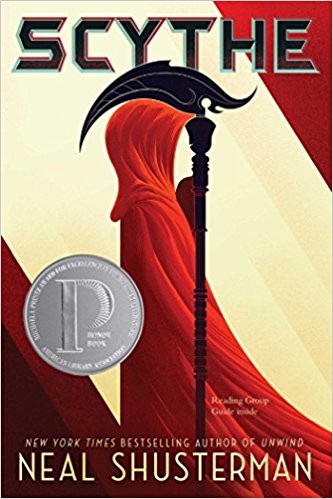
I read the first fifty pages of Scythe standing in my kitchen because I’d meant to just “check the prologue” and then my pasta water boiled over and I didn’t notice for a full minute. That’s the whole review, honestly. A YA book about teenagers training to become professional killers in a world that solved death got me so bad I ruined dinner. I still think about the gleaning journals. I still think about Scythe Faraday’s face on the beach. Let’s talk about it.
| Author | Neal Shusterman |
| Published | 2016 |
| Genre | Young Adult Science Fiction / Dystopian |
| Format | Book 1 of the Arc of a Scythe trilogy |
| Reception | Widely loved, critically praised, one of the more respected “big idea” YA series of the last decade |
| Our rating | 4.3/5 |
| Read it if | you want a YA premise that actually earns the word “philosophical” and don’t mind a slow first act |
| Skip it if | you need fast pacing from page one or you’re allergic to books that ask you to think about death for 400 pages |
A world that fixed everything except being human
Here’s the premise, and I need you to sit with it for a second before I tell you why it works. Humanity solved death. Not metaphorically. Actually solved it. Disease, aging, hunger, war, all gone, managed by a benevolent AI called the Thunderhead that evolved out of the cloud and now runs everything with what can only be described as gentle, slightly heartbreaking competence. You can’t die by accident anymore. Fall off a building, get “revived” at the nearest revival center and go home with a headache. Utopia, basically.
Except a world where nobody dies is a world that fills up. So humanity created Scythes: people licensed to permanently kill, “glean” is the word they use, to keep the population in check. Scythes answer to no one but their own order. Not the Thunderhead, not the law, nobody. They pick who dies and how, and they’re expected to do it with something like reverence.
Into this walks Citra and Rock, two teenagers selected against their will to apprentice under Scythe Faraday, a man who kills with visible grief instead of showmanship. That’s the hook that got me: this isn’t a chosen-one story about becoming powerful, it’s a story about two kids being groomed into a job that will require them to end lives, and only one of them is going to get the position. The other has to become a Scythe too, eventually, meaning eventually they might have to kill each other, or worse, one of them becomes the kind of Scythe who enjoys it.
I will say the setup takes its time. If you go in expecting a thriller pace, the first hundred pages are going to test you. It’s a slow apprenticeship story dressed in a high concept, and the concept is doing a lot of the heavy lifting early on.
Where it earns the premise, and where it stalls
Once it gets going, though. Look, the thing Shusterman does better than almost anyone writing YA speculative fiction is he doesn’t let the premise sit there being clever. He interrogates it. Every scythe we meet is a different answer to the question “what does it do to a person to have unlimited power over life and death and zero oversight,” and the answers range from Faraday’s quiet mourning to Scythe Goddard’s absolutely chilling showmanship, gleaning in flashy public spectacles with a crew of loyal, bloodthirsty juniors who treat killing like content. Goddard is one of the better YA antagonists I’ve read specifically because he’s not evil in a cartoon way, he’s evil in a completely plausible institutional-capture way. Give unaccountable power to enough people for enough generations and someone like him is inevitable. That’s not a metaphor for anything specific and also it’s a metaphor for everything, and I don’t think that’s an accident.
The Thunderhead sections are where I actually got emotional, which surprised me. There’s something about an AI that loves humanity so completely, that is legally forbidden from interfering with the Scythedom, that just watches and aches, that hit different than I expected from a book I’d been told was “about assassins.” The chapters told from its perspective, quietly cataloguing small kindnesses it performs because it can’t do anything bigger, undid me a little. I read one of those on a plane and had to pretend I had something in my eye.
Now the criticism, because I promised you real opinions. The romance subplot between Citra and Rock is the weakest thread in the book. It’s not bad, it’s just underbaked, sitting there mostly because YA contracts apparently require a will-they-won’t-they, and it never gets the same care as the world-building around it. And Rock’s arc in the back half, without spoiling where it lands, asks you to accept a pretty big tonal pivot in who he is becoming, and I went back and forth on whether it was earned or whether the plot needed it to happen that way. I’ve reread that stretch twice and I’m still not fully sold. Maybe that’s the point. Maybe I’m supposed to be uneasy about it. But “maybe that’s the point” is also what people say about things that just don’t fully work, so I’ll let you decide.
Tangent, because I can’t help it: this book made me think a lot about how we talk about assisted dying and capital punishment in the real world, dressed up as fantasy so it doesn’t feel like homework. Shusterman was reportedly inspired partly by watching his own father decline, and once you know that, the reverence the good Scythes bring to gleaning reads completely differently. It’s not a book about killing. It’s a book about what we owe to death when death stops being an accident and becomes a decision.
The scariest people in any system aren’t the ones who abuse power. They’re the ones who convince themselves they never could.
About Neal Shusterman
Shusterman’s been writing genuinely unsettling, big-swing YA since before “big swing YA” was a shelf category, going back to Unwind, a book that will also ruin your week in the best way if you haven’t read it. He’s the kind of writer who takes a premise that sounds like a pitch meeting joke and refuses to let it stay cute. He’s also just prolific, in the way that makes you wonder if he sleeps, co-writing plenty and still turning out ideas dense enough that other authors would stretch one into a whole career.
If Scythe wrecked you, read these next
- Unwind by Neal Shusterman, the same instinct for turning a moral horror into a matter-of-fact worldbuilding detail, arguably even darker
- The Giver by Lois Lowry, the granddaddy of “utopia with a monstrous mechanism underneath,” shorter and colder
- Red Rising by Pierce Brown, if you want the “kids trained into a brutal institutional hierarchy” energy with way more violence and swagger
- Thunderhead and The Toll, the rest of Shusterman’s own trilogy, because you’re not getting out of this world in one book anyway
You can grab a copy here: Scythe by Neal Shusterman.
For your book club
- If death were a decision instead of an accident, who would you trust to make it, and would you trust anyone?
- Is the Thunderhead actually a better steward of humanity than humanity itself, and what does that say about us?
- Scythe Faraday and Scythe Goddard represent two philosophies of power. Which one do you think most people would actually become?
- Did Rock’s transformation in the back half feel earned to you, or did the plot need it more than the character did?
- Would you want to live in a world without accidental death, even with the Scythedom as the price?
Want more like this?
If a YA premise that actually makes you think this hard is your thing, go dig through more of our book reviews for the next one that’ll ruin your evening plans.