
A freshly dog-eared review
The Gnostic Notebook: The Comedian Who Says the Grimm Fairy Tales Were Hiding Secret Codes
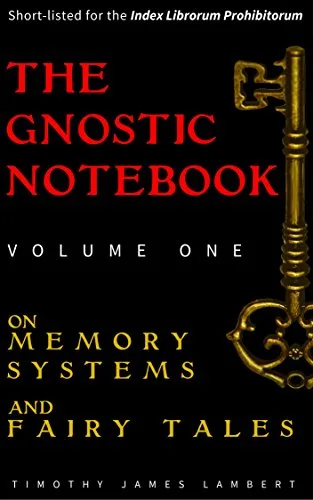

I picked up The Gnostic Notebook: Volume One expecting to roll my eyes. Books that promise to decode fairy tales tend to fall into one of two camps: the earnest self-published mystic who has discovered everything, or the academic who has discovered nothing and written 400 pages about it. Timothy James Lambert, as far as I can tell, is neither, which is the first interesting thing about this book.
The pitch is this. The Brothers Grimm collected oral folk tales, sure. But some of those tales contain structures that look an awful lot like encryption, and not the fun kind you find in a Dan Brown novel. Lambert argues they were built in accordance with the Ad Herennium, a Latin rhetorical text from roughly 80 BC that contains the earliest surviving instructions for building a memory system, also called the Art of Memory. Places, images, rooms you walk through in your head. The whole medieval cathedral of mnemonic technique.
If that is true, and I want to be clear that Lambert has not convinced me it is, then the fairy tales are not folk tales at all. They are storage devices. Little memory palaces that a reader could walk through, retrieve the images, and reconstruct a hidden message.
What Is the Art of Memory, and Why Does It Matter Here?
The Art of Memory is one of those subjects that sounds like a fantasy novel until you realize it was standard educational practice for about 1,500 years. You memorize a building. You put an image in each room. To recall a speech or a list, you walk the building. The Ad Herennium lays out the technique in detail, and it was still being taught in Renaissance Europe. Frances Yates wrote the big book on it (The Art of Memory, 1966) if you want the whole history, and I recommend it even if you never touch a Gnostic text in your life.
Lambert’s move is to read the synoptic Gospels through this lens. He points out that the scourging of Jesus mirrors one of the key images in the Ad Herennium‘s instructions, and argues that a writer trained in the memory system would have used it to place hidden information inside the narrative. That is a real claim, not a vibe. You can argue with it. I did.
What Is the Gnostic Notebook Actually About?
The book is theological criticism, which is a polite way of saying it is a scavenger hunt through the entire Western canon. Lambert moves from the Grimm tales to the Ad Herennium, from there to the Gospels, and from there to the millennia-old split between the two oldest traditions of Gnostic Christianity, the schools of John and Thomas. If you have ever fallen down a Wikipedia hole at 2 a.m. about the Nag Hammadi library, this is your book. If you have not, it will still work, but bring coffee.
What I appreciated most is that Lambert does not pretend to be neutral. He is a Gnostic. He thinks the Gnostics got something right that the orthodox tradition buried, and he is going to show you the receipts. That kind of commitment is refreshing in a genre that often hides behind the word suggests. I do not agree with all of it. I do not think the Grimm connection is anywhere near as proven as the book’s framing implies, and I would have liked to see him address the boring explanation, which is that patterns are easy to find when you go looking for them. But he is honest about the project, and he writes like a person rather than a thesis committee.
Who Is Timothy James Lambert?
This is the part that made me keep reading. Lambert is a writer, a stand-up comedian, and a Gnostic, and he has lived in Prague for twenty-something years. Prague, the alchemical capital of Europe, the city of Rudolf II and his court of astrologers and alchemists. The man lives in the exact place where this kind of book belongs. You can find him on Twitter at @gnosty, and yes, I checked, he is still there.
That biography shows up in the writing. There is a comic’s timing in the way he sets up a claim before landing it, and a performer’s patience in the sections where he walks a reader through a difficult idea. One Amazon reviewer put it well: he writes like he is sitting in front of you explaining the points simply, yet profoundly.
Should You Read The Gnostic Notebook: Volume One?
Yes, if you are the sort of reader who owns a copy of Marie-Louise von Franz’s The Interpretation of Fairy Tales and has opinions about it. Yes, if you have ever wondered why the Ad Herennium keeps showing up in books about Shakespeare, Dante, and Renaissance magic. Yes, if you like your esoterica with a sense of humor and a real author behind it.
No, if you want a book that proves its case beyond a reasonable doubt. Lambert’s argument is suggestive, not conclusive, and the book is better for it. It is a starting point, a provocation, a set of doors you can walk through or leave shut.
The one thing I would change is the pacing. Some chapters spend a long time building the case for the memory system before they get to the good stuff, and I found myself skipping ahead to the section on John and Thomas, which is where the book really catches fire. If you are on the fence, start there and work backward. It is a better way in.
If you liked this and want more books that treat reading as a puzzle to be solved, my review of The Malazan Book of the Fallen is the other one on this site where the author clearly expects you to keep up. And if you want something shorter but just as strange, the most famous poems in the world are full of the same coded imagery Lambert is chasing here.
Our Summary
The Gnostic Notebook: Volume One is a work of theological criticism. It investigates the deeper meanings behind several fairytales and the Memory Systems presented in the Latin text, Ad Herennium. Fans of The Astral Body and The Interpretation of Fairytales will love this philosophical esoterica that challenges the notions of what you thought you already knew.
What Readers Are Saying
 Deciphering the coded. This book is a rosetta stone for gnosis enthusiasts. It offers an alternative to the obvious interpretations of fairy tales, and how they may be applied for a different purpose… A must read for anyone interested in mythology and Gnosticism.” – Somone timeo., Amazon reviewer ★★★★★
This book is an excellent read. It is obvious that Timothy James Lambert knows his subject matter well and has a great love & interest in it. His style of writing displays a lot of patience and gives the feeling of him sitting in front of you explaining the points simply yet profoundly. The subject matter is also extremely fascinating.” – kubar, Amazon reviewer ★★★★
I think this book brought forward a lot of relational aspects of symbols, references, text, and meanings… Good effort in discussion and drawing connections.” – Kindle customer ★★★

About the Author
Timothy James Lambert is a writer, stand-up comedian, and Gnostic. The author of The Gnostic Notebook series, he has been a resident of Prague, the Alchemical Capital of Europe, for the last twenty years. You can follow him on Twitter @gnosty.
Similar Books
- The Astral Body by A.E. Powell
- The Goetia by S.L. MacGregor Mathers
- The Interpretation of Fairy Tales by Marie-Louise von Franz
- The Golden Dawn by Israel Regardie
- The Gnostic Religion by Hans Jonas
Preview the Book

The Gnostic Notebook: Volume One is a work of philosophical criticism that will appeal to fans of deciphering, encrypted texts, gnosticism, esoterica, theosophy, memory systems, fairytales, the Brothers Grimm, and understanding legends.