
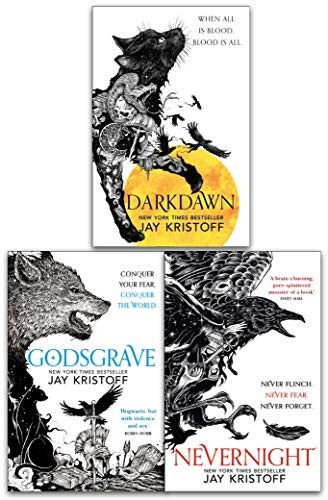
Nevernight Chronicle
A decade on, Nevernight still functions as one of the great litmus tests in modern fantasy: hand it to ten readers and you’ll get five obsessives, three deserters, and two people arguing about the footnotes. That kind of clean division is rarer than it sounds, and it’s exactly why the book still matters. Kristoff wrote something with the courage to be actively disliked.
| Author | Jay Kristoff |
| Published | 2016 |
| Genre | Grimdark / dark fantasy (assassin subgenre) |
| Format | Book one of a completed trilogy (The Nevernight Chronicle) |
| Best for | Readers who love a distinct narrative voice and don’t need to be coddled |
| Our rating | 4/5 |
Where it landed, and why it caused a fuss
Nevernight arrived in 2016, squarely in the grimdark wave that Joe Abercrombie and Mark Lawrence had made commercially safe. The premise is the oldest one in the drawer: a girl watches her family destroyed, swears revenge, and joins a school for assassins to get it. On paper, this is Ancient Roman Hogwarts with knives. What made it stand out was never the plot. It was the delivery.
Kristoff writes the whole thing in a swaggering, present-tense, footnoted narrative voice, as if a very clever and slightly cruel historian were recounting Mia Corvere’s story after the fact. The footnotes are the flashpoint. Some are genuine worldbuilding; others are jokes, asides, or the narrator openly needling the reader. Half the audience found them delicious. The other half found them the literary equivalent of someone talking over the movie. Both camps are correct, which is the interesting part.
The honest assessment: brilliant, indulgent, occasionally both at once
Let’s be fair about the strengths, because they’re real. The prose has genuine muscle. Kristoff can write a set piece, and the Truth, the school of murder run by the not-entirely-metaphorical Red Church, gives him plenty of room. Mia herself is a strong lead: bitter, competent, funny, and refreshingly willing to make ugly choices. Her companion, a shadow-cat named Mister Kindly who feeds on her fear, is one of the more memorable fantasy familiars of the decade. The book is also, notably, willing to earn an adult content warning; it does not pretend violence and sex are tidy.
Now the honest part. The narrative voice, so much of the book’s identity, is also its biggest liability. It works hardest when it steps out of the way and lets the story breathe, and it’s weakest when it’s showing off. A few of the footnotes exist purely so the author can be seen being clever, and the density of them in the opening chapters is a wall some readers never get over. The plotting, meanwhile, leans on a school-competition structure we’ve all seen, and one late reveal is telegraphed far enough in advance that the “twist” reads more as confirmation. This is a book of enormous style occasionally writing checks the substance has to hustle to cover.
The footnotes aren’t a flaw or a feature so much as a filter: Kristoff is sorting for readers who enjoy being addressed directly by a book, and cheerfully losing everyone who wants the storyteller to stay invisible.
What’s held up best is the atmosphere. The city of Godsgrave, its three suns and the near-permanent daylight, the religion of a murder-goddess called Niah. It’s a fully committed setting that never feels like reskinned Europe. What’s dated least gracefully is the sense, in places, that the book is trying very hard to convince you it’s transgressive. In 2016 that register felt fresher; a decade of grimdark later, some of the shock beats land softer.
What the actual reading experience feels like
Bumpy for the first fifty pages, then propulsive. Nearly every reader who bounces off Nevernight bounces off it early, defeated by the voice before the story has hooks in them. If you make it to the Red Church, the pace and the stakes tighten considerably, and the back third genuinely earns its reputation. It rewards a reader who’s willing to meet it on its own terms rather than one waiting to be gently eased in. Check the latest price on Amazon if you want to see whether the sample chapters click for you. This is genuinely a try-before-you-commit book.
Who should read it, and what to read next
Read it if you love a strong authorial voice, don’t mind grimdark’s blood and appetites, and enjoy a narrator with opinions. Skip it if you want your fantasy invisible, your storytellers polite, or your pages free of footnotes. If Mia’s revenge arc lands, the good news is the trilogy is complete: no waiting on a phantom final volume. From there, Scott Lynch’s The Lies of Locke Lamora scratches the same clever-criminals-in-a-gorgeous-city itch with a warmer heart, while Mark Lawrence’s Prince of Thorns pushes the morally-bankrupt-protagonist idea even harder.
Where Nevernight sits in the wider fantasy shelf
It’s a divisive modern entry rather than a settled classic, but it’s exactly the kind of bold, love-it-or-leave-it book that keeps the genre interesting. For where the giants and the newcomers stand, see our full 60 best fantasy novels list: Nevernight is the sort of contemporary gem that earns its place by refusing to please everyone.