
A freshly dog-eared review
I Wanted to Love Ready Player One More Than I Actually Did
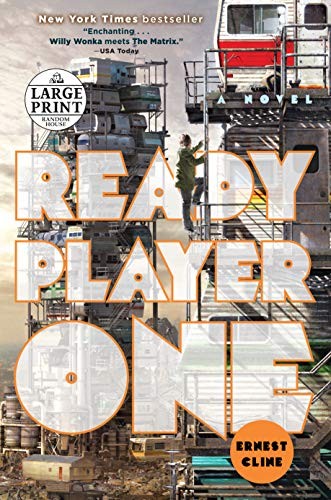
I read Ready Player One in a weekend, on a friend’s couch, mostly because he wouldn’t stop shoving it at me and saying “trust me.” And look, I did have a good time. I also finished it slightly annoyed, which is a weird combo I don’t get from many books. It’s the literary equivalent of eating a whole sleeve of those neon orange crackers: gone before you notice, faintly regretful after.
| Author | Ernest Cline |
| Published | 2011 |
| Genre | Sci-fi, dystopian adventure, 80s nostalgia trip |
| Format | Standalone, though a sequel (Ready Player Two) followed in 2020 |
| Reception | Beloved by a huge crowd, genuinely disliked by another; one of the more divisive “fun” novels out there |
| Our rating | 3.5/5 |
| Read it if | You grew up on arcades, D&D, and John Hughes movies, and you want a plot that never slows down |
| Skip it if | Endless pop-culture name-dropping reads to you like a checklist instead of a story |
A treasure hunt built inside a video game, which is a genuinely great idea
Here’s the setup, and I’ll say up front the premise is the best thing about the book. It’s 2045, the real world is a burned-out mess (energy crisis, poverty, stacked-trailer slums literally called “the stacks”), and basically everyone escapes into the OASIS, a sprawling virtual reality universe that’s part game, part internet, part second life. The OASIS’s creator, a reclusive genius named James Halliday, dies and leaves his entire fortune plus control of the whole thing to whoever can solve a series of puzzles he’s hidden inside it. The catch: every puzzle is soaked in the 1980s pop culture Halliday was obsessed with. Solve the riddles, you have to basically become a scholar of Halliday’s childhood.
Our guy is Wade Watts, a broke teenager who hunts for the prize (the hunters are called “gunters,” egg-hunters) from a hidden nook in a junked van. And the villains are the best part of the concept: a soulless megacorp called IOI that wants to win the OASIS so they can slap ads on everything and start charging for it. Corporate raiders versus nerds. That’s a good fight. I was in.
The early quest beats genuinely work. There’s a moment where Wade has to play a perfect game of a certain ancient arcade cabinet, and Cline writes the tension of it well enough that I actually leaned forward. When Wade recites every line of a movie from memory to clear a gate, I rolled my eyes and kept reading anyway, which honestly sums up my whole experience.
The part where I have to be honest with you
So here’s the thing that keeps this out of the top tier for me, and I say this as someone who wanted to love it: the book confuses “listing things I recognize” with “making me feel something.”
There are stretches, especially in the first third, that read like Cline emptied a box of 80s trivia onto the page. Every room, every gun, every song gets a citation. Pac-Man, WarGames, Rush, D&D, Atari, Ladyhawke, on and on. When it’s woven into a puzzle, great, that’s the whole engine of the plot. But a lot of the time it’s just Wade telling me a thing exists, and I’m supposed to feel warm because I also know that thing exists. That’s not a story. That’s a quiz where I get a gold star for being old.
And Wade himself is a problem. He’s supposedly this scrappy underdog, but he’s also good at literally everything the plot needs him to be good at, at exactly the right moment. He knows the obscure reference. He has the perfect item. He makes the perfect move. There’s very little cost to anything, which drains the tension out of what should be a life-or-death hunt. The stakes are cosmic on paper and weightless in practice.
Let me question my own taste for a second, because it’s only fair. Maybe I’m being a grump. Millions of people read this and felt pure joy, and I don’t think they’re wrong to. If you hit this book at thirteen, or if the specific 80s stuff Cline loves is the specific 80s stuff YOU love, the name-dropping isn’t a checklist, it’s a hug. I get that. I just didn’t grow up inside those exact references, so a lot of them landed as “cool, I guess” instead of the intended lightning bolt. Your mileage will genuinely, wildly vary here, and that’s kind of the whole story of this book’s reception.
Quick tangent, because I can’t not mention it: the romance. Wade falls for a fellow gunter, Art3mis, and there’s a whole thread about him being obsessed with her avatar before he knows anything real about her. Cline gestures at “but is she really who she seems online,” which, for a 2011 book about living inside a virtual world, is a genuinely interesting question he mostly doesn’t have the patience to sit with. He raises it, resolves it fast, and moves on to the next gate. I wanted the messier version of that.
What actually redeems the back half: once the puzzle-hunting turns into an all-out war with IOI, the pacing goes electric. The final act, with a mass rebellion and a last gate and Wade having to make a real choice, is a rush. I read the last hundred pages standing up in my kitchen because I’d stopped being able to sit still. Whatever my complaints, the man knows how to build a climax. That’s a real skill and I won’t pretend otherwise.
The whole book is really one argument: that the stuff we escape into can either save us or swallow us, and Cline never quite decides which. That tension, more than any Atari reference, is the interesting thing here.
About Ernest Cline
Ernest Cline is a former spoken-word poet and screenwriter who is exactly, precisely, the person you’d guess wrote this book. He’s a card-carrying 80s obsessive who famously owns a real DeLorean (yes, the Back to the Future car). Ready Player One was his debut novel and it detonated: it became a bestseller, got optioned fast, and eventually turned into a big Steven Spielberg movie in 2018. He followed it with Armada (about, what else, a teenage gamer whose skills turn out to matter) and the sequel Ready Player Two, which got a rougher reception than the original. Whatever you think of his stuff, Cline writes with zero irony about the things he loves, and there’s something almost disarming about that. He’s not too cool for any of this. He’s the opposite of too cool.
If this scratched the itch, read these next
- Snow Crash by Neal Stephenson. The grandparent of the whole “metaverse” idea, funnier and smarter and stranger than Ready Player One, with a pizza-delivering hacker hero named Hiro Protagonist. If you liked the virtual-world stuff and want more brains behind it, start here.
- Ender’s Game by Orson Scott Card. If what hooked you was the gifted-kid-in-a-high-stakes-game engine, this does it with far more emotional weight and a gut-punch of an ending.
- Warcross by Marie Lu. A younger, glossier take on the “broke hacker gets pulled into a giant virtual game with real stakes” premise, and honestly it handles its heroine better than Cline handles Art3mis.
- Neuromancer by William Gibson. The one that basically invented cyberspace. Denser and colder than Cline, but if you want to see where all of this came from, it’s the source code.
For your book club
- Did the constant 80s references pull you into the world or push you out of it? Be honest about whether it depended on how many you recognized.
- Wade is very good at almost everything the plot asks of him. Did that make him fun to root for, or did it drain the tension for you?
- The book treats the OASIS as both a beautiful escape and a dangerous trap. Which side do you think Cline actually lands on, and does the ending back it up?
- How does the online-avatar-versus-real-person question play out with Art3mis, and did the resolution satisfy you or feel rushed?
- IOI wants to commercialize the OASIS. Reading this now, how close does its vision feel to the actual internet we ended up with?
Want more worlds worth escaping into?
If the virtual-reality-adventure hook is your thing, I’ve rounded up the heavy hitters (and a few deep cuts) over on our best sci-fi books list. And if you just want to grab this one and judge for yourself, here it is on Amazon.
I keep coming back to that weekend on my friend’s couch. He loved this book with his whole chest, and I liked it with maybe two-thirds of mine, and we argued about it for an hour afterward. Which, now that I think about it, might be the most a book can do…