
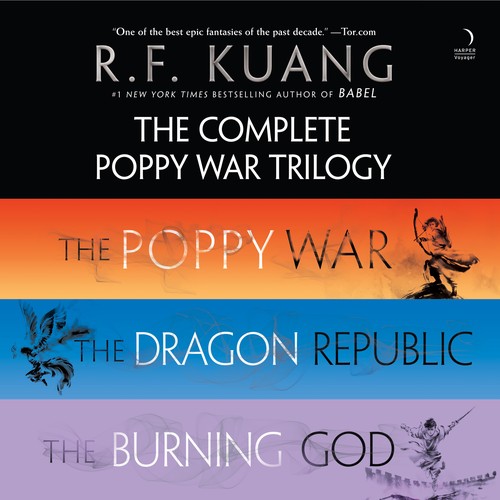
The Poppy War
R.F. Kuang was twenty-two when she published a debut that reads like the work of someone twice her age and half her patience for comfort. The Poppy War arrived in 2018 and detonated the polite consensus about what a fantasy debut was allowed to do. It still matters because it refuses the one thing the genre usually promises: that the hero’s suffering will be worth it.
| Author | R.F. Kuang |
| Published | 2018 |
| Genre | Grimdark / military fantasy (historical-inspired) |
| Format | Book 1 of The Poppy War trilogy |
| Best for | Readers who want fantasy with teeth and a strong stomach |
| Our rating | 4/5 |
The book that made “grimdark” mean something again
By the late 2010s, fantasy had two dominant modes: the cozy, found-family warmth that would soon become romantasy, and a grimdark tradition that had started to feel like edginess for its own sake. The Poppy War split the difference and then set the difference on fire. Kuang, a scholar of modern Chinese history, built her world on the bones of the twentieth century (the Sino-Japanese War, the Rape of Nanjing, the poppy trade that gutted an empire) and dropped a furious orphan girl named Rin into the middle of it.
The opening half is almost a different book, and a wonderful one. Rin aces the empire-wide exam to escape an arranged marriage and lands at Sinegard, an elite military academy. If you love the “gifted outsider claws through a brutal school” setup (and most of us secretly do) the first act delivers it with real snap. Kuang writes ambition better than almost anyone working: the humiliations, the alliances, the specific ache of being the poorest kid in a room full of aristocrats. Then the war comes, the school burns, and the novel becomes something you did not sign up for.
The honest part: this is a book that costs you something
Let’s be direct, because the internet often isn’t. The back third of The Poppy War contains a sequence, drawn closely from the historical atrocities at Nanjing, that is genuinely harrowing: deliberately, unglamorously so. It is not gratuitous, but it is graphic, and Kuang means for it to sit in your chest. This is the novel’s central gamble and its most divisive feature. Some readers find the fictionalized rendering of real, recent genocide powerful and morally serious. Others find it too much, too fast, or object to the whiplash from magic-school romp to war-crime tribunal. Both reactions are legitimate. You should walk in knowing the second half is not the first half.
Kuang’s real subject isn’t whether Rin can win the war, but what winning costs a person who was never given the option to stay soft: power here is not a reward for suffering, it’s the next thing that eats you.
The prose itself is the book’s most fixable weakness. It’s clean, propulsive, and occasionally flat: Kuang is a storyteller and a historian first, a stylist second, and the shamanic-magic passages sometimes reach for a grandeur the sentences don’t quite earn. The pacing lurches. Characters you’d like to know better get conscripted into the plot’s momentum. If you need lyrical, luxuriant fantasy prose, this may frustrate you. But the ideas move so fast that most readers stop noticing, and Kuang’s control of structure (the slow reveal of what Rin is willing to become) is genuinely impressive for a debut.
The reading experience
Fast. Occasionally exhilarating, occasionally punishing. You will tear through the school chapters, then slow down, then find you can’t look away. Rin is the engine: not likable in the cozy sense, but magnetic, a protagonist whose choices get steadily harder to defend, which is precisely the point. This is a book about how ordinary trauma manufactures the people who commit extraordinary horrors, and it earns that argument by making you root for her right up to the moment you shouldn’t. Check the latest price on Amazon if you want to see where Rin’s road ends, because the trilogy only gets more unflinching from here.
Who should read it, and what to read next
Read it if you loved the darker registers of Fonda Lee’s Green Bone Saga or the moral vertigo of Joe Abercrombie, or if you want fantasy grounded in real, under-taught history. Skip it, or wait for the right headspace, if graphic wartime violence is a hard no for you. That’s not squeamishness, it’s self-knowledge, and this book will not reward pushing through. If you finish and want the same intelligence with a cooler temperature, Kuang’s own Babel is the natural next step; for more history-forged epic fantasy, Fonda Lee’s Jade City is the obvious companion.
Where this sits on the shelf
The Poppy War is one of the defining fantasy debuts of its decade: brutal, brilliant, and not for everyone, which is exactly why it lasts. See where it ranks among the greats in our full 60 best fantasy novels list, alongside the classics and the contemporary books rewriting the rules.