
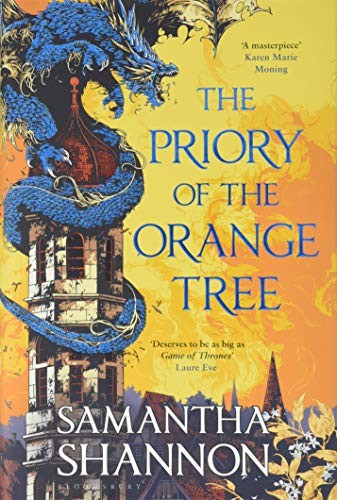
The Priory of the Orange Tree Review: Dragons, Secret Love, and 800 Uneven Pages
I admire any fantasy novel willing to give me ancient dragons, court sabotage, a hidden order of women, and a queen falling for the person assigned to protect her. I admire The Priory of the Orange Tree slightly more than I love it. Some parts beg for another hundred pages, while others seem determined to prove every journey occurred in real time. The romance has patience and genuine heat. The ending runs as if someone rang a closing bell.
| Author | Samantha Shannon |
| Published | 2019 |
| Genre | Epic / high fantasy |
| Format | Standalone (with a 2023 prequel, A Day of Fallen Night) |
| Best for | Readers who want the sweep of a saga without the multi-book hostage situation |
| Our rating | 4/5 |
Publication context: the anti-Game of Thrones
To understand why Priory landed the way it did, remember the moment. The final season of HBO’s Game of Thrones aired in the spring of 2019, and a decade of grimdark (political brutality, sexual violence deployed as “realism,” heroes who existed mainly to die badly) had defined what mainstream epic fantasy was supposed to look like. Shannon, already known for the Bone Season series she’d started at twenty-one, offered something deliberately different: a sprawling secondary world built around four women, a queer central romance treated as unremarkable, and dragons split along an East/West cultural divide that the book actually wants to interrogate rather than just decorate.
It became, almost immediately, the book that TikTok and Bookstagram reach for when someone asks for “feminist fantasy” or “sapphic dragons.” That’s a real cultural role, not just marketing. Priory helped prove that a doorstopper standalone could sell: a lesson the industry has been dining out on ever since.
The honest assessment: ambition, and what it costs
Here is the great thing about Priory: the worldbuilding is enormous and it mostly holds together. Shannon runs two parallel mythologies (the Western tale of the Damsel and the saint who slew the Nameless One, and the Eastern reverence for water-dwelling dragons as gods) and the plot turns on the reader slowly realizing that neither culture has the full truth. That’s a genuinely elegant piece of construction. The four-thread structure (a queen fighting to hold her dynasty, a spy who is secretly a mage, a dragonrider in the East, an alchemist chasing forbidden knowledge) gives you real breadth.
And here is the honest catch, the thing the rapturous reviews tend to skip: the pacing is uneven, and the prose is competent rather than luminous. The middle third sprawls; you can feel the connective tissue between the big set-pieces. Shannon is a clear, sturdy writer, but she rarely writes a sentence you’ll stop and reread for its own sake. The romance that so many readers cherish is developed more by proximity and destiny than by the slow, earned friction great romance needs. It’s lovely that it exists, less convincing in how it arrives.
The East/West framing is the most divisive element, and reasonably so. Shannon clearly intends respect and correction: the “Eastern dragons are gods, not monsters” reversal is the whole thematic point. But some readers find the world’s cultural coding broad, the geography a touch schematic. It’s a book gesturing hard toward inclusivity that occasionally shows the effort. Whether that reads as thoughtful or as slightly dated depends a lot on when you’re reading it and what you bring.
The quiet radicalism of Priory isn’t the dragons or the queens. It’s that it treats a queen’s right to choose her own body and her own succession as the axis the entire kingdom turns on, and dares you to find that less epic than a war.
What the reading experience is actually like
Dense at the start, propulsive by the end. The first 150 pages ask patience (names, houses, two theologies, a lot of political scaffolding) and plenty of readers stall there. Push through and the threads begin to braid, and the last act delivers the payoff a big epic promises: convergence, dragons in the sky, a climax that earns its length. It reads faster than its page count suggests once you clear the on-ramp. This is a bath-and-blanket book, not a savor-a-page-a-night book.
If you want to sample before committing to the heft, check the latest price on Amazon: the ebook is a friendlier way to test whether Shannon’s world clicks for you before you buy the physical monument.
Who should read it, and what to read next
Read it if you want epic scope without a lifetime series commitment, you’re drawn to woman-centered courtly fantasy, or you want the sapphic dragon epic everyone keeps recommending and would like to form your own opinion. Skip it if lush, sentence-level prose is your non-negotiable, or if slow-burning middles make you bail.
What to read next: for prose that sings where Shannon’s is functional, R.F. Kuang or N.K. Jemisin’s Broken Earth. For more dragons with sharper politics, Naomi Novik’s Temeraire. And if you loved this world, the 2023 prequel A Day of Fallen Night is arguably the better-crafted book: leaner focus, stronger emotional core.
Where this sits in the fantasy canon
Priory isn’t the best-written epic of its decade, but it may be one of the most quietly influential: proof that a standalone doorstopper built around women could move the market. See where we ranked it against the heavyweights in our full 60 best fantasy novels list, alongside the classics and contemporary gems worth your shelf space.