
The Wayward Children
Most portal fantasies end at the happy homecoming: the child steps back through the wardrobe, older and wiser, and we roll credits. Seanan McGuire started her Wayward Children series with the question nobody wanted to ask: what happens to the kid who didn’t want to come home? A decade on, that single inversion still feels like a small act of rebellion against the entire genre.
| Author | Seanan McGuire |
| Published | 2016 |
| Genre | Portal fantasy / dark fantasy novella |
| Format | Series opener (Every Heart a Doorway; 10+ novellas and counting) |
| Best for | Readers who loved Narnia but felt betrayed by the ending |
| Our rating | 4/5 |
A note on what you’re actually buying
Quick housekeeping, because the title trips people up: “The Wayward Children” is the series. The 2016 book that launched it is Every Heart a Doorway, a slim novella you can finish in an afternoon. If someone hands you “The Wayward Children” expecting a single fat novel, that’s the source of the confusion. This is McGuire’s ongoing sequence of short, interlocking books, and the first one is where you start.
The doorway that changed the conversation
Published by Tor.com’s novella imprint during its mid-2010s golden run (the same program that gave us Nghi Vo and Martha Wells’ Murderbot) Every Heart a Doorway arrived as part of a deliberate bet that readers were hungry for short, sharp, idea-dense fantasy. The bet paid off. The book landed squarely in a moment when the genre was interrogating its own comfortable myths, and it won the major awards for a novella that year (it took the Hugo, Nebula, and Locus). That trophy shelf is not hype; it’s the record.
The premise is elegant. Eleanor West runs a boarding school for children who fell through doors into other worlds (Nonsense realms, Logic realms, Underworlds of bone and candy) and then got spat back into ordinary life, homesick for a magic their parents insist never happened. It reframes the portal-fantasy “adventure” as trauma and grief. These kids don’t need to move on. They need someone to believe they went somewhere real.
The genius here isn’t inventing new worlds. It’s noticing that the classic portal story always treated return as a reward, when for the right child it would feel like exile.
The honest assessment: brilliant premise, uneven delivery
Let’s be clear-eyed, because this book is often reviewed with more reverence than rigor. McGuire’s worldbuilding taxonomy is the real triumph. She organizes the infinite by axes (Nonsense versus Logic, Wickedness versus Virtue) and that framework is so intuitive you’ll start sorting your own favorite fantasy worlds onto the grid before you finish chapter two. It’s the kind of idea that reorganizes how you read everything else.
The cast is refreshingly, matter-of-factly diverse: an asexual protagonist in Nancy, a trans boy in Kade, characters whose identities are simply true rather than issues to be litigated. In 2016 that felt quietly radical, and it still reads as generous rather than performative.
Now the flaws. The book grafts a murder mystery onto its premise, and the mystery is the weakest limb: thinly plotted, its culprit more convenient than earned, resolved before it’s had room to breathe. The novella length that makes the concept feel like a jewel also starves the characters; several distinct, fascinating kids get a line of description and then vanish. And McGuire’s prose has a fondness for the aphoristic, quotable sentence: lovely in isolation, occasionally exhausting when every paragraph reaches for the tote-bag epigram. Readers who bounce off the book usually cite that: it can feel like it’s narrating its own themes rather than trusting you to find them.
The reading experience
What stays with you isn’t the whodunit; it’s the ache. This is a book about children being disbelieved by the people who love them, and McGuire writes that specific loneliness with real precision. You read it fast because it’s short and because the sentences pull you, then you sit with it far longer than its page count suggests. It’s a mood as much as a plot (melancholy, defiant, occasionally macabre) and if that mood catches you, the murder plot’s shortcomings stop mattering much.
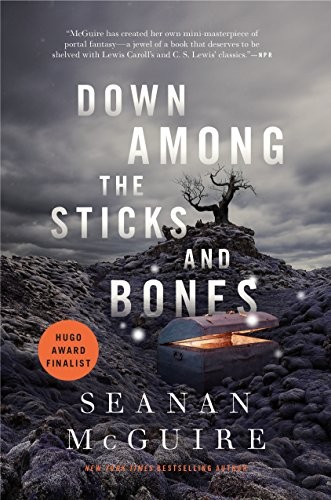
Fair warning: the series that follows is uneven, and the books alternate between “school” installments and “origin” installments that go back into individual characters’ worlds. The origins (Down Among the Sticks and Bones especially) are, for many of us, better than the opener. Check the latest price on Amazon before committing: the novellas are best sampled one at a time rather than boxed-set binged.
Who should read it, and what to read next
Read it if Narnia’s ending always felt like a small cruelty, if you love a killer concept and can forgive a soft plot, or if you want an inclusive fantasy that wears its politics lightly. Skip it if you need airtight mysteries or a full-length novel’s worth of character depth. Next, go to Down Among the Sticks and Bones for the series at its most focused, then reach for Alix E. Harrow’s The Ten Thousand Doors of January or Catherynne Valente’s Fairyland books for portal fantasy with more room to sprawl.
Keep exploring the doors
McGuire’s novellas are a gateway drug to the wider world of modern portal and door fantasy. If this one caught you, there’s a whole shelf waiting. Browse our full 60 best fantasy novels list for the classics and contemporary gems worth walking through next.