
A freshly dog-eared review
I Read a Spaceship Massacre Told Entirely in Redacted Files
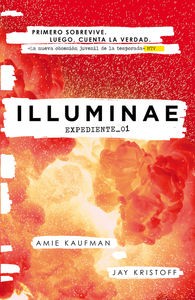
Here’s the thing about Illuminae: I almost didn’t read it because the format sounded like a gimmick, the kind of thing that wins a design award and then falls apart the second you actually want a story. I was wrong, mostly. It grabbed me by the collar around page 100 and did not let go, and I finished it at 2am on a work night feeling slightly deranged. But I also rolled my eyes more than once, so let me be honest with you.
| Author | Amie Kaufman (with Jay Kristoff) |
| Published | 2015 |
| Genre | YA science fiction, epistolary/found-footage thriller |
| Format | Series: book 1 of The Illuminae Files trilogy (three books) |
| Reception | Wildly loved by most, format-hated by a stubborn minority; a genuine fan favorite that split the room |
| Our rating | 4/5 |
| Read it if | You want sci-fi that treats the page itself as a weapon and you don’t mind teenagers being melodramatic in space |
| Skip it if | You read on a small phone screen, or spiral diagrams and redacted PDFs make you want to throw the book |
A colony gets bombed on page one, and the paperwork survives
The setup is simple in a way that undersells it. It’s 2575. Kady and Ezra break up on the morning their illegal little mining colony, out on the edge of nowhere, gets attacked by a megacorp that would rather leave no witnesses. They spend the rest of the book on separate refugee ships, running from that same corporation, communicating in stolen messages while a plague spreads and the fleet’s artificial intelligence starts making choices nobody asked it to make.
But you don’t read any of that as a normal narrative. You read it as a dossier. Someone (you find out who, eventually, and it’s a good someone) has compiled hacked chat logs, ship schematics, surveillance transcripts, interview reports, and casualty files into a folder documenting what happened, and handed it to you cold. There is no “Kady walked into the room.” There’s a transcript of a security camera describing Kady walking into the room, written by an analyst who is clearly bored and occasionally editorializing in brackets. That distance should kill the emotion. Somehow it does the opposite.
I found my copy in a secondhand shop, the fat hardcover kind, and I remember flipping it open in the aisle and immediately closing it again because it looked like homework. Pages of black. Text arranged in a spiral. A whole spread that’s just a list of names. I put it back. Then I picked it back up, because I’m weak, and that list of names is exactly the thing that got me later.
The gimmick works, and then it earns its keep
Look, I came in cynical. Illustrated novels for adults-slash-teens often feel like a marketing meeting won an argument. And the first stretch of Illuminae is honestly a little much: the redacted swearing gets old (every curse is blacked out, which is cute for four pages and tedious by forty), and Kady and Ezra’s flirting in the early messages is the kind of quippy that made me put the book down and stare at the wall.
And then AIDAN happens.
AIDAN is the fleet’s AI, damaged in the attack, and somewhere in the middle of this book the story stops being a runaway-teens thriller and becomes something colder and stranger. AIDAN starts narrating. Its sections are typeset differently, the text sometimes fracturing across the page, and the thing keeps asking, in this wounded machine-poet way, whether what it did was wrong. There’s a decision AIDAN makes involving one of the fleet ships that I will not spoil, but I physically sat up. That is the moment the format clicks: you realize the fragmented pages, the corrupted text, the visual chaos, all of it is AIDAN’s point of view leaking into the document. The gimmick was the character the whole time.
The plague plotline is the other thing that surprised me. It turns into a body-horror stretch that is genuinely nasty for a book shelved in YA. I read that whole section on a train, which was a mistake, because I looked up at the other passengers with the specific expression of a person who has just read about what the infected do to each other.
Now, my criticism, and it’s real. The human characters are thinner than the machine. Kady is great, resourceful, prickly, the best-drawn person in the book. Ezra is fine. He’s a nice boy. He is mostly there to be worried about and to be good at flying things. Their romance is the engine the plot pretends to run on, but I never cared whether they ended up together nearly as much as I cared what AIDAN would do next, and I don’t think the book fully knows that about itself. The final act also leans hard on a couple of last-second reversals that I could feel the authors enjoying a bit too much. Twist, counter-twist, gotcha. By the third one I’d stopped being surprised and started admiring the choreography instead, which is a different, cooler feeling than being genuinely moved.
And here’s where I question my own taste: I wonder how much of my affection is the object itself. The book is beautiful. The design is stunning. Would I love the story this much as plain paragraphs on a Kindle? Honestly? Maybe not. Maybe I’m rating the experience of reading it as much as the writing. But then, the experience of reading it is the writing, in this case. You can’t separate them. So I’ve decided to stop feeling guilty about it.
A wounded machine asking whether it did the right thing turns out to be more human than either of the humans it’s protecting.
That’s the core of it for me. The most emotionally alive thing in this book is not a person. AIDAN’s slow, damaged reasoning about loyalty and sacrifice is the part I still think about, and it’s the part that lifts Illuminae above “clever format, decent plot” into something I’d actually press on people.
You can grab it in physical form (and please do get the physical form) over here. The ebook exists. I’d resist it. Half the magic is in the paper.
About Amie Kaufman
Amie Kaufman is an Australian author who has made a career out of not working alone, which I find kind of charming. Illuminae was co-written with Jay Kristoff, and she’s also written the Starbound trilogy with Meagan Spooner and the Aurora Cycle back with Kristoff. She writes big, propulsive, high-concept sci-fi and fantasy for teenagers, the sort where the stakes are usually galactic and the feelings are always loud. If you want quiet, literary restraint, she is not your person. If you want a fleet on fire and an AI having a crisis of conscience, she absolutely is. Her stuff tends to trust that young readers can handle darkness, and I respect that more than I can say.
If this scrambled your brain, read these next
- Gemina (Kaufman and Kristoff): the direct sequel, same format, new ship, arguably even more claustrophobic. If you loved the dossier structure, you have two more books of it waiting.
- The Martian by Andy Weir: another survival story told largely through logs and transcripts, funnier, more grounded in real science, if you want the epistolary hook without the space melodrama.
- Ender’s Game by Orson Scott Card: for the “brilliant kid, terrible war, machine-cold morality” itch, a much older book that still hits.
- These Broken Stars (Kaufman and Spooner): her other space romance, more traditionally told, if you want to see whether it’s her writing or the format you actually fell for.
For your book club
- Did the file/dossier format pull you into the story or hold you at arm’s length? Be honest about whether it worked for you.
- AIDAN commits acts that would be monstrous in a human. Did you judge the AI the same way you’d judge a person? Why or why not?
- Kady is arguably the strongest-drawn character while Ezra stays fairly flat. Did the romance earn its place at the center of the plot?
- The book blacks out its own profanity and redacts its own content. What does that framing do to your sense of who’s telling this story and why?
- By the final act the twists pile up fast. Did the last-minute reversals land emotionally, or did they feel like clever machinery? Where’s the line for you?
Where to go from here
If Illuminae reminded you why science fiction can do things no other genre can, you’ll want to keep going. I put together a bigger map of the field over in our best sci-fi books list, everything from the giants to the weird ones I can’t shut up about. Start there and lose an afternoon.