
A freshly dog-eared review
I Kept Reading Station Eleven Because of a Comic Book
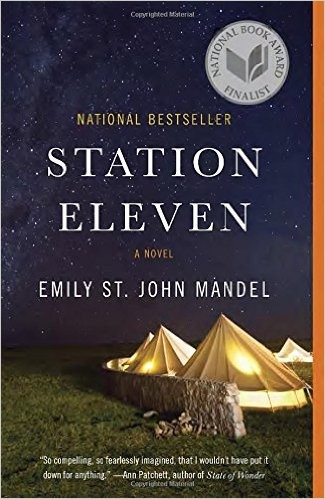
Here’s the thing about Station Eleven: it’s a book about a pandemic that wipes out most of humanity, and somehow the part I think about most is a washed-up actor having a heart attack while playing King Lear. I read this the first time in a bathtub that had gone cold an hour earlier, refusing to get out. That should tell you something. A flu book made me forget my own body.
| Author | Emily St. John Mandel |
| Published | 2014 |
| Genre | Literary post-apocalyptic, quiet speculative fiction |
| Format | Standalone (though it shares a fictional universe with her later novel The Glass Hotel) |
| Reception | National Book Award finalist, huge critical love, a devoted reader following, and a small but vocal camp who found it slow and precious |
| Our rating | 4.3/5 |
| Read it if | you want the end of the world to feel like a held breath, not an explosion |
| Skip it if | you need plot momentum and get itchy when a book wanders |
A flu, a comic book, and an actor who dies on page one
Okay, setup. A pandemic called the Georgia Flu tears through the world in a matter of weeks. Not zombies, not war, just a virus that moves too fast to outrun. Ninety-nine-point-something percent of people die. The book opens the night it all begins, in a Toronto theater, where a famous actor named Arthur Leander collapses onstage during a production of King Lear. A paramedic-in-training named Jeevan rushes up from the audience to try to save him. He can’t.
That’s the last normal night the world will ever have. And Mandel knows it, so she lingers there.
Twenty years later we follow the Traveling Symphony, a caravan of actors and musicians who walk a loop around the ravaged Great Lakes region performing Shakespeare for the small settlements that survived. Their motto, painted on a wagon, is lifted from Star Trek: “Because survival is insufficient.” I rolled my eyes at that the first time. Then it wormed into me and I couldn’t get it out, which is basically the whole book’s trick.
The thread that stitches it all together is a self-published comic book, a strange little sci-fi thing called Dr. Eleven, about a physicist living on a space station that looks like a small planet. Almost nobody in the world has ever seen it. But the few people who own a copy keep turning out to be connected, across decades, across the collapse, in ways they never know. I won’t say more. The connections are the good part.
What it does that almost nothing else does
Look, most apocalypse fiction is obsessed with the collapse itself. The looting, the last can of beans, who has the gun. Mandel gives you maybe a chapter of that and then jumps twenty years ahead, because she’s not interested in the fall. She’s interested in what a person carries forward. What survives that isn’t a body.
The structure is the whole ballgame. She braids together the world before (mostly Arthur Leander’s messy life, his three ex-wives, his loneliness inside fame) and the world after, and she cuts between them with this uncanny confidence. A paperweight. A snow globe. A tabloid photo. Objects pass from hand to hand across the timeline and land somewhere you didn’t expect, and every time it happens something in my chest went tight. There’s a chapter that’s just a list, an inventory of things that are gone: no more diving, no more flight, no more countries, no more Internet. It should feel like a gimmick. It feels like grief.
My favorite stretch is Jeevan alone in his brother’s apartment as the flu takes the city, watching the lights of the neighboring towers go dark one window at a time. I read that at 1am with my own apartment quiet around me and I got up to check that my hallway light still worked. That’s the effect. She makes absence loud.
Now the criticism, because I promised myself I’d be honest. The Prophet. There’s a villain in the after-world, a cult leader who menaces the Symphony, and he is the weakest thing in the book by a country mile. Mandel is so good at the quiet, ambient dread of ordinary people that when she needs an actual antagonist with actual stakes, the machinery shows. His menace feels imported from a different, lesser novel. Every time the plot needed a gun pointed at someone I could feel the book straining against its own gentle nature. And the ending ties its coincidences a little too neatly. This is a novel built on beautiful, aching near-misses, so when a few of them resolve into tidy reunions, some of the ache leaks out.
Here’s my tangent, bear with me. I have a theory that whether you love this book depends entirely on what you think Shakespeare is for. Mandel’s whole argument is that after everything burns, people will still want the plays, still want the music, that art is not a luxury we shed but a thing we crawl back toward. And I want to believe that so badly that I sometimes wonder if I’m grading the book on the flattery. Does it actually earn the idea, or does it just make me feel good about being a person who reads? I genuinely don’t know. I’ve reread it twice and I still can’t tell whether it’s wise or just very, very comforting to people like me.
But then I hit a line, a moment, and the doubt evaporates. The Symphony performing A Midsummer Night’s Dream in a field, the audience of survivors, children who have never seen a working lightbulb watching Titania fall in love. Come on. That got me. That gets me every time.
Survival is insufficient. Everything the book believes is packed into those three words, and I’ve made peace with the fact that they’re right.
About Emily St. John Mandel
Mandel is Canadian, from British Columbia, and before Station Eleven blew up she’d written three quieter literary thrillers that almost nobody read (I’ve since gone back for them, they’re interesting and a little uneven). She trained as a contemporary dancer, which honestly explains a lot: the way she moves people around a timeline has real choreography to it, entrances and exits, bodies crossing a stage. Station Eleven is the book that turned her from a well-reviewed writer’s writer into someone with an HBO adaptation. She’s said in interviews she didn’t set out to write “a pandemic novel” so much as a novel about what we’d miss, and that instinct, mourning the ordinary rather than staging the catastrophe, is her whole signature. Her later books (The Glass Hotel, Sea of Tranquility) quietly share a universe with this one, which is either a delight or a rabbit hole depending on your temperament.
If this one lingered, read these next
- The Road by Cormac McCarthy, for when you want the apocalypse stripped to a father, a son, and a cart. Bleaker than Mandel by a mile, and just as much about love.
- Sea of Tranquility by Emily St. John Mandel, her own follow-up, which pulls a character or two from this book’s orbit and goes stranger and more sci-fi. If Station Eleven left you wanting more of that snow-globe interconnection, here you go.
- Severance by Ling Ma, another literary pandemic novel but funnier and colder, more interested in office jobs and consumerism as the real disease. A sharp companion piece.
- The Dog Stars by Peter Heller, post-flu, spare and lonely and full of flying and fishing, for readers who want the after-world with a pulse of adventure in it.
Grab a copy of Station Eleven right here on Amazon if you want to read it in a cold bathtub too.
For your book club
- Mandel spends almost no time on the collapse itself and jumps twenty years ahead. Did that choice work for you, or did you want to see more of the world falling apart?
- “Survival is insufficient.” Do you actually believe it? Would art really be one of the first things people reached back for, or is that a flattering fantasy?
- Arthur Leander dies on the first page and yet he’s the gravitational center of the whole book. Why do you think Mandel built it around a man we barely get to know alive?
- The Dr. Eleven comic connects nearly everyone without any of them realizing it. Did the web of coincidences feel meaningful to you, or too neat by the end?
- The Prophet is the book’s one real villain. Did he land, or did he feel like he wandered in from a different novel? What does his weakness (or strength) tell you about what Mandel is best at?
Where to go from here
If Station Eleven scratched an itch you didn’t know you had, you’ll want to keep wandering. Start with our list of the best sci-fi books in existence, where the end of the world comes in about forty different flavors and at least one of them will keep you up too late in a bathtub gone cold.