
The Shades of Magic Review: Four Londons and One Excellent Coat
Kell has a coat with too many sides, a dangerous habit of smuggling souvenirs, and access to four versions of London. The coat is honestly doing a lot of work, but I mean that affectionately. A Darker Shade of Magic is sleek, colorful, and very good at making doors feel irresistible. Its villains are flatter than its cities, and Lila Bard occasionally mistakes recklessness for a personality. I followed her through the door anyway.
| Author | V.E. Schwab |
| Published | 2015 (A Darker Shade of Magic, Tor Books) |
| Genre | Adult portal fantasy / parallel worlds |
| Format | Series: book one of the Shades of Magic trilogy |
| Best for | Readers who want big-concept fantasy that moves fast |
| Our rating | 4/5 |
The book that bridged two eras of fantasy
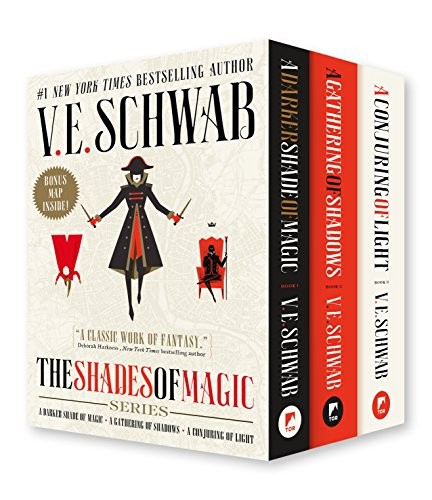
To be precise about what we’re reviewing: “The Shades of Magic” is the trilogy; the book people mean is A Darker Shade of Magic, published by Tor in 2015 and followed by A Gathering of Shadows (2016) and A Conjuring of Light (2017). It arrived at a useful hinge point. The grimdark wave had made fantasy feel obligated to be bleak, and the YA boom had made “propulsive” feel like a slightly embarrassing compliment. Schwab, writing her first explicitly adult fantasy under the “V.E.” byline, split the difference: a novel with the pace and clarity of the best YA and the body count of something grimmer.
The premise is the hook, and it’s a good one. There are four Londons stacked on the same coordinates: Grey (our drab, magicless world, circa King George III), Red (magic-rich, thriving, gorgeous), White (magic-starved and cannibalistic), and Black (sealed off, consumed by magic, spoken of like a plague). Only a handful of blood-magicians called Antari can pass between them. Kell is one of two left alive, an ambassador and (because he can’t help himself) a smuggler of trinkets across worlds. That smuggling is how a scrap of Black London ends up loose, and how he collides with Delilah Bard, a Grey London cutpurse who wants out of her own life so badly she’ll steal a whole other one.
What’s genuinely great, and what’s oversold
The worldbuilding conceit is the star, and it deserves the acclaim. “Parallel worlds” is an old idea, but Schwab’s move (same city, four moral temperatures, one door) is elegant enough that it does real thematic work. Red London’s easy abundance and White London’s desperate scarcity aren’t just set dressing; they’re an argument about what power does to the people who have too much or too little of it. And Schwab writes atmosphere with a confident, sensory hand. You can smell each London.
Now the honest part. The prose is clean and quick but rarely lingers long enough to be beautiful; readers who came expecting the aching lyricism of Schwab’s later The Invisible Life of Addie LaRue sometimes find this earlier book plainer than its reputation. The plot of book one is, structurally, a fairly straightforward object-must-be-destroyed quest: the MacGuffin does what MacGuffins do. And the villains, the Dane twins of White London, are vivid but thin: menace without much interiority.
The trilogy’s real subject isn’t magic at all. It’s belonging. Every major character is trying to force a locked door into a life that was never issued to them, and the four Londons are just the most literal version of a wall each of them is trying to cross.
Lila Bard is where the series earns its devotion, and, fairly, where it divides people. She is reckless, amoral in a cheerful way, and openly hungry for adventure in a genre that too often makes its women reactive. Some readers find her a bracing correction; others find her a touch too effortlessly competent, a wish-fulfillment blade who rarely pays for her swagger. Both readings are defensible. What’s not really in dispute is that she and Kell have chemistry, and that A Gathering of Shadows (built around a magicians’ tournament) is where the trilogy stops being clever and becomes genuinely gripping.
The actual reading experience
Here’s the thing nobody tells you: book one is the setup, and it’s the weakest of the three. If you bounce off the first hundred pages of exposition and coat-shuffling, that’s a normal reaction, not a personal failing. But the trilogy rewards the reader who stays. The middle book is a genuine level-up, and A Conjuring of Light pays off the emotional debts with a scale and a body count that the tidy first volume never promised. Read as one continuous story (which is really how it wants to be read) it’s a satisfying, fast, big-hearted piece of adventure fantasy. Read as a single 2015 novel judged alone, A Darker Shade of Magic is a very good opening chapter that occasionally gets credit for things its sequels deliver.
If you want a taste before committing, check the latest price on Amazon: the boxed set is usually the sensible buy, since you’ll want the next two anyway.
Who should read it / what to read next
Read this if you want inventive, momentum-driven fantasy that respects your time and doesn’t drown you in appendices, and if you like a morally flexible heroine. Skip it if you prize dense, ornate prose or slow-burn political intrigue; this is adventure, not architecture. Fans should move on to The Invisible Life of Addie LaRue for Schwab at her most lyrical, or to Susanna Clarke’s Jonathan Strange & Mr Norrell for a very different, chillier take on London and magic. For portal-hopping with a similar sense of play, Seanan McGuire’s Every Heart a Doorway is a natural next step.
Keep exploring the genre
Shades of Magic is a modern gateway drug into fantasy: the kind of book that makes new readers into lifelong ones. If it hooked you, see where it sits among the greats in our full 60 best fantasy novels list, and find your next door to walk through.